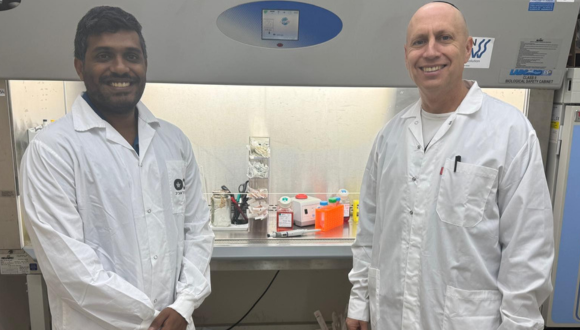

(Left to right): PhD student Anish Dsilva & Prof. Ariel Munitz. Photo credit: Tel Aviv University.
Tel Aviv University – New Experimental Model Can Accelerate Next-Gen Allergy Treatments
New Experimental Model Can Accelerate Next-Gen Allergy Treatments
Researchers at Tel Aviv University have developed one of the first experimental models that faithfully reproduces eosinophilic gastritis (EoG), a rare but increasingly recognized allergic disease of the stomach. Using this model, they identified the immune pathways responsible for driving the disease and explained why a new generation of biologic therapies currently being evaluated in clinical trials may benefit patients.
The study was led by Prof. Ariel Munitz and PhD student Anish Dsilva from the Department of Clinical Microbiology and Immunology at the Gray Faculty of Medical and Health Sciences, Tel Aviv University. The findings were published in Allergy, the world’s leading journal in clinical immunology.
Eosinophilic gastritis belongs to a family of disorders known as eosinophilic gastrointestinal diseases (EGIDs). The disease occurs when immune cells called eosinophils accumulate in the stomach, leading to chronic inflammation. Patients may suffer from abdominal pain, nausea, vomiting, early satiety, poor digestion, weight loss, and reduced quality of life. Although EoG is considered a rare disease, the number of diagnosed patients has increased substantially over the past decade, partly due to greater awareness and improved diagnosis. Despite this growing recognition, the biological mechanisms responsible for the disease have remained poorly understood, and treatment options remain limited.
Prof. Munitz explains:
“One of the greatest challenges in studying eosinophilic gastritis has been the lack of experimental models that accurately mimic the disease seen in patients. Without such models, it has been difficult to understand what causes the disease and, more importantly, to develop better treatments.”
To overcome this challenge, the researchers developed a new mouse model that closely reproduces the key features observed in patients, including accumulation of eosinophils and mast cells, chronic inflammation, structural changes in the stomach lining, and tissue fibrosis. The new model now provides researchers worldwide with an important platform for studying this poorly understood disease and evaluating potential therapies.
The team then used the model to investigate two major immune signaling pathways controlled by the cytokines IL-4 and IL-13 molecules that play central roles in allergic diseases and are already targeted by several biologic drugs.
Their findings revealed that the two pathways perform remarkably different functions during disease development.
Blocking IL-4Rα, a receptor that responds to both IL-4 and IL-13, dramatically reduced the accumulation of inflammatory cells in the stomach and prevented many of the structural changes caused by the disease. In contrast, eliminating IL-13Rα1, a closely related receptor, had little effect on inflammatory cell recruitment but significantly reduced the abnormal remodeling of stomach tissue.
“Although these two receptors have long been considered part of the same inflammatory pathway, we found that they actually perform distinct jobs,” says Prof. Munitz”. IL-4Rα acts as a master regulator that drives both inflammation and tissue damage, whereas IL-13Rα1 primarily controls how the stomach tissue remodels during disease”.
The findings are particularly timely because biologic therapies targeting IL-4Rα are already transforming the treatment of several allergic diseases, including asthma, atopic dermatitis, chronic rhinosinusitis with nasal polyps, and eosinophilic esophagitis. These therapies are now also being investigated in patients with eosinophilic gastritis.
“Our study provides a biological explanation for why therapies targeting IL-4Rα may be effective in eosinophilic gastritis,” says Prof. Munitz. “At the same time, it suggests that future therapies could become even more precise by targeting different pathways responsible for inflammation and tissue remodeling separately.”
Beyond its therapeutic implications, the researchers believe the new disease model represents an important resource for the scientific community.
“Developing new treatments begins with understanding how diseases work,” Prof. Munitz concludes. “By creating a model that closely resembles eosinophilic gastritis in humans, we now have a powerful tool for uncovering new therapeutic targets and accelerating the development of treatments for patients suffering from this challenging disease.”