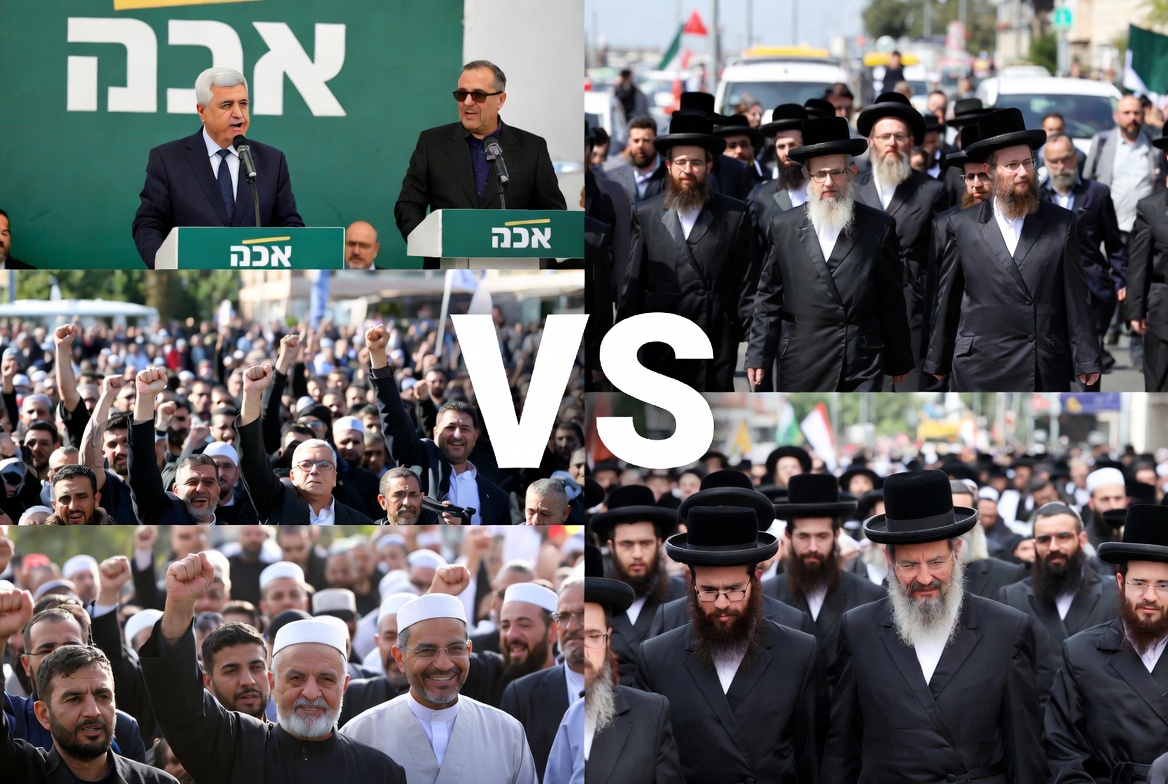

Prof. Sam Lehman-Wilzig – Israel’s Electoral Zionist Test: Ra’am (Islamic Brotherhood) vs. the Ultra-Orthodox
Israeli polls over the last two years have consistently shown that the Opposition is well ahead of the governing Coalition. However, the former are not guaranteed an absolute majority in the elections, necessary for forming a government with at least 61 Knesset seats. The general polling trend: around 59-60 for the Opposition parties, roughly 51 for the Government’s parties, and approximately 10 for the Arab parties.
Given this breakdown, the governing coalition has but one realistic hope: ensuring that none of the Arab parties join the opposition. This would ensure a new government not being formed; a new round of elections would then be called three months later (that’s five months after the previous one this coming October 27; coalition negotiations take around two months to succeed or fail). In that scenario, PM Netanyahu continues in office.
It’s therefore no surprise that the Likud’s main election campaign message is: “[Eizenkot/Bennett/etc.] will have Arabs joining the government.” With 70% of Israel’s Jews against an Arab party in the government, such an accusation has resonance. But it’s hypocritical – and most probably also doesn’t indicate what is very likely to occur.
The hypocrisy can be seen in two different ways. First, during the previous post-election negotiations, the Likud itself was deeply involved in discussions with Mansour Abbas’s moderate Muslim Brotherhood, Ra’am Party, to see whether and how it could join the government. So back then Ra’am was legitimate, but this election it isn’t?
Indeed, after Oct. 7, 2023, Mansour Abbas (not the head of the Palestinian Authority; that’s Mahmoud Abbas) said absolutely nothing to support Hamas’s depredations. Quite the opposite, for in interviews that November he criticized the attack without reservation: it was “against everything we believe in, our religion, our Islam, our nationality, our humanity” (https://www.wsj.com/opinion/mansour-abbas-is-an-arab-and-a-proud-israeli-mideast-october-7-b4224ca6).
Moreover, Abbas already had served professionally in the previous Bennett/Lapid government. There was no “Fifth Column” evident anywhere in his functioning – reflecting what’s happening generally in Israeli society as almost all Israeli Jews are served by Arabs in all fields of endeavor: pharmacies (Arabs make up about 50% of all Israeli pharmacists!), health care (lab workers and nurses), bus drivers et al, with no friction at all between Jews and Arabs in the economy. There are very few (if any) government supporters who have not been serviced by Israeli Arabs on a regular basis without any friction. In real life they’re OK, but somehow in politics they’re not?
Perhaps the bigger Likud hypocrisy regarding the “veto” of Ra’am is who Netanyahu is willing to sit with: the Haredim. If the criterion for serving in an Israeli government is being “Zionist,” then one has to ask who exactly is more or less of a Zionist: Ra’am or the Haredi parties? One can’t argue that only Jews can be Zionists, because numerous non-Jews and Christian organizations have supported Israel morally and financially through the years, some even moving here to live in Israel. A realistic definition of “Zionism” in its most generic sense is anyone who accepts the Jewish People’s right to self-determination through national sovereignty. Ra’am has done exactly that. On the other hand, through their refusal to serve in the army (some extreme sects don’t even recognize the legitimacy of the Jewish State), the Haredim cannot be considered “Zionist” – indeed, they themselves don’t!
Most Israeli Arabs do not serve in the IDF because the state prefers not forcing them to fight their “cousins” in Israel’s wars. However, any Arab can volunteer to be drafted, and many do (some Moslem, but especially the Druze and many Bedouins). Abbas has already stated that he supports civilian national service for all Arabs – something the Haredim also oppose. Indeed, Abbas recently announced that he is working on a plan to have “national public service for all” that would not be under the aegis of a civilian ministry and not the IDF. (https://www.themarker.com/weekend/2026-07-17/ty-article-magazine/.premium/0000019f-6a62-df91-a7df-eb72d88b0000). So why is Netanyahu willing to sit with the non-or-anti-Zionist Haredim but “vetoes” the Opposition forming a Coalition with moderate Arabs?
What is likely to occur in light of the fact that most Opposition parties have stated that they will not include Ra’am in the Government? The answer: follow the semantics. They use the term “Government” but not “Coalition.” Vive la difference!
In Israel, being in the “Government” means holding ministerial positions and sitting in the Cabinet. However, being part of the “Coalition” entails voting with the Government in return for Knesset committee chairmanships (deciding policy), receiving government outlays to implement specific pet programs, and taking part in deciding the new government’s overall policy direction – but not having any ministerial responsibility.
Thus, assuming the present Opposition parties fall just short of a majority in the upcoming elections, the following scenario might well come to pass: 1) RA’AM joins the Coalition, voting with the new Government on the main issues; 2) In return, it receives the Chairmanship of the Knesset’s Finance Committee as well as its National Security Committee (in charge of the police among other institutions; this to influentially work on the plague of organized crime in the Arab sector); 3) The Minister of National Security would be Yair Golan (head of the Left-wing Democratic Party, and a former IDF Vice-Chief of Staff) who is highly sympathetic to the needs of Israel’s Arab communities; 4) The Government devotes large sums of budgetary money to the Arab sector to improve its education, housing, and social welfare situation.
A party doesn’t have to be in the “Government” to significantly influence public policy. Being “merely” part of the governing Coalition serves two purposes. First, the present Opposition parties get to keep their promise of not including Arab parties in the “Government” – thereby neutralizing the Likud’s only real chance of staying in power. Second, the Arab sector finally gets to have major policy input and accompanying resources to start fixing the myriad problems with which besets it, in large part due to previous Israeli governments’ laissez-faire attitude towards a fifth of Israeli society. Given that the non-Zionist Haredim will lose all their state largesse in the next government (if they continue refusing military service), that financial windfall will be right at hand to help the Arab sector.
And who knows? Perhaps from different directions, all this will ultimately push Israel’s Arabs as well as the country’s Haredim closer to mainstream Zionism!