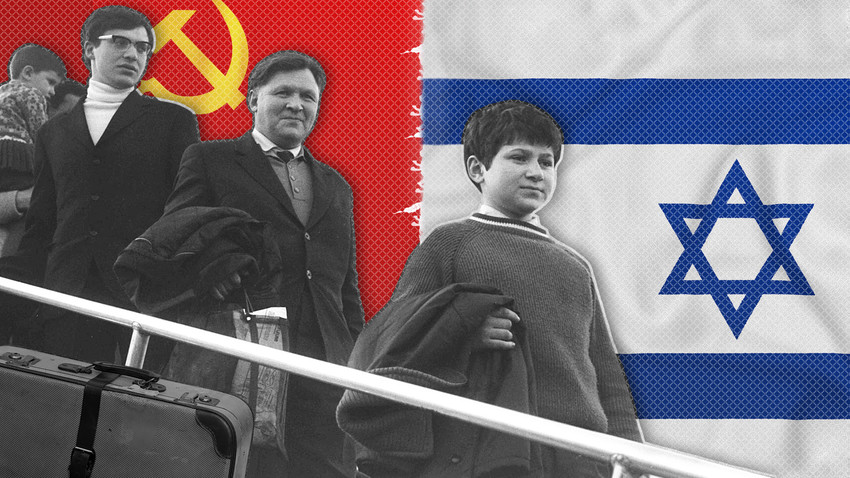

Soviet Jews leaving for Israel. Facing hidden anti-Semitism at home, they decided to find a new one. Legion Media; Moshe Milner/National Photo Collection of Israel
Sheila Raviv – Soviet Jewry story June 2026
More than fifty years have passed since a handful of determined students in Jerusalem helped ignite a movement that would eventually change Jewish history. Today, when so many of the heroes of that struggle remain uncelebrated, it is worth remembering how it all began.
For younger readers, it is difficult to imagine a time when millions of Jews lived trapped behind the Iron Curtain, denied the right to leave, denied the right to live openly as Jews and denied the freedom that so many of us take for granted today. Yet that was the reality for Soviet Jewry in the late 1960s.
In May 1969, while students at Tel Aviv University and the Hebrew University of Jerusalem, Avi Plaskow and Yona Yahav, who was then National Chairman of the National Union of Israeli Students, met a group of recent immigrants from the Soviet Union, headed by Dov (Boris) Sperling, in Tel Aviv. At this meeting the recent immigrants complained that the Israeli public was unaware of the plight of Jews in the Soviet Union and the Israeli Government censored any information thereof. Yona and Avi were shocked. The stories Boris Sperling told held them spellbound. He spoke of persecution, discrimination, arrests and exile on long train journeys to freezing Siberia. To the two young Israelis, born in the shadow of the Holocaust, the stories seemed almost impossible to believe. They echoed memories inherited from a generation that had witnessed Jews being rounded up and sent away on trains, never to return.
As a result, Yona approached Zvi Raviv and asked him to do a fact-check on all the allegations, especially government policy. Raviv was surprised. Like many Israelis at the time, he knew very little about the situation. Zvi spent weeks checking every detail with the Mossad and government authorities. Surely there had to be some exaggeration. To their astonishment, there was none. Everything Sperling and his group had described was true.
What shocked them even more was discovering that the State of Israel, fully aware of the situation, was doing very little beyond quiet diplomatic efforts.
Yona and Zvi reached a simple conclusion: silence was not enough and they decided to begin a nationwide student campaign to change government policy.
Zvi began planning a demonstration on the campus of the Hebrew University with huge banners proclaiming “Let My People Go,” echoing Moses’ biblical demand to Pharaoh.
When Zvi’s plans were announced for a demonstration, the Rector of the University, Prof. Yaakov Katz, asked for his permission to interrupt classes for two hours in order to hold a demonstration.
Prof. Katz explained that he could not permit demonstrations on campus and disruption of the academic schedule. The event would have to be cancelled. Faced with authority, Raviv calmly replied that if the University prevented a one-hour demonstration, the students would simply strike for an entire day. The Dean decided that one hour was preferable.
On the day of the demonstration, a student, by the name of Menashe Raz, who had just begun his broadcasting career in the new midday radio magazine B’Chatzi HaYom asked if he could broadcast from the demonstration and for the first time all of Israel heard the message that Israeli students were proclaiming the fact that the Israeli government was not fulfilling its role to protect the Jews of the Diaspora. The size and impact of that broadcast attracted the attention of the security services, who contacted the student leaders and warned them to cease and desist their activities or serve a few months of reserve duty in Sinai rather than studying.
Instead, they requested a meeting with the Prime Minister.
To their surprise, she accepted their request within a few days.
Three young men — Zvi Raviv, Yona Yahav and Avi Plaskow z”l — entered the office of Prime Minister Golda Meir expecting twenty minutes. Facing them sat that tiny but formidable woman, her renowned Chesterfield cigarette in between her fingers. Question after question followed. How would such a campaign work? How many Jews might wish to leave? Could Israel absorb them? What would be required financially and socially? For every question, Yona Yahav produced calculations and detailed plans from a folder he had prepared.
Golda explained that the government had deliberately chosen quiet diplomacy. Public pressure, she believed, might endanger the very Jews they were trying to help. She finished her explanation, lit a cigarette and thanked them for coming, signalling that the meeting had come to an end
As they were preparing to leave the Prime Minister’s Office, Zvi Raviv turned and asked if he could say just one last sentence. “Mrs Meir, we will continue demonstrating because in twenty years’ time, when I have children, and they ask me what I did to help the Jews of the Soviet Union, I want to have an answer. Unlike my father’s generation, who did nothing and lost six million Jews.” Of course, Golda understood that he was not referring to his father but to her.
The Prime Minister was taken aback.
“You do not know your history, young man,” she replied. “We sent in paratroopers.”
“Actually, Ma’am, I am a history major from the Hebrew University,” he answered. “We sent thirty-seven parachutists for the purpose of espionage”
“But then we didn’t have a country,” Golda responded.
“Now we do!”
At that moment, he saw something remarkable. The Diaspora mentality that had shaped generations of Jewish leaders seemed to fall away. For the first time in the conversation, Golda Meir was no longer speaking as a representative of a vulnerable people, but as the Prime Minister of a sovereign Jewish State.
Instead of ending the meeting, she sat down, and the meeting started anew. “What do you want?”.
The scheduled twenty-minute meeting stretched to nearly ninety minutes.
As they left, they realised how seriously Golda had taken them. Waiting outside her office were Vice-Premier Yigal Alon and Mossad Director Zvi Zamir, both delayed while the Prime Minister continued her discussion with three student activists.
Three days later, Golda Meir’s secretary, Adi Yafe, telephoned Yona Yahav. The government had adopted a new policy, embracing many of the proposals put forward by the students. Israel would go public. Israel would go public.
No longer would the struggle for Soviet Jewry remain solely behind closed diplomatic doors. The State of Israel would openly advocate for Soviet Jews and support international efforts on their behalf.
Zvi Raviv had one final request: he wanted Israeli politicians and diplomats standing openly alongside the Refuseniks. Golda agreed, and on 2 December 1969 stood on the stage at the historic demonstration in Tel Aviv, which the Israeli government recognises as the birth of the worldwide campaign to free Soviet Jewry.
In May 1970, an international conference, disguised as a privately organised event but in fact by the Israeli government, was convened in Brussels to bring the plight of Soviet Jews to the international arena. In July of that year, the Israeli Government established “The National Council for Soviet Jewry,” bringing a successful resolution to the student campaign that began just a year previously.
The campaign spread rapidly across the Jewish world. Communities organised demonstrations, vigils and letter-writing campaigns. Activists picketed Soviet cultural events in their countries. Thousands of postcards arrived at Soviet embassies demanding freedom for Soviet Jews. Organisations from London to New York adopted the cry: “Let My People Go.”
Refuseniks became household names throughout the Jewish world.
These were not dissidents seeking to overthrow the Soviet regime. They were Jews seeking the most basic of human rights: the freedom to leave, the freedom to live openly as Jews and, for many, the freedom to come home to Israel.
The campaign gathered momentum. In 1977, the famed trial of Soviet dissident Natan Scharansky gave a further international exposure to the student campaign, which began 8 years previously. The trickle eventually became a flood and beginning in the late 1980s and accelerating through the 1990s, more than a million Jews from the former Soviet Union came to Israel.
What those students could not have known in 1969 was how profoundly this Aliyah would transform Israel. The struggle was fought to save Jews and restore their freedom, but it also brought an extraordinary gift to the Jewish state. Scientists, physicians, engineers, mathematicians, musicians and academics arrived in numbers unprecedented in modern history. They enriched Israel’s universities, hospitals, laboratories and industries, helping to propel a small country into a world leader in medicine, technology and scientific research. However, statistics tell only part of the story. Perhaps that is the greatest measure of success. The immigrants from the former Soviet Union are no longer a separate community. They are simply Israelis. Their children command military units, perform surgery, conduct scientific research, teach in universities, create music and raise families of their own. Their story has become part of Israel’s story
Behind every immigrant was a family reunited. Behind every scientist was a refusenik once denied opportunity because he or she was Jewish. Behind every child was a future no longer limited by Soviet restrictions.
In 1991, Zvi Raviv returned to Moscow with a Keren Hayesod delegation for their annual conference. Standing in Red Square, he quietly produced a large Israeli flag from his pocket. The group posed proudly in front of the Kremlin. Two American tourists walked past. “Now I’ve seen everything,” one remarked. Indeed, they had.
History remembers prime ministers, famous refuseniks and international statesmen. It rarely remembers the students carrying banners across a university campus or the young activists bold enough to challenge a Prime Minister. Yet without them, history might have taken a very different course.
There is an old saying that success has many parents, whereas failure is an orphan. The campaign for Soviet Jewry became one of the greatest successes in modern Jewish history and, understandably, many organisations and individuals became part of that remarkable story. They deserve recognition for their contribution.
Yet every movement has its genesis. Before the worldwide campaigns, before the diplomatic pressure and before the great public rallies, there were a handful of students in Jerusalem who simply refused to remain silent. Their names are not always remembered, but history should remember them. For it was their determination, their courage and their chutzpah that helped set in motion a chain of events that brought more than a million Jews to freedom and transformed the State of Israel forever.
And it all began with a few students, a great deal of chutzpah, and a simple refusal to remain silent when fellow Jews cried out for help