
Prof. Harry Atwater Dr. Lior Michaeli & Dr. Claudio Hail.
Photo credit: Tel Aviv University.
Tel Aviv University – A Breakthrough in Light Control
Caltech-Led Research by Scientists Now at UC Berkeley and Tel Aviv University
A Breakthrough in Light Control:
Steering Light Beams in Under One Trillionth of a Second
- A newly developed ultra-thin layer enables light beams to be steered and shaped almost instantaneously, at a record speed of 74 femtoseconds. The advance could ultimately contribute to optical computing, communications, high-speed imaging, sensing, and quantum technologies.
The ability to control light underpins technologies ranging from cameras and sensors to communication systems and advanced computing. Yet while light itself travels at extraordinary speed, the components used to direct and shape it generally operate much more slowly. A new study published in Nature Nanotechnology presents a way to overcome this limitation: an ultra-thin optical surface that can redirect and reshape a beam of light in just 74 femtoseconds — less than one tenth of a trillionth of a second.
The research was carried out at the California Institute of Technology (Caltech) in the group of Prof. Harry Atwater. It was led by Dr. Claudio Hail, now a faculty member at the University of California, Berkeley, and co-authored by Dr. Lior Michaeli, now head of the Meta-Optomechanics Laboratory at Tel Aviv University’s Fleischman Faculty of Engineering.
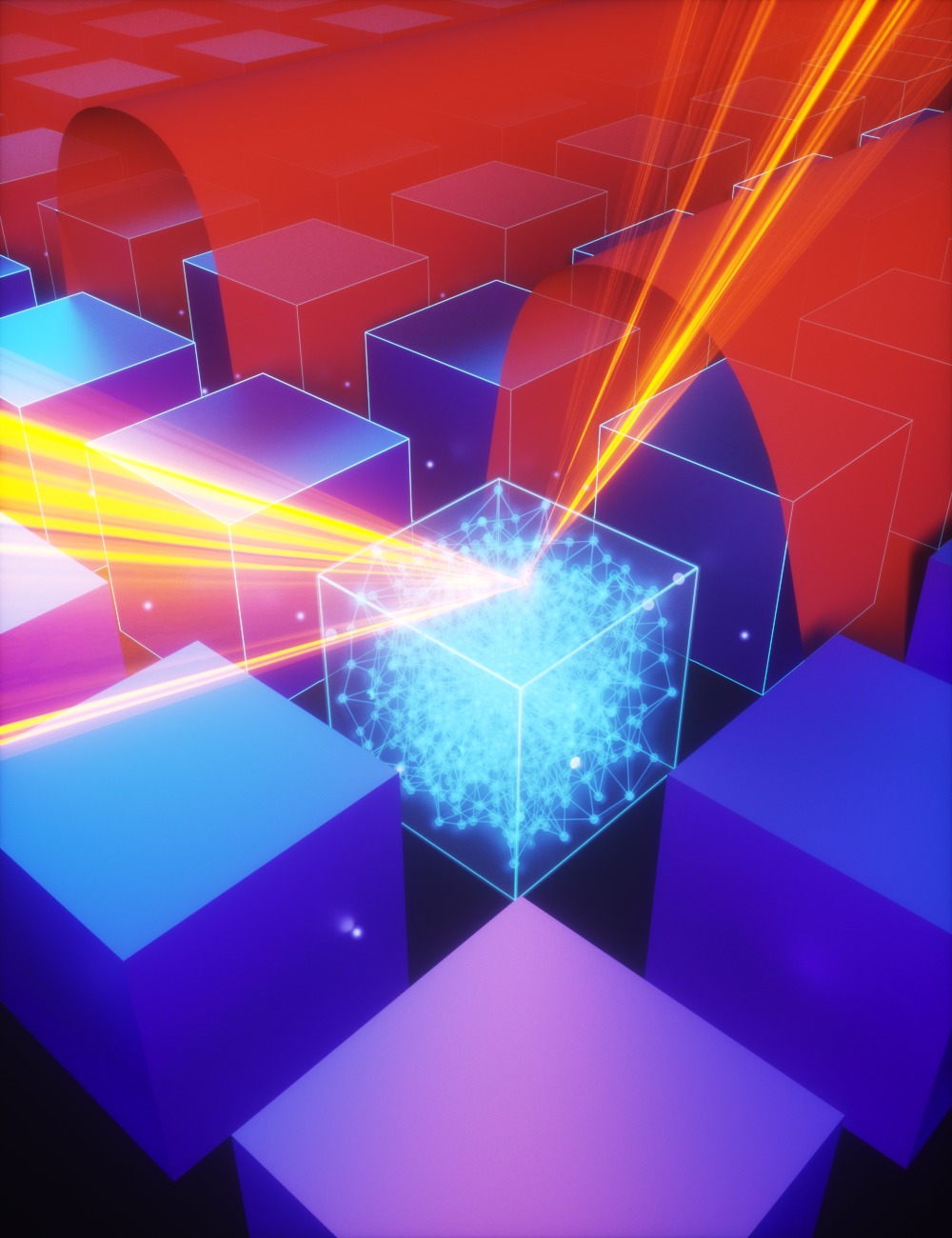
At the heart of the breakthrough is a metasurface — an ultra-thin layer patterned with tiny silicon structures, each smaller than the wavelength of light. When the surface is illuminated by a short laser pulse, the optical properties of the silicon change for an extremely brief time. The carefully designed nanostructure amplifies this normally weak effect, allowing another beam of light to be controlled without moving mirrors, lenses, or other mechanical components.
In laboratory experiments, the researchers steered the beam by angles of up to 13 degrees in either direction. By changing the spatial pattern of the illuminating pulse, they were also able to reshape the beam and create different light patterns. In other words, the same device can perform different optical functions depending on how it is illuminated.
“The key idea was to create a metasurface whose optical response is not fixed once it is fabricated,” says Dr. Hail. “By changing the illumination pattern, we can reconfigure how the device steers and shapes light, and do so on an ultrafast timescale.”
Prof. Atwater explains: “Light usually interacts only weakly with matter, so controlling one beam of light with another is extremely challenging. The metasurface enhances that interaction, allowing a very small and very fast material response to produce a useful change in the outgoing beam.”
“For me, the most exciting aspect is seeing an idea that had been with us for years become an experimental reality,” says Dr. Michaeli. “The ultrafast effect we wanted to use is naturally very weak. We had to design the metasurface so that it would amplify the effect enough not only to measure it, but to use it to steer and shape light.”
The measured switching time was close to the duration of the laser pulse itself, suggesting that even faster operation may be possible with shorter pulses. The device also has no moving parts and returns rapidly to its original state once the pulse has passed.
Today, many communication and computing systems convert information carried by light into an electrical signal for processing and then convert it back into light. Direct, programmable control at such high speeds could eventually allow some operations to be performed optically, reducing reliance on repeated optical-electrical conversion.
Dr. Michaeli adds: “This work points to a broader opportunity: using engineered structures to strengthen interactions between light and matter and turn them into tools for control, sensing, and information processing. This is closely connected to research directions we are now pursuing at Tel Aviv University.”
The researchers emphasize that the work is a fundamental demonstration rather than a product ready for practical use. Nevertheless, it opens new possibilities for ultra-fast, reconfigurable optical devices in which light not only carries information, but can also help control and process it.