
Paul Nirens
Susan R. Eisenstein: Nugget Series: Paul Niren’s Galileat: Your Culinary Adventure in the Galilee
Scheduling a visit to Galileat in Israel is the first step to your unique culinary and cultural adventure, an adventure not duplicated anywhere else. Galileat’s website states that Galileat is “your passage to the soul of the Galilee and invites you to “experience authentic and traditional home hospitality in Israel’s most culturally diverse region.” And both statements serve as a teaser to explore more about Galileat and what Galileat offers.
Paul Nirens is the founder and owner of Galileat. In his over 30 years of living in the rural Galilee region, Nirens has cultivated relationships with many people living in the area, working with them in co-operation, based on mutual respect. This co-operation and mutual respect allow Nirens to offer true cultural and culinary experiences.
“Galileat started as a food-oriented business, showing off the often unknown local Galilean food to the world. I realized quite quickly that Galileat is actually far more than that. Whilst the food is authentic local fare of the highest quality, it’s actually about bringing people together. After a Galileat experience, guests come away with a better understanding of Israel as a modern multi-cultural society and an understanding that what binds us as humans is far greater than what separates us, no matter what our religion or culture. So Galileat is a true ambassador for the Israel that we are so proud of.”
“In addition, we saw the need and desire for people who keep kosher to also be able to experience our programs, so we purpose-built a kitchen in the Druze village of Dalyat el Carmel, with Kashrut supervision. We are very proud of this development. In addition, we work with someone who has a kosher kitchen in the village of Hurfeish, not too far from Tzfat, so we have two kosher options, in Dalyat el Carmel and Hurfeish. We are continually developing new experiences, including culinary tours, picnic baskets and more.”
Galileat is currently the largest operator of culinary and cultural programs in Israel’s northern Galilee region, with host families and activities in an area ranging from Dalyat el Carmel, close to Haifa and as far as the Majdel Shams in the northern Golan Heights. “We continue to combine authentic programming whilst insisting on the highest of international standards,” says Paul Nirens.
Galileat’s bio explains Paul Nirens viewpoint. “In order to encounter the real-life atmosphere of Israel’s green North, it has be done with and by locals. Galileat is such a venture and will show you a slice of Israel that is authentic, interesting and different to what most tourists see. Galileat grass roots cultural experiences include Galilean cooking workshops, home hospitality and meals in a local Galilean village, traditional Jewish cooking experiences, market tours, full day culinary tours and more.”
Nirens self-describes himself as a person who was just born into food. He says. “amongst my earliest memories are those of my father, owner/chef in the family restaurant, spending his one day off a week in the kitchen, trying out new and wonderful experiments on his family. We were a foodie family in the pre-foodie 70’s. Upon moving to Israel, after a short stint working in kibbutz agriculture, I followed in my father’s footsteps. I trained at one of Israel’s leading culinary schools, managed commercial kitchens, worked as a chef in a vegetarian restaurant, and then opened my own business, wholesaling locally crafted gourmet foods. Showing others what the Galilee has to offer seems like a natural progression.”
As to how hosts are sourced, Nirens says, “hosts will introduce us to people who want to join our team, individuals will approach us or I will ask professional acquaintances to help me find hosts. I would like to point out that all our hosts undergo intensive training so that they understand exactly what our guests want. And I am very faithful to my hosts. I stick by them through thick and thin and they all feel that they are part of one large family.”
And what does Paul Nirens hope visitors will take away from their Galileat experiences? Here is what he said.
A unique culinary experience
A special meeting with real Israelis, in their homes, who are part of Israel’s 20% Arabic speaking minority
A better understanding of Israeli society
An off-the-beaten-track experience that they will remember for many years, which is both authentic and of the highest quality.
And oh yes, Paul Nirens is also available for Zoom presentations.


Paul Nirens was also kind enough to share some recipes with IsraelSeen.com.
Cauliflower sinye
Ingredients:
1 cauliflower, cut into florets.
2 tablespoons raw sesame paste (tahini)
Juice 2 lemons
1/2 cup ice-cold water
1/2 teaspoon crushed garlic (optional)
5 sprigs parsley, chopped finely (for garnish)
Preparation:
Fry cauliflower in deep oil until they start to brown, or bake in a very hot oven for 15 minutes, until they start to brown.
Place par-cooked cauliflower in a tray that can be placed on the stove or in a deep frying pan.
Prepare tehina; mix tehina with 1/2 of the lemon juice and the water (and garlic, if using). Stir vigorously. Taste. If you want it more lemony, add more lemon to taste. The tehina should be quite runny.
Pour made tehina onto cauliflower and place pan on the stove on high flame. The tehina will start to bubble and thicken. It will also change color from white to beige/light brown. The dish is ready when the tehina has thickened and fully turned color. Garnish with a little chopped parsley.
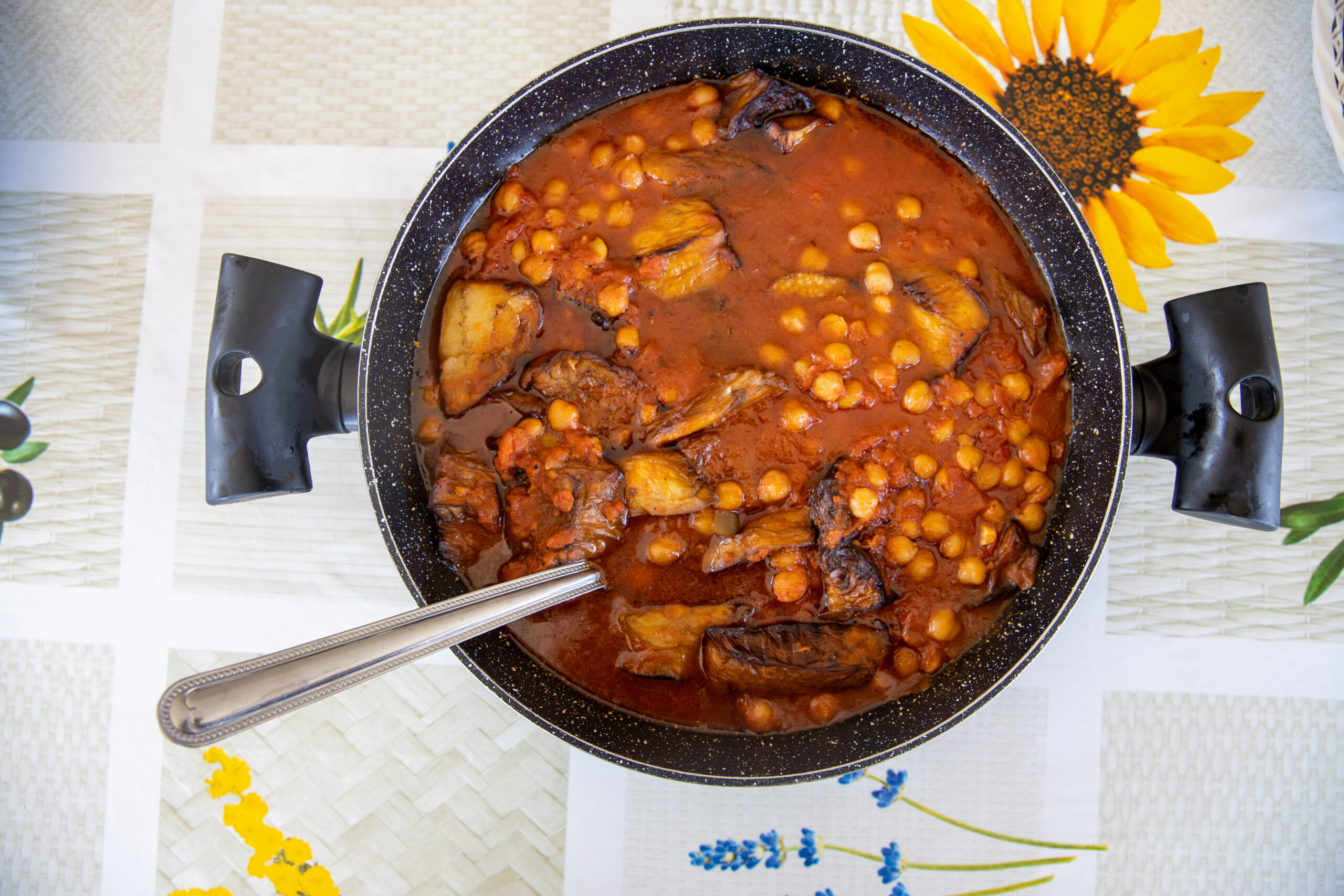
Manazalleh – Aubergines and Chickpeas in Tomato Sauce
Ingredients:
2 eggplants
Extra virgin olive oil
Salt
2 to 3 garlic cloves, crushed
1 can chopped tomatoes
25 gr. tomato paste
1 teaspoon cumin
1 teaspoon baharat
Black pepper
One 14-ounce can of chickpeas, drained
2 tablespoons chopped flat-leaf parsley
Directions
Cube the eggplants into 5 cm pieces. Brush them generously with oil, sprinkle lightly with salt, and cook them under the broiler for 15 minutes, or in an oiled saucepan, turning them over once. They do not need to be cooked through as they will be stewed further in the sauce.
In a large saucepan, heat the garlic in 1 tablespoon olive oil for one minute, stirring, until it just begins to color. Add the tomatoes, tomato paste and spices and cook for 5 minutes. Add the eggplants and chickpeas, and simmer for 20 to 30 minutes, or until the eggplants are very soft.
Serve sprinkled with chopped parsley.
Allow the dish to cool a little before serving. It can be served warm or room temperature, but not boiling hot.
Sinye
Ingredients
Kebabs – I kg/2 lbs minced meat – beef, lamb or chicken or a mix of it. The meat should not be minced too fine. The coarser the better.
25 gr./1 oz. lamb fat, minced, if not using lamb meat.
1 onion, diced small or grated into the meat.
1 heaped teaspoon minced garlic.
1/2 bunch fresh parsley, chopped fine, or 1 spoon dried parsley.
1/4 bunch fresh mint, chopped fine.
Salt and freshly ground black pepper.
Tehina – 2 cups of tehina (whole-grain tehina is best)
Juice of 2 lemons
1 cup of cold water (important that it is cold)
(Garlic to taste)
1/2 teaspoon of salt.
**it is essential to make the tehina from scratch. Store-bought, ready-to-eat tahini will separate in cooking and will not give the desired result.
Directions:
Mix all the kebab ingredients together well. Let it rest for 1/2 an hour at least.
Meanwhile, prepare the tahini. Add all the ingredients together, stirring with a whisk. The mixture might be lumpy at first. Not to worry. Keep stirring. If it is too thick, add a little more cold water. The consistency should be quite thin. It will thicken with cooking.
Correct taste. It should be quite lemony.
Set tehina aside.
Cooking the Sinye –
Spread the meat out onto an oven tray, about 5 cm thick. Cut ridges lengthwise and crossways into the meat, about halfway through the meat patty. By doing this, the tehina will be absorbed better in the meat, and you form guidelines to cut the meat into individual servings when the dish is ready.
Brush olive oil over the top of the meat. Bake in a 170˚ oven for 10 minutes. Remove meat from the oven. Pour tehina over the meat and jostle the pan a little so the tehina seeps into all the ridges in the patty and spreads evenly. Return to the oven for another 8 minutes.
**it is possible to add sliced tomatoes or cherry tomatoes when pouring the tahini over the kebabs. Cherry tomatoes give added flavor and colour.
Garnish with chopped parsley, if desired.
Cut the meat along the ridges and serve with the tehina sauce over rice or freekeh
Majadara
Ingredients
2 cups brown lentils
2 chopped onions
oil for frying
1 cup bulgur wheat
1 spoon cumin
2 teaspoon salt
1 teaspoon baharat.
Directions
Fry the onions in oil until very brown, almost black, about 1/2 an hour. It is past the point of caramelization and is almost burnt. This is very important, as it gives a very rich flavor. Add the lentils and 4 cups of hot water. Bring to the boil and reduce heat to low. Do not add salt until the lentils have started to soften, about 20 minutes. Add salt, cumin and baharat together to the lentils just as they start to soften.
In a separate bowl, pour two cups of lightly salted boiling water over bulgur. Cover and let rest. When the lentils are soft, after approximately 1/2 an hour, drain out excess liquid from the lentils and add the soaked burlghur. Very gently mix the bulgur and lentils together and continue to cook over low heat for 5 minutes. Wait 5 minutes till serving.
Alternatively, don’t soak the bulgur and add it directly to the lentils. You will need to cook it longer and pay attention to the amount of liquid, as the bulgur will absorb all of the lentil liquid.
Fatayer (stuffed pastry)
Ingredients:
dough
250 gr whole flour with 250 gr white flour
1 teaspoon instant yeast
1 teaspoon salt
1/2 cup olive oil
1 cup water
Preparation:
Add flours and yeast together and mix well. Add salt and mix again (don’t add the salt with the yeast together. Salt diminishes yeast’s effectiveness)
Add oil and mix well. Add as much water as needed to make a smooth dough.
Knead dough for at least 15 minutes, until the dough is smooth and soft.
Cover and allow to rest 15 minutes. Whilst a yeast dough, it doesn’t need a long prove (rise)
Divide dough into 8 balls , a little smaller than fist size.
Filling:
spinach
1 large onion, diced fine
1 bunch spinach (preferably large leaved Turkish spinach) or Swiss chard, cut into thin strips.
1 tablespoon harissa – optional. It depends on whether you like spicy food.
1/3 cup olive oil.
I teaspoon salt
Mix all filling ingredients together.
Tomato and pepper
1 teaspoon organic tomato paste
1 tomato, grated
3 fresh sweet red peppers, minced
1 red chili pepper, minced.
2 tablespoons olive oil.
1 teaspoon salt.
Mix all the ingredients together until well combined
Zaatar
½ cup zaatar spice mix
½ cup olive oil
{you can make a closed fatayer or open pitta with za’atar with the za’atar mix}
Preparation
Sprinkle maize flour on a work surface and roll out the dough balls thinly into a circle. The maize flour prevents the dough from sticking to the surface. Add filling on one half of circle and close over with the empty half, so a semi-circle is formed. Or fold one edge in, then another, then the third, forming a triangle. Either way, ensure that it is well closed.
If you are using the zaatar mix, just spread a generous spoonful of the mix over the top of the rolled dough and bake it in the oven as a sort of pizza.
Cook in a tabun or pizza oven, or a house oven, preheated to high heat, 220°c/440°f.
For more information: Paul Nirens: paul@galileat.com
+972-558810727 – phone and WhatsApp
https://www.facebook.com/GalileatIsrael/
https://www.instagram.com/galileat/
Paul Nirens
Galileat