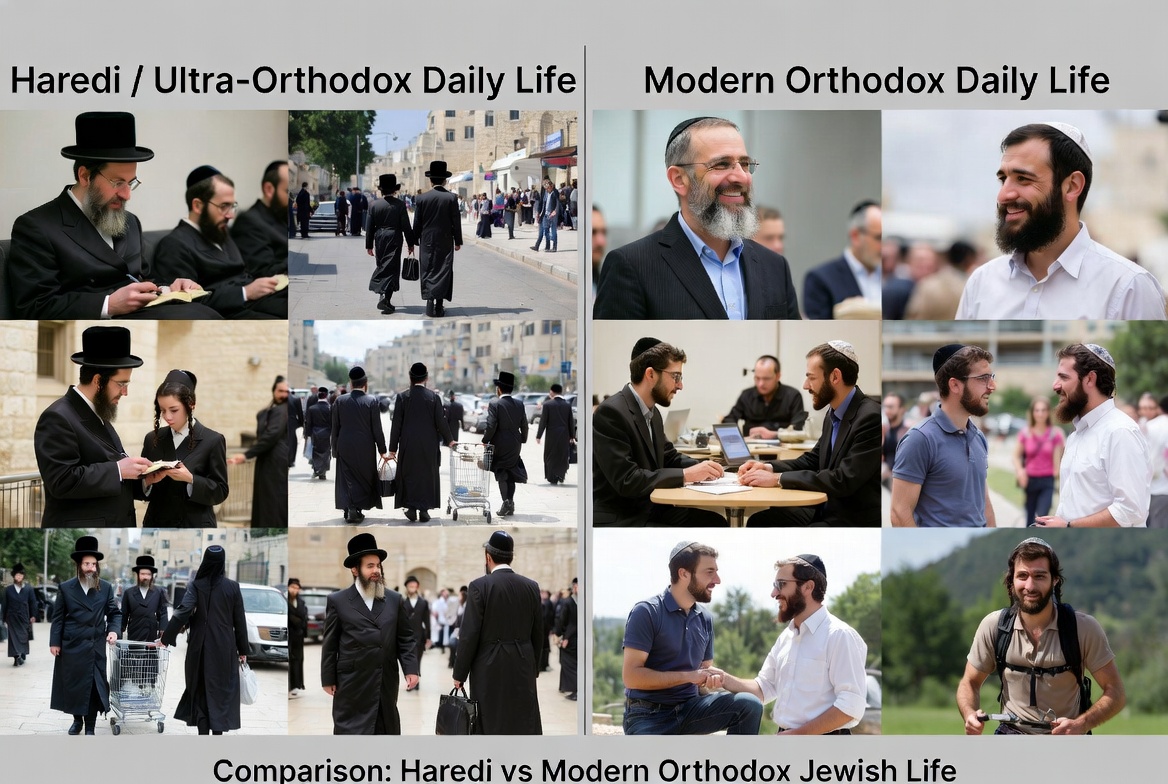

Prof. Sam Lehman-Wilzig: Israel’s Ultra-Orthodox: Not Just Black & White
When something is relatively alien to us, we tend to generalize. This is particularly the case regarding Israel’s ultra-Orthodox. However, given how central Israel’s Haredim are to the country’s politics, economy, and society, it behooves us to understand how heterogeneous they really are – and the profound trends among them. Comprehending the complexity of Israel’s Haredi communities (note the plural) – and the forces shaping their future – is essential for recognizing the direction Israeli society could take well into the 21st century.
All Haredim (in Hebrew: in Fear [of God]) seemingly adhere strictly to the Halakha (Jewish law), maintaining a lifestyle separate from secular society. However, such an umbrella definition over-generalizes the situation by a wide mark, as it covers communities who are as different from each other as they are from the secular sector. Before getting into some surprising trends (past, present, and future), though, here’s a brief survey of the three main groups, and a few that are lesser known.
1. Lithuanian: They have been shaped by a tradition of intensive Talmudic study, centered around large yeshivot (religious seminaries), with their communities generally clustered in Israel’s central cities like Bnei Brak and Jerusalem. Most men study full-time and rely on state and communal support.
2. Hasidim: These constitute a sect established in 18th century Eastern Europe, characterized by mysticism, joyous worship, and allegiance to charismatic rabbis. Israel is home to numerous Hasidic sub-sects: Gur, Belz, Vizhnitz, Satmar, and Chabad, each with their own customs, dress, spiritual outlook, and dynastic rabbinic leaders. How different? Satmar is rabidly anti-Zionist whereas Chabad is officially neutral but in practice mildly pro-Zionist.
3. Edot Ha’Mizrakh: These are highly religious Jews from the Middle East and North Africa who once they immigrated to Israel (most, back in the 1940s and 1950s) eventually took on many of the trappings of their Ashkenazi (European) counterparts (especially dress style). Although they too came from diverse national backgrounds, each with specific religious rituals and approaches, from the 1980s onwards they have become more monolithic under the umbrella political leadership of the SHAS Party.
- Haredi Leumi (Hardal): This a relatively more recent phenomenon, combining very strict religious adherence (like other Haredim) with a more modern approach to life: secular studies and gainful employment for men.
- Miscellaneous: As noted above, within these primary streams there are divisions and sub-communities, each defined by loyalty to a particular leader, yeshiva, or previous geographical community tradition. And then there are much smaller, radical groups such the Neturei Karta who vociferously (and occasionally violently) reject the legitimacy of the State of Israel – counterbalanced by modern-leaning Haredim who are quietly pushing for integration within the broader society.
However, none of the above has remained static; several trends significantly impact Israel’s present and future. First and probably foremost: demography. The Haredi population in Israel is growing rapidly due to high birth rates. Today Haredim constitute approximately 13-14% of Israel’s population, projected to reach 20-25% within a generation. However, there are countertrends working here as well.
After their European communities were decimated in the Holocaust, survivors who immigrated to Israel prioritized Torah study over participation in the workforce and against general social integration (except for politics, where power lay). They were supported especially by state subsidies (communal networks too). Nonetheless, over the past two decades or so several pressures have begun to significantly change their situation.
Many subsidies were cut back early in the 21st century as a result of Israel’s economic recession during the Second Intifada (back then it was Finance Minister Netanyahu who initiated those cutbacks). Over the past two decades, the rising cost of living, coupled with growing families, have pushed more Haredim into the workforce, aided by specialized training programs and vocational schools – even academic curricula tailored to Haredi needs (e.g., separate college programs for men and women).
More recently, and fast gaining ground, are elementary and high school programs that teach secular core subjects (English, math, science etc.). Today, there are 9,000 Haredi children studying such curricula, a 40% increase in the last year alone. Meanwhile, Haredi wives/mothers have entered Israel’s workforce in droves – by now at the same rate as their non-Haredi counterparts.
Another straw breaking the Haredi front was Israel’s Supreme Court ruling last year that Haredim cannot receive government subsidies if the present law is not changed to free them from being drafted into the army. The result of such economic pressure is already being felt: a significant increase in Haredi young men enlisting in the army: in 2024, over 3,000 in the IDF and other forms of national service.
Last but certainly not least, modern communication technologies are completely decimating Haredi information “ghetto walls.” Notwithstanding “kosher” (i.e., informationally restricted) smartphones, the internet and social media constitute a socio-cultural threat as well as an economic lifeline for work, shopping, and connecting with relatives, here and abroad.
What does all this portend for Israeli society? Here too the trends paradoxically are contradictory and reinforcing. On the one hand, given the “threats” to their way of life, the Haredi leadership continues to demand autonomy on such issues as local Sabbath observance (e.g., closing off entire neighborhoods from traffic) and gender segregation at public events. On the other hand, greater workforce integration and exposure to broader Israeli culture leads to mutual understanding and reduced friction among those Haredim learning secular studies and entering the workplace.
Indeed, it is precisely because of the latter trend that the Haredi leadership is becoming more rigid in its stance regarding, for example, the army draft issue. They see the writing on the wall. Among these signs: the latest surveys indicate that approximately 14% of Haredim are leaving the fold (not necessarily to become secular, but definitely not Haredi) – one in every seven! The numbers have become so large that the stigma is losing its force; many are now finally able to join their families for Friday night meals – a Haredi “concession” that only further undermines the previous difficulty of leaving the community.
Given all this – economic pressure, cultural integration, open communication channels, secular education – Haredi birth rates have been gradually declining for some time, from around 7.5 children per woman in the early 2000s to 6.4 in the mid-2020s. Projections are for further decreases to around 4.3 in the next twenty years. If one adds to this the growing number of youth and young adults leaving the Haredi world, as well as others receiving a general secular education, then the future socio-demographic “threat” to the Israeli economy and society loses some (much?) of its force.
All this explains why the current (anti)draft law being considered in the Knesset has become such a divisive issue. For both the Haredim and secular Israeli society alike, it is a monumentally existential issue. Its outcome will determine the very future of Israel’s existence: militarily, economically, socially, and even “Zionistically.”