
Sabine Sterk – Israel Cannot Win the Information War by Chasing Every Lie
At nursing school, I learned something that has stayed with me for decades: it is impossible not to communicate. Even when you deliberately remain silent, your silence communicates something through your expression, your posture and your refusal to respond. But we learned this in another era, before social media turned almost everyone into a publisher, before a claim originating in Gaza could reach Amsterdam, London and New York within seconds, and before artificial intelligence made it possible to create photographs, voices and videos convincing enough to confuse millions of people before anyone has established whether they are genuine.
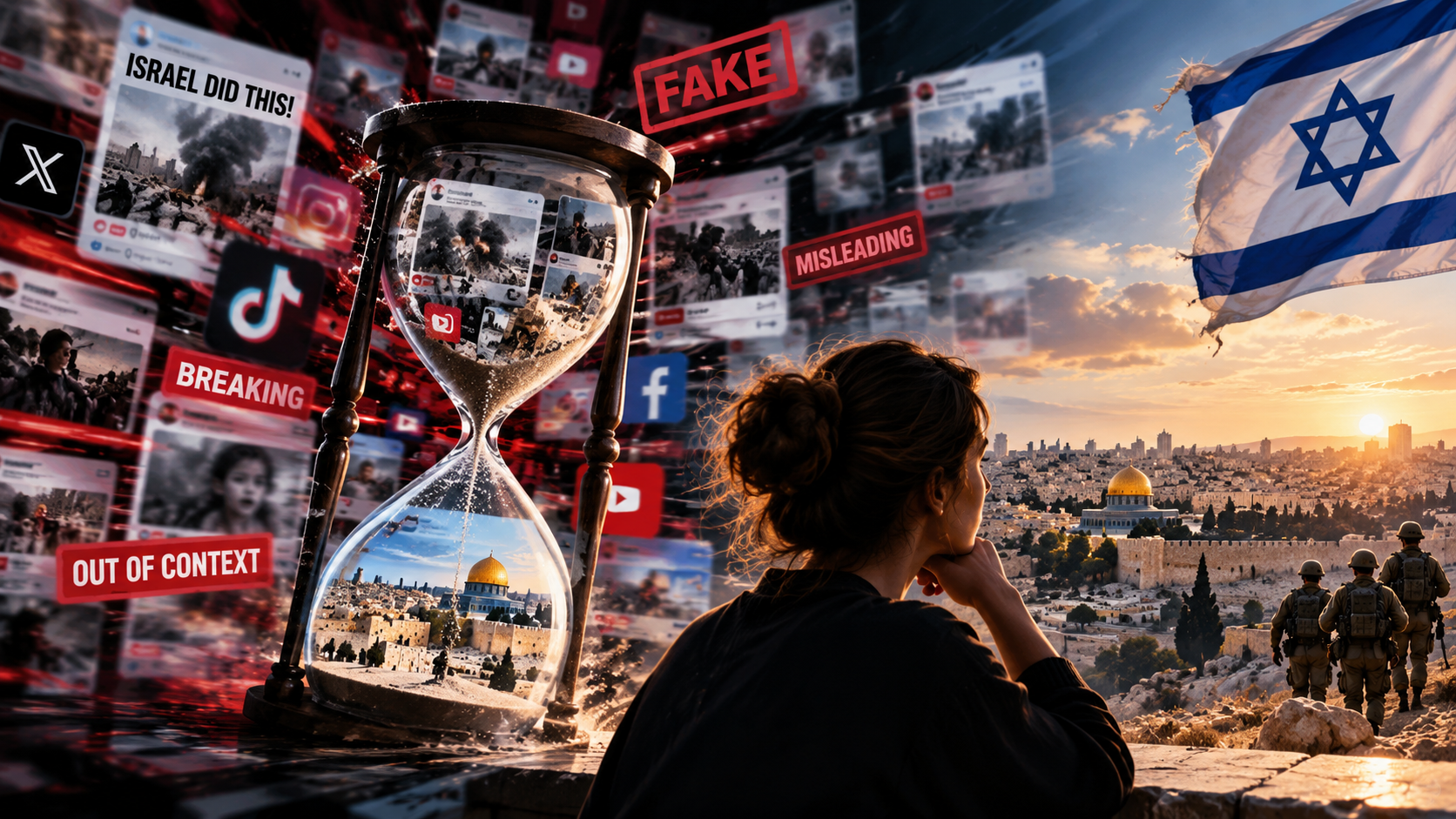
For Israel, this revolution in communication has created a battlefield almost as consequential as the physical one. Israel is not only fighting Hamas, Hezbollah and other armed groups that openly seek to harm Israelis; it is simultaneously fighting an information war in which an allegation can circle the world before an Israeli spokesperson has established what actually happened. Israel is expected to provide evidence almost immediately about events occurring in the chaos of combat, while those accusing Israel can publish first and substantiate later. When a horrifying image appears accompanied by the words “Israel did this,” the accusation itself can become the story. By the time additional evidence emerges, corrections rarely travel with the emotional force or enormous reach of the original allegation.
That asymmetry matters. Hamas does not need to defeat Israel militarily to damage Israel internationally. Images of Palestinian suffering, including genuine and terrible civilian suffering, inevitably influence public opinion, but genuine suffering must never become permission to abandon verification of who caused a particular incident, what preceded it, whether combatants were involved or whether the description attached to an image is accurate. Israel should be held accountable for its actions like any democratic state, but accountability requires facts. Automatically accepting every accusation against Israel is not accountability. It is the abandonment of the very evidentiary standards that journalists, governments and human rights organisations should be defending.
Yet Israel’s supporters have a problem of our own. For years I have tried to counter false narratives about Israel, and increasingly I wonder whether responding to every outrageous post is helping. Social media platforms reward engagement rather than accuracy. When thousands of us angrily reply to a false allegation, the algorithm does not understand that we are correcting misinformation. It understands that the post is generating attention and therefore deserves more attention. We may consequently help a lie travel further while believing that we are destroying it.
It reminds me of the oil crisis of the 1970s, when the Netherlands introduced car-free Sundays. The idea was simple: when an important resource is under pressure, stop wasting it. Today perhaps the scarce resource is our attention. Imagine if supporters of Israel occasionally practised the digital equivalent of a car-free Sunday. Instead of immediately reacting to every shocking accusation, we could refuse to provide engagement until there is something verifiable to discuss. Not silence because we are afraid to defend Israel, but silence because we refuse to allow Hamas, anonymous accounts, activists, influencers, or algorithms to decide what deserves our attention.
Israel advocacy therefore needs a simple principle: verify first, communicate second. If a photograph cannot be authenticated, do not share it. If the location of a video cannot be established, wait. If casualty numbers originate with authorities controlled by Hamas, identify their source and explain what is and is not independently established. Equally, if a viral claim supporting Israel turns out to be false, correct it. We cannot demand evidentiary standards from Israel’s critics while abandoning those standards ourselves. Israel does not need fabricated stories to justify its existence, and its supporters should never sacrifice credibility for a temporary social media victory.
This is also why freedom of expression deserves a more serious discussion. I do not want governments deciding which political opinions citizens may express, and criticism of Israel, even harsh criticism, cannot simply be labelled misinformation. But freedom of expression does not oblige us to become unpaid distributors of somebody else’s propaganda. We retain the freedom not to share, not to react and not to transform an unverified allegation into tomorrow’s viral narrative.
My nursing teacher taught me that refusing to speak is itself a form of communication. Perhaps that lesson has acquired an entirely new meaning. Israel must challenge demonstrably false accusations, present evidence and defend itself vigorously, but its supporters do not have to chase every lie across the internet.
Sometimes the strongest response is evidence.
Sometimes it is correction.
And until either exists, sometimes the strongest response Israel’s supporters can give is silence.
Not surrender but discipline.