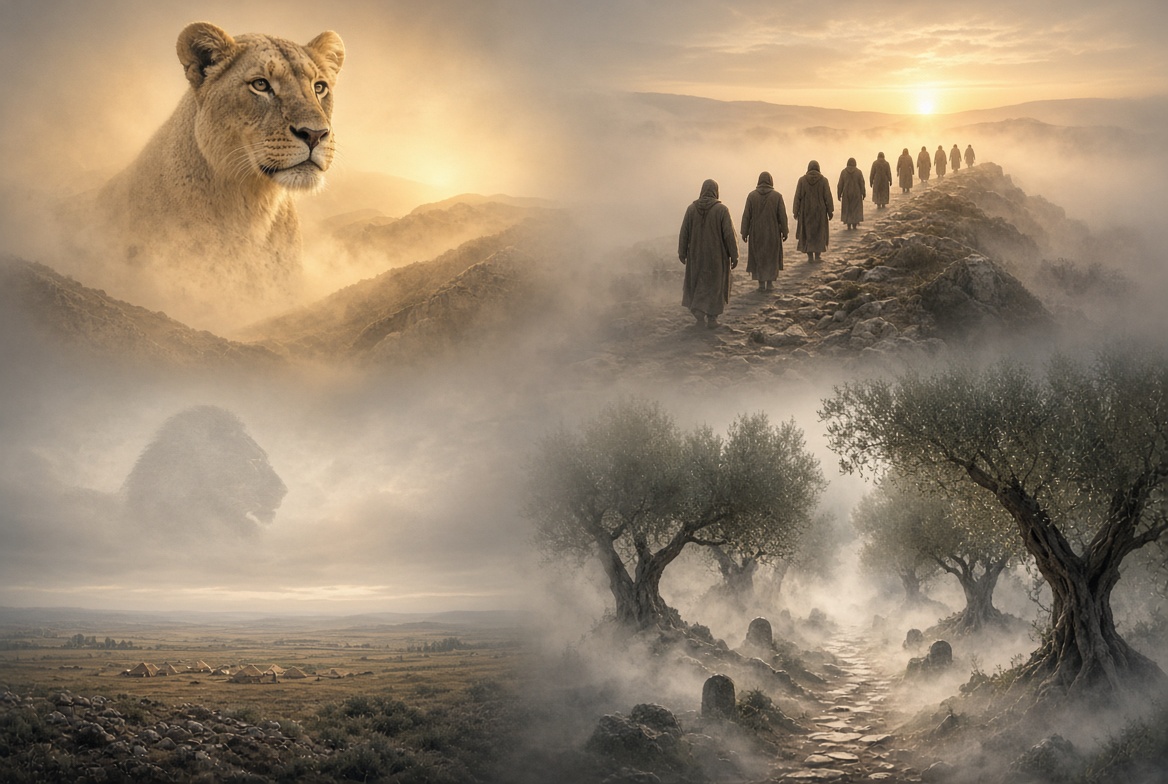

Grok-AI
Galia Sprung – Israel: Am KeLavi: Rising through the Fog
It’s hard to write about October and the Aftermath.
It’s hard to write this in the first person. I’m on the periphery. Thank God, I did not suffer directly on October 7th. There are, however, degrees of separation that connect me to the terror of that day. I highly doubt there’s even one person in Israel who doesn’t have a connection. For me, it’s my son-in-law’s nephew and his family from a kibbutz in the south who were miraculously rescued in the late afternoon of October 7th after a fierce battle between the army and the terrorists who had taken over their house. And my friend’s niece and her husband who were murdered in a kibbutz. There are more.
It’s even harder to comprehend that three years have passed since that horrifying day. I can’t even use that cliché: like it happened yesterday. No. It’s still happening. It’s never left. Not a day goes by that I don’t think about those horrific moments, that I don’t see them: the scenes from the Nova of terrified young people running through the fields, even scenes that, thankfully, I did not see, of the atrocities against women and girls. I’m not alone. Maybe it’s the post-trauma that so many are enduring. It’s not the “stress syndrome”; just a light fog. One you can get through yet the dampness of the fog clings to your subconscious. On the outside, most of us continue with determination.
Some of the tragic deaths from that day are fresh in my mind, so I am surprised to see pictures of the weddings of bereaved spouses who have chosen life and remarried. In my mind, they are still reeling from the shock of their devastating loss. I am not judging. I am just not on the same timeline as they are. I see announcements from survivors who had protected their newborns or were pregnant, sharing news of another baby and I wonder how a baby could have been born so quickly. Yet, a full year has passed, two years, three years. I am aware of that. Yet apparently, I’m not.
It’s hard to remember which name denotes which war or a war within a war, and all the operations and campaigns we’ve had since October 7th. I’m living through this history, yet I can’t always keep them straight. It’s overload. Stress.
It’s comforting when others also mix up the names. Even TV commentators often hesitate before coming up with the correct name. Who can blame them? One war after another.
I find more significant comfort in what is expressed in many of these names. They are living expressions of who we are, if you know the history, if you know the Bible. Names tell a story. They are a direct link to our heritage. They connect us to ancient battles and biblical stories related to the situation or geographical location. Am KeLavi, “Rising Lion,” Mivtza Chetz HaBashan, Operation Arrow of Bashan and Mivtza Sha’agat Ha’Ari, Operation “Roaring Lion.”
When I hear these names, I feel thousands of years of our history reaching out to the present. Almost a wink. A reminder of the strength of our connection. I am reinforced by a sense of familiarity and tradition that surges through me.
My favorite code name is Am KeLavi, otherwise referred to as “The 12-Day War.” At 3 am on Friday morning June 13, 2025, we were rudely awakened with an Extreme Alert that shattered our senses. Israel was attacking Iran’s nuclear sites! TV anchors, probably just as tired at that hour, kept repeating something that sounded like they were swallowing syllables instead of coffee, which left me struggling to decipher an unintelligible “amkelavi.” I had no idea what they meant and assumed it was a Hebrew word I had never encountered. How embarrassing and depressing to not understand a word used so frequently that first day. What were they saying? It wasn’t until I saw it in print online that the syllables took form. They were saying Am-Ke-La-vi. I discovered I wasn’t the only one who had been stymied by the blurred pronunciation, including native Hebrew speakers. It became a topic of conversation.
In fast-paced, spoken Hebrew, the phrase “עם כלביא“ – Am KeLavi – flows together as one word. To a listener hearing it on the news for the first time, in a secure room or bomb shelter, it sounded like a single, unfamiliar multi-syllable jumble rather than a poetic two-word phrase.
No, I didn’t know the reference by heart, but I did remember the context. After defeating the Amorite kings Sihon and Og, the Israelites journeyed south and were encamped in the Plains of Moab. King Balak, fearful of the Israelites below, hired the prophet Balaam to curse the Israelites. Instead, Balaam ended up blessing them three times. The second blessing begins:
“Behold, the people shall rise up as a great lion…” (Numbers 23:24).
This time, we were the people and we did rise up as a great lion.
Eight months after Am KeLavi, the second offensive strike against Iran was launched. This operation was called “Roaring Lion” – a clear message of power symbolized by a Lion on attack – with the added element of fear mentioned in Amos 3:8 “The Lion has roared – Who will not fear?”
Arrows of Bashan was unleashed in December 2024. Israeli forces moved in to take control of the demilitarized buffer zone and of the strategic peaks of Mt. Hermon in modern Syria. Of course! Bashan is the biblical name for the region south of Mt. Hermon and east of the Jordan River that was conquered by the Israelites after defeating the same Og, the king of Bashan, mentioned above. Bashan is mentioned in several biblical sources, especially Numbers 21:33–35. How fitting.
I visited that same area with the Israel Defense and Security Forum (IDSF) six months later and wrote about it here in the August 2025 issue. The strategic aspect needed no explanation. IDF bases and observation posts and even an IDF hospital have filled the buffer zone. We stood as close to the zone as possible and were able to see in the distance the field hospital set up to treat Syrian civilians, mainly from the Syrian Druze community.
Druze in Israel serve in the army and they, too, have made the ultimate sacrifice, as have Circassian citizens, non-Arab citizens of Israel (Muslims, Bedouins, and Christians).
It’s hard to remember the names of the murdered civilians of October 7th or the names of the soldiers who fell in these wars and operations. So instead, I honor their memory by reading about their lives, visiting memorials set up by their families, like the Ahihud Forest Olive grove in memory of Druze soldiers or the park in my community honoring Sgt. Roni Eshel, killed in the Nahal Oz base.
As I honor the fallen, I take a deep breath and look to the future. It’s a process. I see the October 7th survivors and the soldiers from all the wars rising up like Lions as they engage the challenges of mental and physical recovery. I, too, rise up. If they can walk to a chupah with a prosthesis and invisible scars, take trips, laugh and dance and enlist in the IDF, I – we – must continue. We are indeed Am KeLavi.