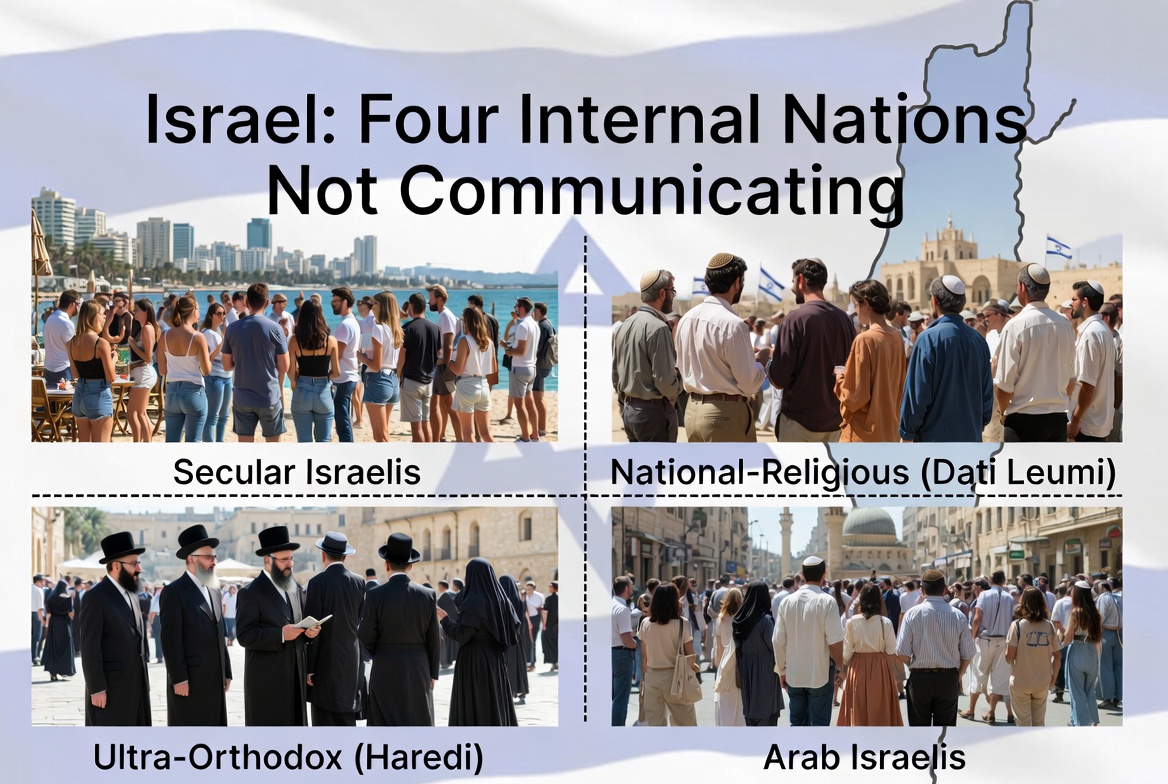

Prof. Sam Lehman-Wilzig – Israel: Four Internal Nations Not Communicating
Various countries around the world are now making efforts to legislatively prohibit social media use by youngsters. That’s a positive micro-turn, but it’s not really the macro-threat undermining social cohesion and even democracy. Where’s the real danger? The characteristics of social media themselves. Here’s the problem and the evidence, in Israel and the U.S.
As Israel heads into its (not so usual) quadrennial election campaign, internal divisions and nastiness are sharper than ever. Yes, Israeli politics has always been full of rancor; it’s enough to quote Ben-Gurion’s “policy” regarding who cannot be part of the first (and later) governing coalition(s): “Just not Herut [today’s Likud] or Maki [the Communists]” – and that lasted for close to thirty years until the Likud’s victory in 1977. Then in the 1980s and 1990s Israel was witness to two political murders: Emil Grunzweig at a peace rally (1983) and PM Yitzchak Rabin (1995).
However, the heat has been steadily rising, especially the breadth of the public’s vituperation. Nor is this an Israeli phenomenon alone; public opinion data show the same trend in the U.S. (less so in Europe, but even there – exhibit #1: the rise of the extreme Right in France, Germany, England et al). The main (not the “only”) factor? Social media.
The evidence for this is abundant. Some examples:
- By a huge margin (80%-14%), Israelis in the early 2020’s claimed that political divisiveness had increased over the previous few years – precisely when social media had become almost universally employed by (almost) all sectors of Israeli society.
- The University of Cambridge’s Political Psychology Lab found that divisions within the US population on social and political issues increased by 64% since 1988, with almost all of this rise coming after 2008 (https://www.cam.ac.uk/stories/political-division-united-states).
- The PEW survey’s “consistent ideology” index showed that the percent of Americans with consistently liberal or conservative views roughly doubled in two decades, from about 10% in the mid‑1990s (start of the internet) to over 20% by the mid‑2010s (when social media had become popular).
- Macro-measures of Facebook article reading displays Democrats and Republicans clustering around different sets of news platforms and stories i.e., partisan news‑diet consumption diverged more in the social‑media era. Fewer and fewer are reading what the “other side” has to say.
As I noted above, social media’s rise did not create these political divisions exclusively, but it did pour a lot of fuel on already existing fires, turning Israel and the U.S. into highly polarized societies. Several factors were, and continue to be, at play.
As opposed to the traditional media environment dominated by a few TV channels and newspapers, the news is now mostly based on personalized feeds and instantaneous viral proliferation. The result: weakening of traditional “gatekeeping,” as politicians, activists, and fringe groups bypass editors, fact-checkers, and regulators – directly addressing fellow citizens through blogs, forums, and numerous (almost unregulated) social media platforms.
In other words, audiences segregate themselves away from “uncomfortable” ideas, aided by algorithms that reinforce users’ predilections as they linger longer on content that affirms their views and/or stirs anger and fear. This also might have been the case in the past, but only during election campaigns; in the social media era political identity is always “on”, with smartphone users now carrying their “political tribe” in their pockets, posting continuously each day. In short, most citizens are living in their particular, narrowly insulated, ideological reality.
The result: in Israel, social media have created (or at least reinforced) four distinct political “internet” communities. First, Jewish and Arab citizens increasingly inhabit separate digital spheres as Arab-Israeli citizens now receive a steady flow of content from the Palestinian territories and regional Arabic media, while many Jewish Israelis inhabit a largely Hebrew, Zionist‑oriented online world. Second, for reasons mentioned above, Israel’s Jewish Left-Right split has grown more intense – two political communities with little ideological commonality between them. The fourth community – the Haredi – is officially not on social media at all, although they have a “kosher internet,” raising the “informational ghetto” walls even higher to keep out the rest of Israel’s political news and ideas.
Adding to all this are many politicians who have eagerly joined the fray through direct populist mobilization, framing politics in binary terms – “the people” versus “corrupt elites” – that bypasses traditionally moderating journalism. Electability is now a function of ongoing digital campaigning. The exemplar: PM Netanyahu hardly ever agrees to be interviewed by Israel’s traditional news media (except for hard-right-wing Channel 14). Instead, his staff monitors engagement in real time, adjusting online (or oral, declarative) messages to what performs best with supporters and potentials.
Adding to all this is the heightened emotional tone of political communication, mostly based on visual rather than textual media. Of course, TV news has been around for many decades, but on “regular” television it tended to be more straightforward – if not really “intellectual,” at least it was moderate in emotional tone. Not so today’s citizen-produced, virally disseminated mini-videos offered with highly emotional (and many times even inflammatory) resonance because that’s what’s needed to “grab” viewers.
Unfortunately, although the problem here is quite clear, a real solution isn’t. As freedom of speech is the lifeblood of democracy (and economic development too), we have to be careful not to throw out the baby with the dirty bathwater.
Nevertheless, just like all other spheres of life that are regulated and somewhat restricted, so too must social media undergo a regulatory facelift. This is best done by establishing a new independent, non-political, quasi-judicial, regulatory institution with the legal power to: force palpable disinformation sources off platforms; set up quick-acting courts with the expertise to deal with defamation, libel, copyright infringement; significantly raise financial (and for particularly egregious infringements, jail) penalties for those transgressing relevant laws and regulations; publicize recidivist transgressors (sort of “buyer beware” warnings regarding social media miscreants); block legally problematic social media content from overseas; and so on.
Differences of political opinion are a sign of a healthy democracy, but just like anything in life that’s pushed to its extreme, “overdoing” it can be more deleterious than positive. Israeli society will never be a fount of complete harmony (Jewish societies in the past weren’t either). But a country with much of its citizenry no longer willing to even listen to each other because the “other political sides” are “evil,” “traitors,” or “plain stupid,” is not one that can survive for long. National security is measured not only by external military strength but (no less) by its internal political cohesion.