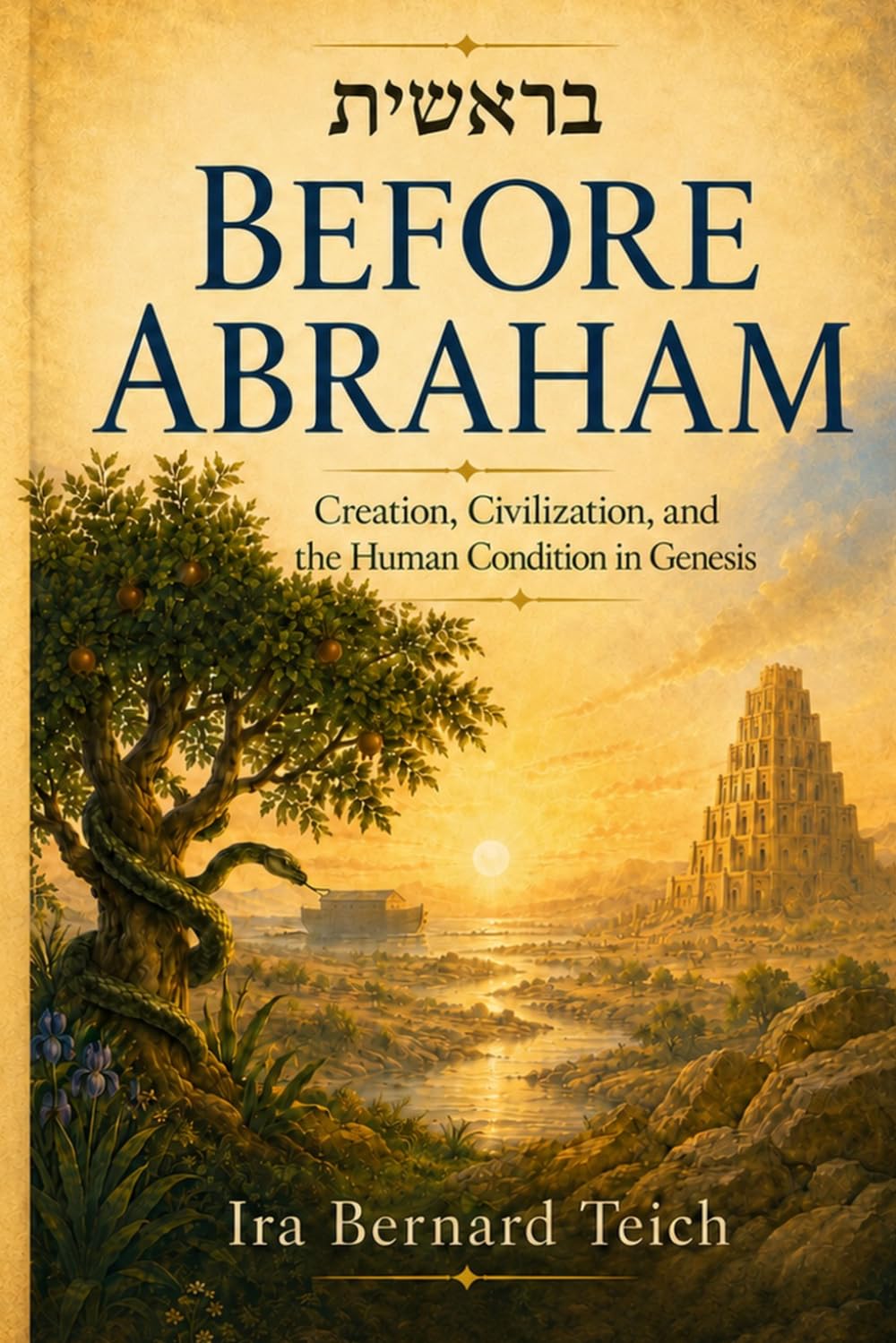

Ira Bernard Teich – Before Abraham: Creation, Civilization, and the Human Condition in Genesis
Before Abraham: Creation, Civilization, and the Human Condition in Genesis is a book about some of the oldest stories we know, and some of the most modern questions we still struggle to answer. Long before Abraham appears, Genesis introduces us to a world of astonishing depth: human beings created “in the image of God,” Adam and Eve confronting freedom and consequence, Cain asking whether he is his brother’s keeper, the builders of Babel pursuing greatness without humility, and a civilization repeatedly discovering that progress without moral restraint can become dangerous.
What makes these stories so powerful is that they are not really – or not only – about an ancient world at all. They are about us. Cain’s jealousy is immediately recognizable in any age. Babel’s ambition speaks directly to societies intoxicated by technology, scale and human achievement. The Flood raises the unsettling question of what happens when violence becomes normalized and corruption spreads through an entire culture. Again and again, Genesis asks whether human beings can develop the moral wisdom to match the extraordinary power they possess.
Drawing on classical Jewish commentators and modern thinkers including Jonathan Sacks, Joseph Soloveitchik, Abraham Joshua Heschel, Hannah Arendt, Viktor Frankl, and many others, Before Abraham brings ancient text into conversation with contemporary life. It does not ask the reader simply to believe these stories; it asks the reader to think with them. Why does Genesis describe humanity as both magnificent and dangerous? Why does civilization advance so quickly while morality seems to lag behind? Why does the Bible place responsibility for another human being at the very beginning of the human story?
And there is another question running quietly beneath the book: why does Genesis devote eleven extraordinary chapters to humanity as a whole before introducing Abraham? Perhaps these chapters are not merely a prelude in time, but a necessary moral journey. Each episode exposes something about human freedom, failure, violence, ambition and responsibility, and together they seem to be moving toward a new answer to the problem of how human beings might live. Abraham does not simply appear after these stories. In an important sense, he emerges from the questions they leave behind.
The result is not only a book about Genesis, but about civilization, leadership, freedom, responsibility and hope. Whether one approaches the Bible as sacred text, literature, philosophy, or a record of humanity’s earliest moral imagination, Before Abraham offers a fresh way of seeing these familiar stories. They are not relics of the past. They are mirrors and perhaps – warnings about the world we continue to build.
Ira Bernard Teich is an author, strategist, international advisor, and artist whose work over more than five decades has taken him around the world. Much of his international career has focused on economic strategy for nation-building, helping developing countries strengthen institutions, expand opportunity, and improve quality of life. He has advised governments and organizations in more than 80 countries.
Much of his formative education took place in Israel during the 1960s and 1970s, years that helped shape his enduring connection to the country and to Jewish history and thought. He comes, as do many Jews, from a family with rabbinic ancestry. He also continues to advise Vatican-based Pontifical Orders on interfaith strategy and contextual theology – particularly in Israel, working to build greater understanding, tolerance, and respect among religious communities. Together, these experiences have deepened his interest in the ideas and values that hold societies together, and the forces that can pull them apart.
Teich is the author of several books, including The Business Mentor, MSME Revolution, The Honesty Advantage, and Beneath the Headlines: The Israel Story the Media Rarely Tells. He is also the author of Inner Visions, a retrospective of his juried impressionistic paintings, many inspired by Jewish, Biblical, and mystical themes. He divides his time between Canada and Israel.
In Before Abraham, he brings these many strands of a lifetime together – strategy, nation-building, interfaith dialogue, Jewish thought, and art – in an exploration of the first eleven chapters of Genesis and what they continue to teach us about human nature, civilization, responsibility, and the kind of world we choose to build.