
Creative Community for Peace – The Problem with NAZA
A new documentary accusing Israel of the calculated mass killing of Palestinian civilians received one of the world’s most prestigious cinematic platforms this week.
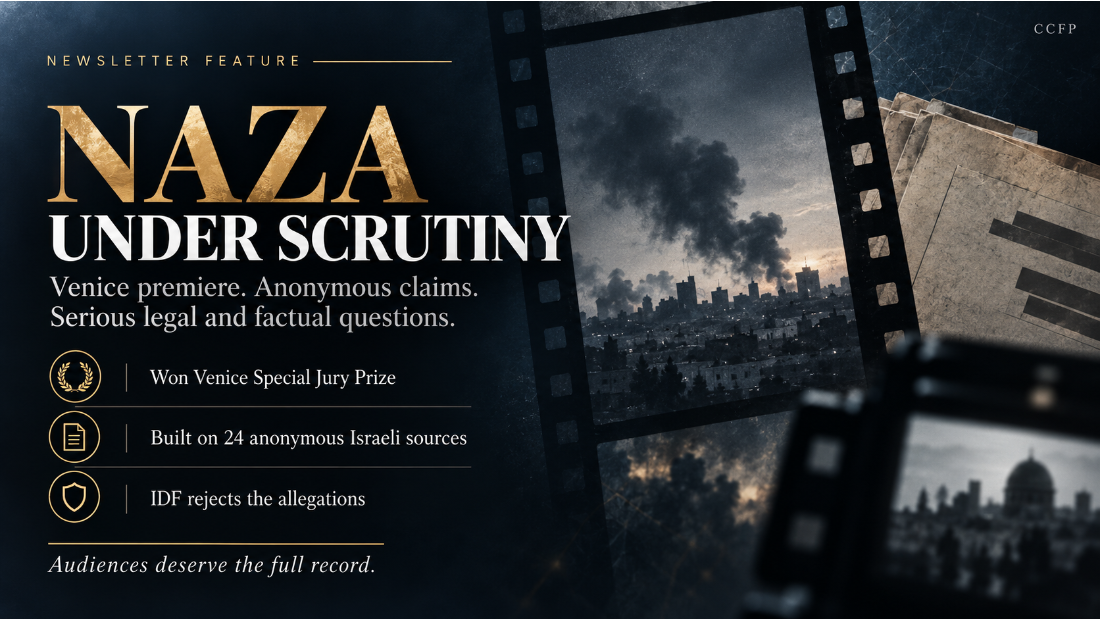
NAZA, directed by antizionist Israeli filmmakers Yuval Abraham and Rachel Szor, premiered in competition at the Venice Film Festival, reportedly received a 25-minute standing ovation, and unsurprisingly went on to win the festival’s Special Jury Prize. The film was produced by The Guardian and JW Films, with Jonathan Glazer serving as an executive producer.
The framing is explicit. Venice’s own synopsis says the film purports to reveal the systems behind “Israel’s calculated mass killing of Palestinian civilians in Gaza.” The language leaves little room for uncertainty. The film begins from a sweeping conclusion and presents testimony intended to substantiate it.
There is only one problem: it’s nonsense.
Abraham is a longtime agitator, propagandist, and reporter for the notorious antizionist rag +972 Magazine, and NAZA builds directly on his previous articles published in +972.
The film relies heavily on testimony from 24 anonymous Israeli military and intelligence figures who make extraordinary allegations about targeting decisions, civilian casualties, and the use of artificial intelligence.
Using anonymous figures is Abraham’s specialty, as he often relies on the unreliable group, Breaking the Silence.
The IDF has categorically rejected the film’s allegations, arguing that the identities, service histories, and relevant roles of the anonymous interviewees cannot be verified.
It also says some of the claims concern decisions far beyond the knowledge of junior-level personnel and disputes the film’s portrayal of how artificial intelligence is used in targeting.
On the film’s claims about AI, the IDF has been explicit that technological systems such as Habsora and Lavender assist analysts in processing information, while target identification and strike approval remain human decisions. Its procedures require individual assessments of expected civilian harm and anticipated military advantage for each strike.
Regarding the use of AI, The Economist in April 2024 praised the Ukrainian army for using AI, while another article in that same issue criticized the Israeli army for using AI. We have a word for this sort of double standard …
There is also a critical legal distinction that the film’s most inflammatory framing risks obscuring. Civilian deaths, however tragic or numerous, do not by themselves establish genocide or prove that a particular military strike was unlawful.
Under the laws of armed conflict, proportionality asks whether the civilian harm expected from a particular attack would be excessive in relation to the concrete and direct military advantage anticipated. The ICRC makes clear that this cannot be reduced to a simple numerical threshold.
Genocide carries an even more demanding legal requirement. The International Court of Justice has repeatedly held that it requires specific intent to destroy a protected group, in whole or in substantial part. Even evidence of high civilian casualty figures does not establish that specific intent, which has to essentially be the only possible reason for the strike.
Any serious examination of the war must also grapple with the battlefield NAZA is describing, and which NAZA hides.
Hamas built an extensive tunnel network beneath almost every inch of Gaza, and even a United Nations commission acknowledged that Hamas and other armed groups had built tunnels beneath civilian structures, used hospitals, schools, and mosques for military purposes, and fired rockets near residential areas.
Serious allegations deserve serious scrutiny. So does the film presenting them.
Urban warfare expert John Spencer has argued that Israel has implemented more civilian-harm mitigation measures and precautions than any military in history, despite fighting in an extraordinarily difficult urban environment against Hamas, which embeds fighters and military infrastructure within civilian areas, and uses civilian deaths as a strategy.
READ: CNN | I’m an expert in urban warfare. Israel is upholding the laws of war
As NAZA moves from Venice to the international festival circuit, its allegations are likely to be repeated across the entertainment industry as established fact. CCFP believes audiences deserve the full record, including the context the film leaves out, the military’s detailed response, and the actual legal standards governing warfare and genocide.
CCFP will continue challenging efforts to turn disputed allegations into accepted cultural narratives. More to come.
Read the IDF’s full response to NAZA