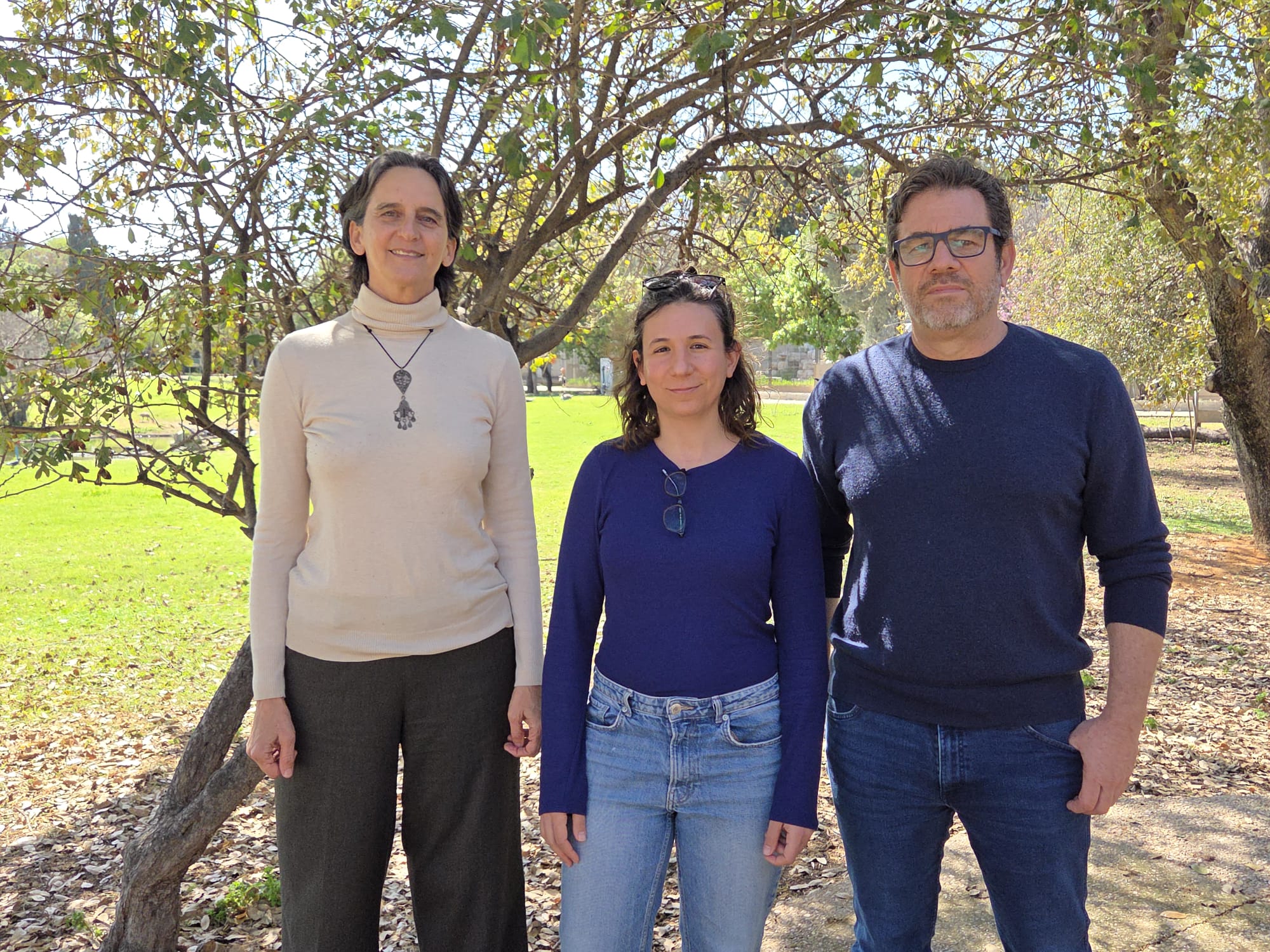

Left to Right: Prof. Noga Kronfeld-Schor, Hagar Vardi-Naim, and Prof. Yariv Wine Credit: Tel Aviv Univer
Tel Aviv Univ. Artificial lighting disrupts the immune system and increases mortality risk in mammals
A study by the New Environmental Studies School and the Faculty of Life Sciences at Tel Aviv University:
Artificial lighting disrupts the immune system
and increases mortality risk in mammals
A new study from Tel Aviv University indicates for the first time that artificial lighting may disrupt natural rhythms of the immune system in wild rodents. According to the study, even exposure to minimal artificial light at night (ALAN), at intensities equivalent to standard street lighting, leads to a 2.35-fold increase in mortality.
The study was conducted at TAU’s Zoological Garden, the I. Meier Segals Garden for Zoological Research on two local mammals, the golden spiny mouse and the common spiny mouse. It was carried out by doctoral student Hagar Vardi-Naim at the George S. Wise Faculty of Life Sciences. The study’s supervisors were Prof. Yariv Wine, head of the Applied Immunology Laboratory at the Shmunis School of Biomedicine and Cancer Research, and Prof. Noga Kronfeld-Schor, head of the Ecological and Evolutionary Physiology Laboratory at the School of Zoology, and Rector of TAU. Both Prof. Wine and Prof. Kronfeld-Schor are also affiliated with the new Environmental School at Tel Aviv University. The research was supported by the Israel Science Foundation. The disturbing findings were published in the journal Environmental Pollution.
Vardi-Naim explains: “Large parts of every mammal’s body, including our own, are regulated by an internal biological clock. With a 24-hour rhythm based on the natural light-dark cycle, this biological clock signals to various organs and physiological systems, including the immune system, what they should do at different times of day. For example, the levels of certain white blood cells rise and fall in the blood, and the body produces more/less antibodies at specific times. Such oscillations can enhance the immune response to bacteria or viruses, but for this the body must know the time. Light pollution alters the natural light-dark regime, disrupts the central clock’s synchronization with environmental time, and changes these patterns, rendering time almost meaningless.”
The researchers examined the effects of artificial lighting on the immune systems of two related species of small rodents: the golden spiny mouse and the common spiny mouse. Both live in the Israeli desert, sharing the same geographical habitat, but differing in their activity time: while the golden spiny mouse is active during the day, the common spiny mouse is active during night. The animals were taken from the Judean Desert to outdoor enclosures at TAU’s Zoological Garden, where some of them were exposed to ALAN.
Vardi-Naim: “We kept the spiny mice in enclosures that simulated natural environmental conditions as much as possible. Half of the enclosures were illuminated at night with white LED, the most common type of lighting used today, at a relatively low intensity that simulates street lighting, while the control group was exposed only to natural light-dark conditions – the sun, moon, and stars.”
The researchers measured the percentage of white blood cells (i.e., lymphocytes) in the mice’s blood at several points in the 24-hour cycle, and found a pattern similar to the human rhythm, with lymphocyte levels in the blood rising during rest hours, between two and four in the morning. In addition, they discovered a very clear 24-hour lymphocyte rhythm, and found that the amount of antibodies produced in response to an antigen (a substance that evokes the immune system’s response, e.g. a virus or vaccine), is time-dependent.
“We saw that animals exposed to an antigen during their rest hours produced far more antibodies than those exposed during their active hours,” adds Vardi-Naim. “Exposure to light pollution, however, completely muddled these rhythms. Instead of a daily cycle of peaks and lows in the level of lymphocytes and immune response, we observed a complete flattening of the daily patterns. This means that the immune system loses its natural timing, and consequently, its response to infections, environmental stress, or vaccination might be less than optimal, possibly increasing the animals’ vulnerability over time.”
In addition, extensive and rapid mortality was observed among the mice exposed to light pollution, with a 2.35 times higher risk of death compared to the control group. The researchers note that even though the exact cause of death could not be determined, the rise in mortality occurred alongside disruption of immune and endocrine (hormonal) rhythms, suggesting a likely connection between damage to biological timing and reduced survival.
Vardi-Naim emphasizes that the spiny mice in the study are only an example, and that the findings have implications for all living creatures, including humans. “Our results show that ALAN is not merely an aesthetic environmental change, but an active biological factor capable of disrupting critical physiological mechanisms. Chronic exposure to ALAN disrupted the timing of the mice’s immune and endocrine systems and impaired their survival under conditions that otherwise simulated the natural environment. We believe that light pollution should be regarded as an environmental health risk with broad implications, not only for wildlife but also for human health and the ecosystem as a whole. Studies show that animals with weakened immune systems can transmit diseases to humans, and it is possible that the human immune system responds in a similar way. The study underlines the need to include biological considerations in lighting policies and to reexamine ALAN scope and intensity in both urban and open spaces.”
Overall, by studying animals that live in conditions close to their natural environment rather than in sterile laboratory settings, this research highlights the value of using wild models to understand how the immune system functions in the real world. Such approaches reveal how environmental changes, including growing light pollution, can affect complex biological systems in ways that are often missed in traditional lab studies. As human activity continues to reshape natural environments, studying immune responses under realistic ecological conditions is essential for understanding how global environmental change may influence the health of wildlife, ecosystems, and potentially humans.