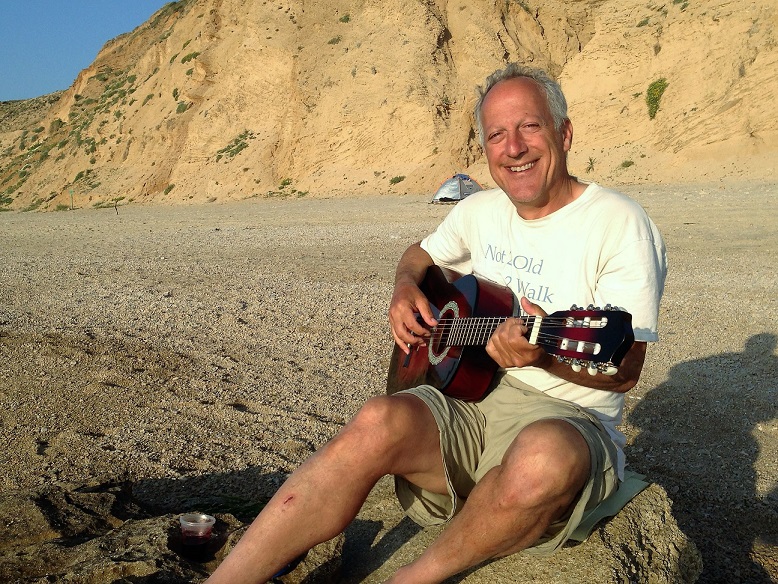

Susan R. Eisenstein: Nugget Series: Aryeh Green, Author of Finding Peace in the Promised Land

Aryeh Green wears multiple hats, skillfully navigating multiple roles. All his roles require great expertise, are challenging, important to the world, and inspiring.
His book can be purchased at https://www.amazon.com/dp/B0GTX2KTDD
Aryeh Green is Chief Strategy Officer at Gigawatt Global, a renewable energy platform for Africa, co-founder of Gigawatt Impact (a US501(c)3 nonprofit), a member of the board of Ma’aleh Film School and IsraellyCool, and a mesmerizing speaker (which I know from personally meeting him some years back on a book tour in the U. S. and also having him take one of my classes on a virtual “trip” in Israel, one that Israeli children take each year).
Additionally, Aryeh Green is an expert in regional affairs, media issues, and Israeli history, with an extensive background in the public and private sectors, including as a senior advisor to Vice Prime Minister Natan Sharansky, and continues to be active promoting freedom and democracy in the Middle East. He holds a BA in psychology from UC Berkeley, an MA in international relations from Hebrew University, and an MSc in management from Boston/Ben Gurion Universities. And as a pastime, Aryeh Green enjoys growing grapes and making wine.
And now, in addition to being the author of My Israel Trail, Green is the author of the newly-released Finding Peace in the Promised Land – From Hatred to Humanity: Five Transformative Steps to Resolve the Arab-Israel Conflict. And he graciously granted me the following interview about his new book, Finding Peace in the Promised Land.
Susan: What was the motivation for writing “Finding Peace in the Promised Land”? And why now? And why this topic?
Aryeh: As I write in the new book, these ideas were percolating as I hiked the Trail. In fact, some were included in the first draft of my first book, My Israel Trail, and were excised as the book was already virtually two stories: the hike itself, the people I met, and the history and geography of the country, and the lessons learned, which helped me face my personal challenge(s). So the relevance of the ideas – the five elements of humility, acceptance, gratitude, forgiveness, and a sense of purpose – to the Arab-Israel conflict, while clear to me and powerful, was only mentioned in passing. But it was there all along (even in my journal notes while walking along Israel’s border with Lebanon).
Why now? Well, October 7th made it more urgent and more acceptable to present my thesis, in addition to the inauguration of the Abraham Accords, which corroborate and have given even more validation to my argument(s).
Susan: Can you share some of the chapter titles? Can you share, perhaps, a chapter?
Aryeh: The elements listed above are most of the chapter headings, followed by practical, tangible steps I suggest to make the recommended changes a reality. Rather than sharing a whole chapter (the opening chapter(s) can be seen on Amazon and other sites), happy to share a small section of the Prologue:
One presumes you’ve picked up this book as it piqued your interest in new ways of thinking about this centuries-old clash of civilizations in the Middle East, and that you might be interested in exploring the subtleties of the history and ideologies that have contributed to the ongoing battle for the soul of this region. In these pages, you’ll find some history, some philosophy, and many perspectives on the culture, religion, and beliefs of the people of the Levant. And you’ll find a clear and moral, values-based path to genuine reconciliation, with no holds barred and no sacred cows left standing.
It may make you uncomfortable… but as Michael Huffington has said, “…growth comes from adversity.”
“Between stimulus and response, there is a space. In that space is our power to choose our response. In our response lies our growth and our freedom.” – Viktor E. Frankl (attributed).
Susan: In what ways do you hope that your new book will shape or change people’s thoughts about Israel?
Aryeh: I wrote the book for the general public, of course, but also or even primarily for policy-makers. For too long, public discourse and policy debates have focused on maps and geography, politics and military issues and the like. The underlying reasons perpetuating the conflict are rarely addressed, even while most (objective) observers agree they are recognizable and significant, or even imperative, as if not addressed there can be no resolution to the conflict. So my hope is that leaders and anyone interested in the issues will find the book helpful to reach an accurate understanding of the nuances and subtleties of the issues, the history, and the reality on the ground… and that this will inform their understanding of what steps can be taken to finally achieve the real peace we all wish for.
Susan: After reading “Finding Peace in the Promised Land,” what questions do you hope will now be asked about the peace process as opposed to how things are already viewed?
Aryeh: I guess “How did this all start?” or even better, “What is the underlying cause of this conflict?” Which is to say – putting it more bluntly – I hope most of the basic assumptions about the conflict will be questioned. The idea that Israel is a ‘colonial settler occupier,’ not to mention an ‘apartheid’ state carrying out a supposed ‘genocide, should be questioned (and rejected) not only from a reading of my book but from any objective, even shallow or online, research. (No offense, but even this question’s phrasing raises similar questions. To what “peace process” are we referring? There has been no process focused on ‘peace’ for decades, unfortunately. And that’s because all the Peace Processors weren’t asking the right questions, or were looking for love in all the wrong places…).
Susan: I absolutely agree. The basic assumptions of this conflict need to be questioned and rejected. That is why leaders and the public need to read and learn from reading your book.
Susan: Do you have future plans for more books? What are your plans for the future in general?
Aryeh: Thanks for asking. I don’t have any ‘plans’ for more books; I never really ‘planned’ the first two. But if there is a need for further elucidation of the concepts, or if I come up with new ideas or approaches, I might decide to write more. (I’ve written a few articles about Judaism as a civilization and not just a religion or belief system, about the nation and people of Israel, and the importance of reasserting the legitimacy of these ideas, and perhaps I’ll write something more substantial along those lines. But that’s just musing.
Susan: Aryeh Green can be reached at: aryeh.green@gmail.com.
His book can be purchased at https://www.amazon.com/dp/B0GTX2KTDD