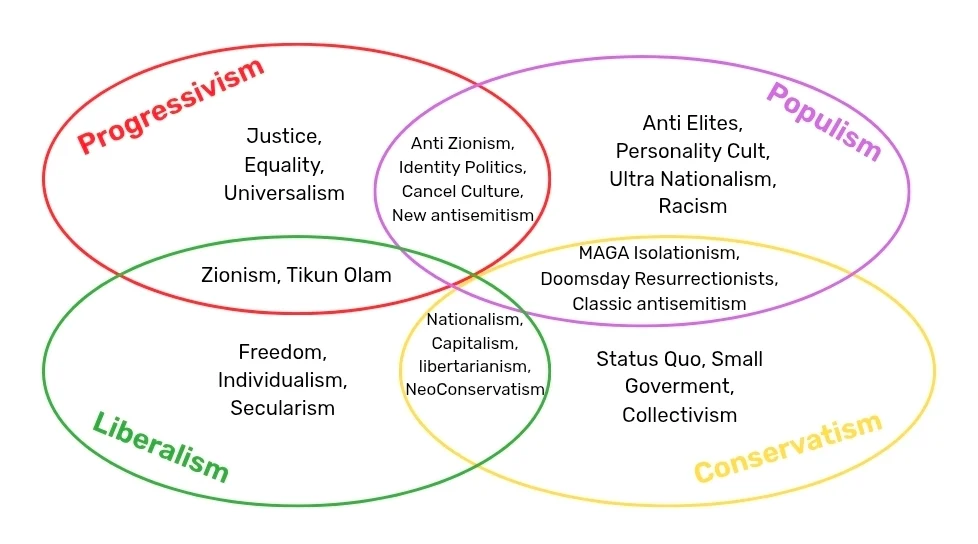

Prof. Sam Lehman-Wilzig: Israel’s Ideological Confusion: Between Radical Conservatism and Status Quo Liberalism
Do you think that you’re a conservative? Or maybe a liberal? In either case, reconsider – you’ve probably got things backwards.
Israel seems to be going along with numerous other democratic countries in rendering our classic ideologies topsy-turvy. Whether this overall trend is a contradiction, a paradox, or even inevitable over the long term, it’s too broad these days to merely strike off as a temporary, political abnormality.
In a nutshell, here’s what’s happening in Israel (I’ll get to parallel developments elsewhere in a moment). Over the past few years, the present right-wing government, supposedly standing for conservatism in public affairs, has attempted to radically change the political system in many spheres of life:
- electing the Supreme Court’s President (turning this into a quasi-political selection) instead of the traditional approach of automatic seniority;
- splitting the Attorney General’s job into three different (and far weaker) bureaucrats;
- arresting peaceful protesters against the government (especially if they’re Arabs); even people with a “provocative” kippah on their head!
- abolishing Israel’s army radio station (Galei Zahal), purportedly for its “left-wing” slant;
- starting a legislative process to ban any (Arab) party that does not support Zionism;
- calling for official annexation of the Administered Territories (against international law), with some government officials demanding the same regarding Gaza;
- amending the law to transform the Council for Higher Education (MALAG) and its Planning and Budgeting Committee (VATAT) from professional institutions to government-political bodies;
- pushing a draft law to “legalize” ultra-Orthodox draft evasion – meanwhile, not administering the present law despite explicit instructions from the Supreme Court to do so.
- encouraging a foreign power (President Trump) to get involved in Israeli politics e.g., “encouraging” Israel’s President Herzog to give a blanket pardon to PM Netanyahu, without any admission of guilt by Bibi or punishment for his purported corruption;
- and this is merely an incomplete list ….
Taken as a whole, this package of policies and (non)actions lies somewhere between evolution and revolution – so let’s call it “radical conservatism.”
In large part as a reaction to this – but also to try and maintain its traditional hegemonic status within Israeli society – Israel’s Center/Left-wing citizenry are fighting a rearguard campaign to preserve these institutions, their practices, and the country’s original highly democratic ethos:
- ongoing massive but peaceful protests against the government’s “Judicial Reform”;
- constant applications to the Supreme Court to stop the government’s “unconstitutional,” non-legislative, and in some cases “illegal” practices;
- ditto, regarding the Knesset’s (r)evolutionary laws that don’t have the support of its own Knesset Committee’s legal counsel or that of the government’s Attorney-General;
- most of the traditional press (newspapers and TV channels) heavily criticizing the government on a regular basis;
To put it bluntly, each side in Israel has changed its political demeanor: right-wingers have become radicalized; left-wingers have turned profoundly conservative.
All this should not be too surprising, given very similar trends overseas. The United States, of course, is leading the pack under President Trump, although it wasn’t the first such country to push a “radical conservative” program. Hungary under Victor Orban was moving in this direction over the past fifteen years. The United Kingdom’s shocking Brexit from the European Union was led by the Conservative Party; today, the leading party in the polls calling for radical change in Britain is the far-RIGHT wing party “Reform UK.” Argentinians elected far-Right Javier Milei to completely transform the economy (partly successful, so far). Japan recently elected its first female PM whose hawkish foreign policy stands in sharp contrast to Japan’s (post WW2) traditional pacifist approach. Here too, the list around the world goes on and on…
How to explain all this? There isn’t any specific, simplistic factor involved; rather, there are a few elements with each country placing greater emphasis on this or that one.
- Ideological exhaustion: At some historical point, all ideologies run out of intellectual steam. As a result , they hunker down within whatever guiding thought worked in the past. Ideological excitement and energy then move to the other side of the ideological spectrum (e.g., America’s MAGA).
- Ideological overreach: Although somewhat contradicting #1, ideologies do try to take their initial idea and stretch it into new areas. One recent example that comes to mind in the Liberal case (especially in America): “woke.” This engenders a strong reaction among those who in the past were neutral about Liberalism but now are fed up with its tentacles trying to control every aspect of social and political life.
- Hegemony: Citizens are willing to tolerate (if not necessarily support) the ruling class for quite a while out of inertia. At some point, though – usually after a couple of decades – whatever ails society (there’s always some problem) is blamed on the “rulers,” not necessarily only the country’s political leadership. Economic, social, judicial, and/or intellectual leaders (media, arts, courts, corporate bigwigs, “Deep State” bureaucrats, etc.) can also be viewed as “hegemonic” and “at fault” for those national “ills.”
Israel is an interesting case because it has opposing hegemonic sectors: politically, the Right-wing has been in political power for most of the past fifty years; the Left-wing has had social dominance (academia, the arts and media, etc.) for even longer. The result: growing enmity between the two camps, each believing that its dominance in their area should be expanded to also take over the supremacy of their opponents’ areas of endeavor.
- Economic grievance: When there’s a growing gap between rich and poor, especially in times of unemployment fears (AI, anyone?), the “outs” will look to those politicians who point fingers at specific groups (e.g., immigrants, external enemies or exploiters) and offer “quick fixes” (e.g., tariffs, legislative change, and/or greater militarism as in Israel, or isolationism as in the U.S.).
None of this means that the success of the “New Right” is guaranteed. Just as Liberalism has suffered from “social expansion,” so too Contemporary (radical) Conservatism has a tendency to push its envelope too far beyond what the mainstream public wants (e.g., Trump’s increasing unpopularity this past year; Orban’s electoral defeat). The potential result? A widening of the Center – not necessarily out of enthusiasm for a “middle way,” but rather the feeling that this is “a plague upon both your (overly extreme) houses.”