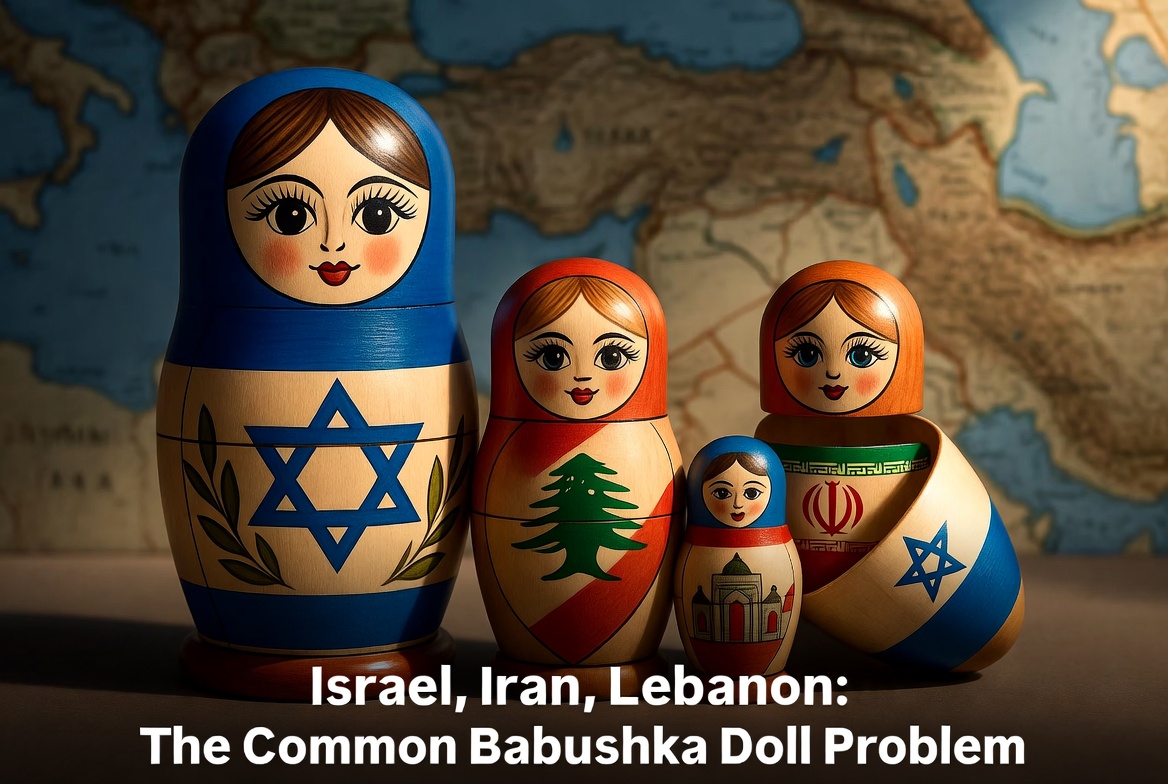

Prof. Sam Lehman-Wilzig – Israel, Iran, Lebanon: The Common Babushka Doll Problem
A “Babushka Doll” comprises a few layers of ever smaller, Russian dolls nestled within each other. Well, some Middle East countries have a similar situation. However, here the Babushka syndrome is found in a national context – and that’s a real problem!
A Middle Eastern nation’s map will often show you only half the picture. Officially, each country has a single national flag, capital city, and constitutional government. In fact, however, inside that structure there might lie another power center: an organization or political party that commands loyalty, controls resources, and sets its own rules with a high degree of autonomy that usually is the state’s exclusive function. These act like political mini-states – embedded in the system but largely insulated from the national authority – distributing benefits to their supporters/adherents, enforcing their own particularistic norms, and wielding coercive power through national legislation and other even more strongarm means that the official state can’t easily overcome.
Three countries are contemporary examples of this phenomenon, with each taking a somewhat different path. Before detailing each example, here’s the quick survey. The most extreme are Iran’s Revolutionary Guards, constituting a political, economic, and ideological power center inside the presently weakened theocratic regime. Somewhat less comprehensively, Lebanon’s Hezbollah combines military power and parliamentary influence, while also providing social services to its Shiite followers. Altogether it’s does much more than a traditional political party but somewhat less than a formal state. And then there’s Israel where the ultra-Orthodox political sector doesn’t command an army (“God forbid”!), but it has created a separate sphere of authority in such fields as education, welfare, and religious affairs through smart but self-serving coalition bargaining.
Despite their several differences, all three share a common feature: layered sovereignty, forcing official state bodies to negotiate and concede authority to powerful actors within the country’s own borders.
The Islamic Revolutionary Guard Corps was created after toppling the Shah in 1979, not merely to defend Iran but to protect the ongoing social revolution itself. Unlike a conventional army, the RGC was created to be the regime’s ideological guardians. But like a “Golem,” over time they accrued major political weight, turning into a military force with strong, domestic intelligence gathering, economic muscle, and widespread media influence. Answering directly to the Supreme Leader, they act outside the state’s normal chains of command – and by now, mostly above them.
The result is a dual system: on paper there’s only one state; however, another power structure controls the means of coercion, patronage, and ideological indoctrination. The result: reform becomes difficult because the same organization that protects the system also profits from it.
If Iran displays a parallel sub-state inside a relatively strong regime, Lebanon’s second-level Babushka is contained within a weak state. Hezbollah emerged from a polity that often failed to deliver security, social services, and any sort of coherent national authority. This mini-state built an armed force that in some respects is more effective than what the state offers – creating clinics, welfare networks, schools, and reconstruction programs.
In short, Hezbollah has major influence without full accountability. True, it sits in the Lebanese parliament and even within the government, but it keeps independent military power with a loyal constituency working for, and being serviced by, its own institutions. The price that Lebanon pays is steep: important decisions – even about war and peace! – aren’t fully controlled by the state. Thus, Hezbollah is not only a symptom of Lebanese weakness; it is a major force maintaining that weakness.
Israel’s case is different in tone and structure, but it harbors many of the same “Babushka” ailments. Unlike the RGC and Hezbollah, the Haredi sector in Israel isn’t a militia and doesn’t compete with the state through armed force. Nevertheless, socio-politically it has created a highly autonomous sphere of influence. Through strong religious parties, voter discipline, independent school systems, rabbinic authority, and smart (legislatively) tailored welfare policies and structures, the Haredim have secured exceptional arrangements that enable them to live as a separate socio-political enclave. They aren’t completely territorially separate (there are Haredim who live in socially “mixed” cities) but nevertheless most live within a semi-detached society with its own rules and leadership. And, indeed, in certain general, national spheres of Israeli life – e.g., marriage, divorce, kashrut – they even control the lives of the rest of Israeli society.
Such authority differentiation in Israel’s democracy fuels tension over fairness (for most Haredim, no military duties), taxation, and labor participation. Making matters worse, what started out as a manageable exception for a small minority has become – due to their high birth rate – a structural (even existential) challenge to the state’s economy and shared civic ethos.
In which direction is this overall Middle East “Babushka” trend moving? In opposite directions (nothing in the Middle East is straightforward). For Iran, the latest war has enabled the RGC to finally take power with only a “nod” to the ostensibly ruling Mullahs. Lebanon seems to be moving in the other direction, with the Lebanese government determined (at least verbally) to bring Hezbollah to heel, at least regarding military disarmament.
At present, Israel seems to be somewhere in the middle. On the one hand, there is extremely strong civic and political pressure to have most Haredim drafted into the IDF, as well as placing critically important secular subjects in their curriculum. On the other hand, few see a diminution in their authority regarding kosher certification, the religious courts, Wailing Wall discriminatory policies, etc. In the middle are some important areas that would potentially weaken their monopolistic authority e.g., officially sanctioned civil marriage.
For Israel, all this is ironic in light of PM Ben-Gurion’s successful, post-independence policy of mamlakhtiut (“statism”) that disbanded all the ideological militias (e.g., Haganah, Palmakh) and centralized the numerous Socialist educational systems under one educational authority. Unfortunately, as time went on the centrifugal force of religious differentiation turned out to be too strong. Whether that can and will be reversed – in Israel as well as in Iran and Lebanon – only time will tell.