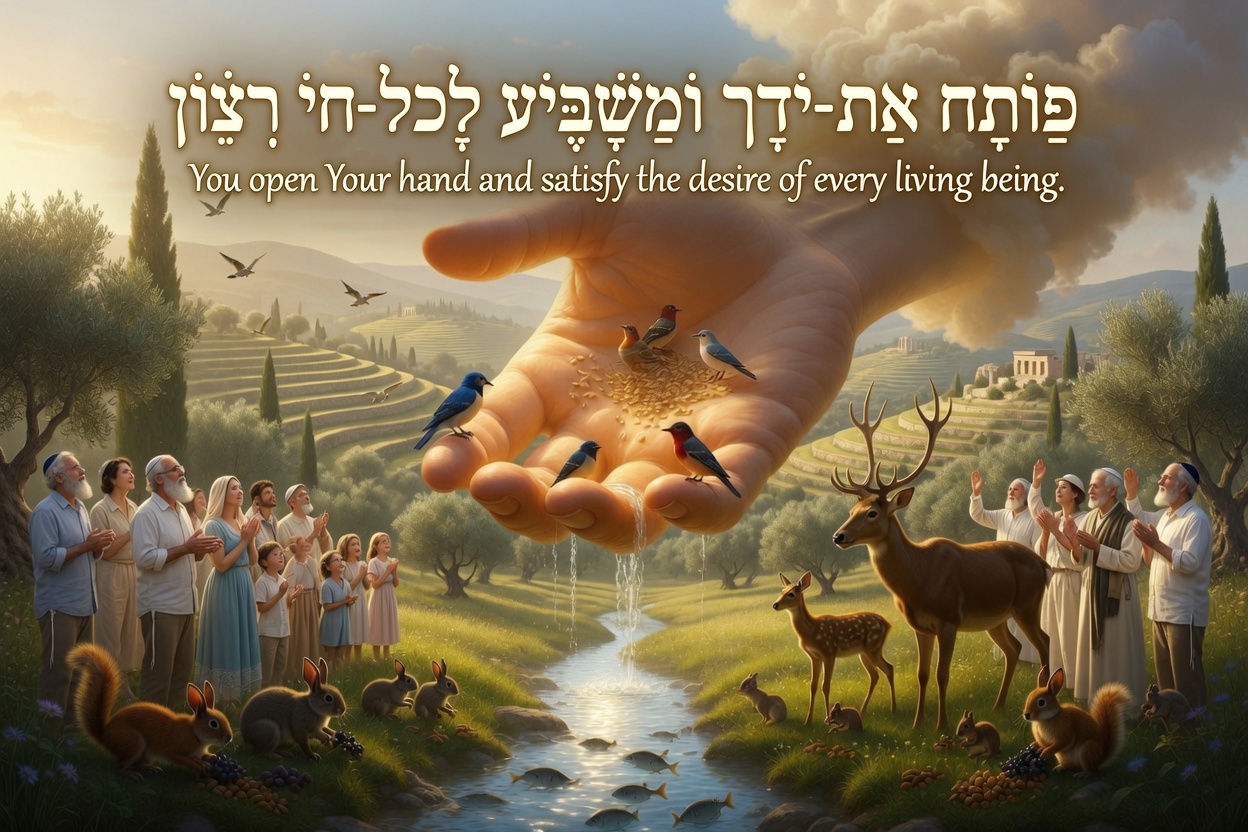

Mark Okrent – “You open Your hand and satisfy the desire of every living being”
פּוֹתֵֽחַ אֶת־יָדֶֽךָ וּמַשְׂבִּֽיעַ לְכָל־חַי רָצוֹן”
“You open Your hand and satisfy the desire of every living being”
This verse is found in the Ashrei prayer which is traditionally recited three times every day.
Yet, as we say these words, a harsh reality stares back at us. There are millions of people starving on this planet. Children go to bed hungry. How do we reconcile this beautiful, daily declaration of Divine abundance with the cold, hard facts of human suffering?
The answer lies not in a lack of Divine giving, but in the nature of human receiving. God does not drop bread ready-baked from the heavens. Instead, God provides the raw materials, the conditions for life, and the human intellect. He opens His hand, but we must reach out ours.
In the opening chapters of Bereishit, we see two distinct phases of human existence:
- The Garden of Eden: An ideal state where sustenance was effortless. Adam and Eve merely had to pluck fruit from the trees.
- The Post-Eden Reality: Humanity is sent out into the world with a new mandate: “By the sweat of your brow you will eat bread.”
This transition was not a curse; it was an initiation into adulthood. God created a planet uniquely suited to sustain us, but He intentionally left it incomplete. The Talmud teaches that everything created in the first six days requires preparation—wheat must be ground, lupines must be sweetened, and the world must be cultivated.
Our scientists have spent decades searching the cosmos. They have found thousands of exoplanets, but to this day, Earth is the only planet in the universe known to sustain life naturally. God built the greenhouse, but He appointed us as the gardeners. If the garden is failing to feed everyone, it is not because the greenhouse lacks soil or water; it is because the gardeners are failing to distribute, cultivate, and cooperate.
To understand what it means for humans to “do their part” with what God provides, we can look to one of the most barren, inhospitable places on Earth: the Faroe Islands.
Located in the brutal, windswept North Atlantic, these volcanic islands have no native trees. The soil is thin, the weather is harsh, and growing crops is nearly impossible. By all logical standards, humans should not be able to survive here.
Yet, for over a thousand years, the Faroese people have thrived and How? By looking at what God did provide and finding creative ways to adapt it:
- Driftwood from Siberia: Because they had no trees to build homes, they gathered driftwood carried thousands of miles across the ocean from the forests of Siberia.
- Turf Roofs: To insulate their homes against the freezing Atlantic winds, they cut the thick green grass growing on their mountains and laid it on their roofs, creating natural, living insulation.
- The Ocean’s Abundance: While the land was barren, the waters surrounding them were rich. Today, the Faroese have turned the rough North Atlantic into a source of world-class salmon farming.
- Subsea Tunnels: Rather than letting the violent, dangerous waters separate their communities, they used the wealth generated from their waters to engineer magnificent, state-of-the-art subsea tunnels, linking their islands together safely.
The Faroe Islands are a living proof of our thesis. God did not hand the Faroese a ready-made paradise. He gave them a rocky, treeless outpost in the middle of a freezing ocean. But He also gave them driftwood on the shores, salmon in the water, grass on the hills, and the human brain to connect them all.
When we say— “You open Your hand”—we are acknowledging that the physical infrastructure for life is fully provided. The Earth has enough food, water, and resources to feed every human being many times over. But God’s open hand requires our open hands. If there is hunger in the world, it is a human failure of logistics, sharing, and effort—not a Divine failure of provision. Like the Faroese looking out at a treeless island and seeing a home, we must look at the resources God has given us and do our part to ensure that His abundance reaches every corner of His creation.