
Jonathan Feldstein: Have Israelis Lost Faith in Netanyahu
He has dominated Israeli politics for the better part of three decades. For many around the world, Benjamin Netanyahu is not merely a prime minister but a permanent fixture of the Israeli landscape, the man who stood before the United Nations with bomb cartoons depicting the Iranian nuclear threat, who forged the Abraham Accords, who made Israel’s voice heard in Washington even when American presidents would rather not have listened, and is one of Israel’s best spoken English leaders. Yet inside Israel, as elections loom, a very different conversation is taking place.
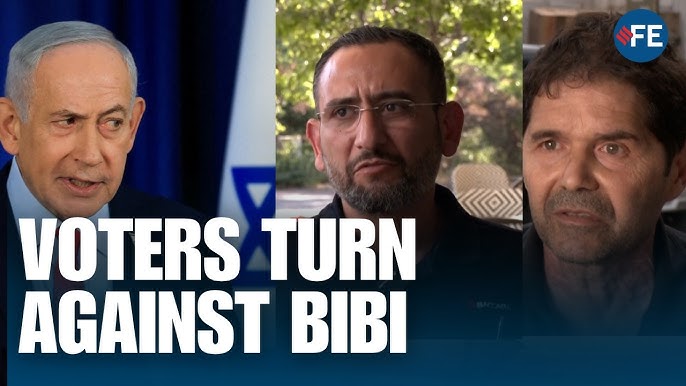
In a candid panel discussion on the “Inspiration from Zion” podcast, five undecided Israeli voters, ranging across the political spectrum from left to right, were asked directly: why aren’t Israelis simply lining up behind Netanyahu again? The answers were pointed, personal, and remarkably unified across what is otherwise a varied group.
The most consistent charge was not about corruption or ideology, but something more elemental: Netanyahu’s deliberate suppression of anyone who might someday replace him. “The biggest issue with Netanyahu is that in 20 years, he has not groomed a successor,” said Arnie Draiman, a Jerusalem-based nonprofit consultant. “There are people who have risen to be his number two, and each time, he just slaps them away, moves them away, or they have left in disgust.”
Draiman noted that Netanyahu could have stepped back on a high note following the Abraham Accords, allowing a chosen successor to carry his legacy forward while continuing to advise behind the scenes. Instead, he stayed, and in doing so, hollowed out much of the political talent around him. The irony is stark: many leaders currently heading opposition parties are former Likud insiders and Netanyahu confidants, driven away by Netanyahu himself.
Batya Medad has lived in Shiloh for over four decades, framing the problem historically, pointing to Franklin Roosevelt, who was elected to four terms and died in office. She notes that Americans, too frightened of change, kept re-electing a man who was visibly failing. The lesson, she argued, applies directly to Israel today. “It is not healthy for a people or a government of citizens to think only one person can be the prime minister,” Medad said. “The government and the country have to be stronger than one person. This is not a monarchy.” She added a warning that should resonate even with Netanyahu supporters: “It frightens me when I hear people say they cannot imagine anyone else, because it means they will overlook problems.”
Erica Schachne, editor of the Jerusalem Post Magazine, offered perhaps the most personal assessment. She acknowledged that Netanyahu once genuinely captured the Israeli public’s imagination and accomplished real things. But she argued that the era has decisively ended. “I think the Israeli people are very disappointed in him,” Schachne said. “He captured the imagination, and now he has kind of devolved. He forgot about what made him great, he has lost touch, and it is time to let some new light in.”
Schachne also pointed to what she called “the death of shame,” a broader collapse of political accountability she traces back to the top. “He is too preoccupied with keeping himself in power. That is the lifeblood of this country now.” She described a government in which nobody takes responsibility for anything, adding bluntly: “The (government) ministers don’t minister. It does feel sometimes like the government doesn’t work.”
For Yehuda Poch, who has worked at the Bank of Israel for 13 years, the decisive issue is accountability for October 7. His position was unambiguous. “I have to give serious consideration to not voting for anybody who is in a position of responsibility for October 7,” Poch said. “Anybody who was in the defense establishment before October 7, going back 10 years, is part of the problem.” He noted this not only rules out Netanyahu but several figures he otherwise respects, including Benny Gantz, whom he described as “the biggest mensch (person of integrity) in the entire Knesset.” The painful conclusion he reached: Israel’s political class is so entangled in the failures that produced that catastrophe that voters are left with almost no one to turn to. “Netanyahu for sure is part of the problem,” Poch said. “The question then becomes: who isn’t?”
Marc Simanowitz, a PhD candidate in genetics at Hebrew University, focused on a pattern he observed across two major crises. During COVID and during the war that followed on October 7, the prime minister was effectively absent as a decision-maker. “Every time there is a crisis, it feels like Israel is being led by no leaders,” Simanowitz said. “He is not there.” He also noted that Likud itself has become a problem for right-leaning voters. “Even if you are on the right, you have better alternatives. The Likud party (under Netanyahu) does not look that appealing to the average young Israeli.”
While generally agreeing that Netanyahu needed to go, the panelists also agreed on one thing: that at his best, Netanyahu was one of Israel’s greatest prime ministers and leaders, if only for his endurance. Yet they converged on an uncomfortable truth: Netanyahu’s continued viability, upon which many Israeli voters are reflecting, not on his record but on the fracturing of everyone around him. “It is the fractures between those parties that give him the power to stay in power,” Poch observed. “He is maybe one of the only guys who really knows how to play that game.” Schachne acknowledged the political reality plainly: “It is a cult of personality, and there is nothing we can do about it. So there is a very good chance Bibi is going to win again.”
Yet perhaps the most telling moment of the entire conversation was the simplest one: this group of Israeli voters across the political spectrum barely mentioned Netanyahu’s name for the first half hour, because they were too busy talking about the economy, the education system, the cost of living, the ultra-Orthodox, and the collapse of political integrity. Those are the issues Israelis care about. They are not the issues around which Netanyahu’s survival has been organized. And when discussing Netanyahu directly, none of the panel members initiated any comments about Netanyahu’s ongoing corruption trial. Does that mean Israelis don’t care about his legal troubles, or that there are more compelling issues, as damning as the legal accusations remain?
What is true is that Netanyahu remains masterful at holding onto power. While none of the panel of undecided voters are prepared to vote for him, none are willing to count him out either.
Register to join the upcoming conversation live on “Inspiration from Zion” on June 17, at 8:00 pm Israel time, 1:00 pm Eastern time (US).