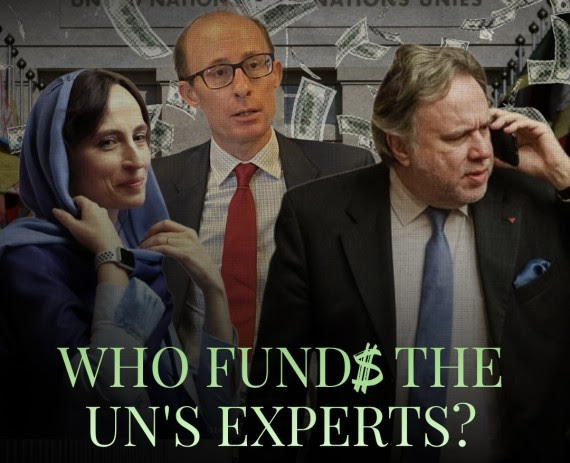
UN Watch – Releases Database Exposing Who Funds UN’s Human Rights Experts
At the British Parliament today, UN Watch launched the first-ever database tracking outside funding of UN human rights experts, exposing significant disclosure gaps involving politically engaged foundations and governments including China, Russia and Qatar.
UN Watch Executive Director Hillel Neuer presented the findings, along with the organization’s recent study on the UN rapporteurs, From Watchdogs to Ideologues, to members of Parliament, parliamentary staff, journalists and activists at a briefing chaired by MP Priti Patel, the Conservative Party’s international secretary and former British home secretary.
Also speaking on the dais for UN Watch were Daniel Radomski, Chief Strategy and Diplomacy Officer, and Luis Pelaez, UN Liaison and Research Associate.
The new database cross-references UN mandate-holders’ annual disclosures with U.S. tax filings, public grant records, and other documented financial support. It identifies approximately $88 million in grants and support for the UN rapporteurs, including estimated values for in-kind contributions.
The database identifies $11.8 million in cash and in-kind support omitted from mandate-holders’ annual UN disclosures.
$1.4 million in disclosed support failed to identify the donors.
More than $42 million is red-flagged for missing information, opaque sourcing or disclosure violations.
These findings raise serious questions about transparency and accountability within the UN’s human rights system. By cross-referencing annual UN disclosures with donor tax filings, public grant records and other sources, the database enables journalists, policymakers and the public to trace outside support, identify potential conflicts of interest and scrutinize the financial relationships behind UN-appointed human rights experts.
UN experts wield enormous influence over government policy, media coverage, and public debate. The public deserves to know who finances their work, where the money goes, and whether private donors are helping shape agendas that are packaged as independent UN expertise.
UN Watch’s database records that these UN experts received over $2.4 million from China and affiliated entities, $2.1 million from Russia, and a combined $174,000 from Qatar and Saudi Arabia, earmarked for specific mandates, including on counterterrorism, racism, and violence against women.
Among the findings:
Ben Saul, the UN expert on counterterrorism, received $150,000 from China then refused to issue any statements on China’s persecution of the Uyghurs, which Beijing justifies as “counterterrorism.” Yet, his new UN report accuses the U.S. of “crimes against humanity.”
George Katrougalos, Chair of the UN committee overseeing all human rights experts, received $100,000 from China in 2025 — the same year he praised Xi Jinping’s book and the Chinese dictator’s “vision of openness and dialogue.”
Francesca Albanese, the rapporteur on the Palestinian territories, disclosed no dollar value for financial support, while UN Watch estimates a $2.56 million footprint including $600,000 from undisclosed sources and tens of thousands from pro-Hamas groups.
Tlaleng Mofokeng, the former UN expert on health, failed to disclose a $200,000 Open Society Foundations grant to an organization she founded. She has said “Hamas are not terrorists,” endorsed “the legitimacy of armed struggle,” and promoted prostitution to teenagers.
Philip Alston, the prominent NYU law professor and former UN poverty rapporteur whose reports sharply attacked British and American policies, failed to disclose $600,000 in Open Society Foundations grants awarded to NYU to support work connected to his UN mandate.
UN Watch is calling for concrete reforms, including:
A coalition of democratic states to regularly assess, publicly rate and hold Special Rapporteurs accountable.
A complete ban on earmarked funding from governments or other external entities.
An independent external mechanism to review, audit and discipline mandate-holders.
External vetting of candidates by democracies, independent of the UN’s politicized selection process.
Mandatory evidentiary standards to end reliance on unverified and anonymous sources.
Democracies must insist that those who investigate others meet basic standards of transparency, impartiality and accountability themselves.
Israel Seen is a labor of love that is a portal to the other side of Israel. We provide content from a wonderful array of innovative, interesting, and dynamic Israelis.
Our content is rich in vision, compassion, education and understanding of the human condition. We probe the depths of our psyche, soul and physical presence
seeking out the questions and answers necessary to make the world a better place to live.
Israel Seen shares a variety of views
and opinions on Israel. We accept full responsibility for challenging and stimulating reevaluation of previous
beliefs and opinions.