
Nathan and Sarah Wolf (top left) and daughter, Blumi (bottom centre) with Sara’s sister and family (Curia, Portugal)
Stuart Kamenetsky & Ronit Zilbershats – The Wolf Family: Escape from Holocaust
“I would rather stand with God against Man than with Man against God”: The tale of one family saved by one righteous man

Aristides de Sousa Mendes
Introduction
According to the Talmud “Whoever saves a single life is considered by Scripture to have saved the whole world.” On May 10, 1940, a young Jewish couple living in Antwerp, Sarah and Nathan Wolf and their nine-month-old daughter, Blumi, faced a harsh reality that would shape the rest of their lives. Nazi Germany invaded Belgium as part of a rapid surprise offensive during World War II, which also targeted the Netherlands, Luxembourg, and France.
While the “Final Solution” – the Nazi plan for the systematic, state-sponsored annihilation of European Jews – did not begin until 1941, Jews were in fact viciously murdered by the occupying Nazis and their local accomplices. If not for the heroic efforts of one righteous gentile, Aristides de Sousa Mendes, a Portuguese diplomat who issued unauthorized visas allowing them to escape, their fate might have been the same as that of at least 65% (over 9,000) of Antwerp’s 13,779 registered Jews who were ultimately deported to concentration camps and murdered among the total of six million European Jews.

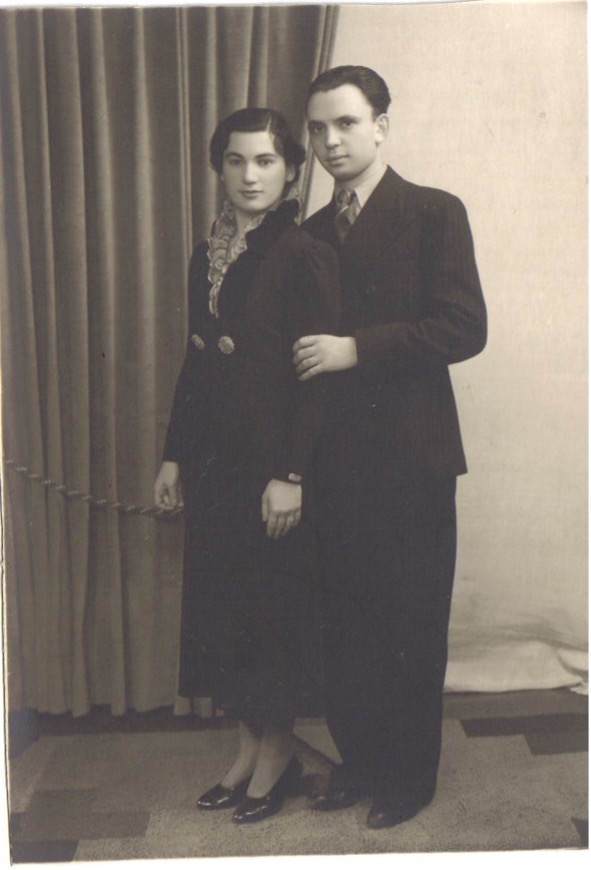
Sarah and Nathan Wolf at their engagement (Antwerp, 1937)
While the young Wolf family was tragically separated from their extended family for many years to come, they were among the fortunate Sousa Mendes visa recipients who were able to escape to Portugal and later to New York, USA, where they built a new life. They had two more daughters, Helen and Debby, ten grandchildren (as well as three step grandchildren) and several dozen great-grandchildren, many of whom are now parents themselves. The authors of this paper are two of the Wolf couple’s grandchildren. We are a family of hardworking and accomplished individuals – doctors, lawyers, professors, psychologists, rabbis, mental health workers, teachers, venture capitalists, high tech personnel and more.
The current rise in antisemitism, which has not been seen to this degree since the rise of Nazi Germany in 1933, as well as broader worldwide conflict and social unrest, compel us during these uncertain times to remember, reflect, and learn from the actions of an incredible individual, Aristides de Sousa Mendes, who followed his faith and acted selflessly towards other human beings in grave need. He did this for the sake of humanity, despite the heavy price that he ultimately paid. The following story recounts Sousa Mendes’ heroic decisions and actions, personalizing it with the tale of the very fortunate Wolf family who might never have survived otherwise.
The Sousa Mendes Story
Following the Nazi invasion of France and neighboring countries in June 1940, millions of refugees, including tens of thousands of Jews, fled from Nazi occupied Northern France to the south, hoping to cross the border into Spain before the Nazis arrived. The New York Times, for example, reported that in mid-June 1940 there were 6-10 million refugees on the roads of France, the largest migration in human history. That migration is remembered in France as “l’exode”’ as a kind of parallel to the Biblical exodus from Egypt. These refugees hoped to reach Portugal – the gateway west to the Americas which promised safety.
In Portugal, the dictator, António de Oliveira Salazar, made it difficult for stateless people to get visas to Portugal during WWII due to strict neutrality policies. Specifically, “Circular 14” issued on November 11, 1939, instructed diplomats to deny visas to stateless individuals, refugees from occupied countries and Jews, fearing they would stay permanently or “destabilize” the regime. As such, visas to Portugal were to be issued only with direct approval from the government in Lisbon and only after careful examination of each application. Most refugees wanted to use Portugal only as a temporary safe haven. Thousands of Jewish and other refugees, many of whom were either stateless or were Polish and other nationals who had escaped pogroms in Eastern Europe, concentrated in Bordeaux in the south of France in an attempt to obtain the desired visa allowing them to leave France and continue their escape through Spain, to Portugal and beyond.
Indeed, the Wolf family’s parents had escaped pogroms in Eastern Europe as did countless other Jewish families in the late 1800s and early 20th century. Such families headed to Western Europe and the Americas with hopes for a better future. A notable example is provided in the famous Broadway 1964 play and later 1971 film Fiddler on the Roof, which tells the story of Tevye, a poor Jewish milkman in early 20th-century Russia who is faced with the challenge of marrying off his five daughters amidst the growing tension in his shtetl (Jewish village) ultimately heading west with the few items he could carry with him, amidst uncertainty as to when or if they will ever reunite with their loved ones.
While countries such as Belgium took in Jewish refugees such as the Wolfs, they stamped their identification cards with large letters indicating that they were foreigners. While it was theoretically possible for Eastern European Jews to obtain Belgian citizenship, it was a long and difficult process. The vast majority of Jewish refugees from both major waves of migration (the 1880s and the interwar period of the 1930s) remained foreign nationals or stateless. The Wolfs, like many other Jews, were Polish, as the following ID cards show.

Sarah Wolf’s Belgian ID card indicating her foreign Polish status


Nathan Wolf’s Belgian ID card indicating his foreign Polish status
At the Portuguese consulate in Bordeaux, Aristides de Sousa Mendes, a devout Catholic and father of 12 living children (two others had died, and one was not yet born, for a total of fifteen), had been serving as Consul General since 1938. He had previously served as Consul General in Antwerp, where he was also the Dean of the Consular Corps. In Bordeaux, a friendship developed between him and the self-appointed representative of the Jewish refugees, Rabbi Chaim Kruger.
As the head of a large family, Sousa Mendes was sympathetic to the plight of the rabbi, who was trying to escape Nazi-occupied Europe with his own large family consisting of himself, his wife and their five children, ages 6-14. Consul Mendes offered to save him and his family by granting them a visa to Portugal, contrary to the Circular 14 edict. The rabbi heroically and courageously refused the offer, taking the moral position that unless Sousa Mendes would also take care of the many thousands of other Jewish refugees (“all of my brothers and sisters,” in the rabbi’s words) who were held up in Bordeaux and faced certain death should they not escape the advancing Nazi army – they wouldn’t go. Sousa Mendes sent dozens of telegrams to Lisbon with visa requests, but many went unanswered or were simply denied. In light of the developing humanitarian disaster, Sousa Mendes took matters into his own hands.
While the exact date is hard to pinpoint, on a day now remembered as his “Day of Conscience,” Sousa Mendes began to act contrary to the instructions from Lisbon and issued visas to anyone who wanted them. He set up a makeshift office inside the consulate and, with the help of two of his sons and several refugees, began to issue visas to enter Portugal. On the night of June 19, 1940, the Nazi Luftwaffe bombed Bordeaux to pressure the fleeing French government to surrender. Bordeaux served at the time as the provisional French capital and some 300,000 refugees were sheltering there at the time.
The bombing resulted in killing approximately 65 to 150 people and wounding a further 160 to 300, many of whom were refugees, spreading panic and fear. Hence, on June 20, 1940, many refugees fled to the city of Bayonne, which was closer to the Spanish border. Sousa Mendes left Bordeaux and advanced with the refugees to Bayonne, where he continued to issue visas. On June 22, 1940, a telegram was sent to Sousa Mendes from Salazar ordering him to stop issuing visas. He refused the order and further followed the refugees to the town of Hendaye on the border of Spain, where he continued to issue visas in makeshift conditions. He even accompanied some of the refugees on their way to the border crossing, in order to ensure that the visas he issued would be respected. Sousa Mendes also ordered the Portuguese vice-consul of Toulouse to issue visas in that city, equally besieged by refugees. On June 23, the Portuguese ambassador in Spain, Pedro Teotónio Pereira, sent a telegram to the Lisbon authorities describing Sousa Mendes as being “out of his mind.” Salazar recalled Sousa Mendes to Portugal, an order he received upon returning to Bordeaux on June 26. Sousa Mendes complied slowly, arriving in Portugal on July 8.
Despite direct orders, and in defiance of “Circular 14,” in May and June of 1940, Sousa Mendes distributed thousands of visas to Portugal, the majority of which were to Jewish refugees, the young Wolf family among them. Those who received a visa crossed the French-Spanish border at Hendaye-Irun. At that time, Spain was a chaotic place due to the civil war, and the atmosphere was tense and unsafe. It was also a physical wasteland compared by many refugees to Dante’s Inferno. The refugees hurried across Spain without stopping until they reached Portugal. They were, in fact, forbidden by Spanish law from remaining in Spain longer than 3 days, and as such were limited to a prescribed route.
When they arrived in Portugal, the refugees began to “breathe.” Many recalled an atmosphere of peace and meeting kind people all around. Vilar Formoso, the border village now known as the “Frontier of Peace” and the site of a museum memorializing this history, provided initial safety, food, and shelter for those crossing the border. The refugees who made it into Portugal stayed anywhere between a few weeks to a year and a half before sailing off mainly to the Americas. They were scattered throughout the country, including the cities of Lisbon and Porto, the fishing village of Figueira da Foz, the university town of Coimbra and elsewhere. The refugees were assigned by the PVDE, the Portuguese Secret Police, to these “fixed” or “forced” residences where they were required to live and were closely watched. Their passports were confiscated for the duration of their stay in Portugal and were only returned upon their departure. Sometimes families were required to move several times. For example, the Wolf family was sent first to Curia, then to Porto. The Portuguese authorities did not want the refugees to get too comfortable and attempt to remain in Portugal.
Sousa Mendes faced discipline in Lisbon for what he did. He was tried and accused of insubordination. As punishment, he was dismissed from the Ministry of Foreign Affairs and was deprived of his pension. He was also blacklisted and unable to find employment. His cherished family home, Casa do Passal, which was an elegant manor in Cabanas de Viriato, was repossessed by the bank, sold to creditors and fell into total ruin. His large family lived in humiliation and abject poverty to the point that they were dependent on meals at the soup kitchen run by COMASSIS, the Jewish refugee aid organization funded by the American Jewish Joint Distribution Committee (the “Joint”). The first time the Sousa Mendes family ate there, they explained that “we too are refugees.”
On April 3, 1954, Aristides de Sousa Mendes died, disgraced and penniless. His children fought for years to clear his name. Despite the suffering caused to the entire family, none of them ever expressed regret for his actions. One of his great-grandchildren, Jason Abranches, even proudly wears a tattoo with his great-grandfather’s quote: “I would rather stand with God against man than with man against God.” This statement is consistent with another statement he made to Rabbi Kruger: “If thousands of Jews can suffer because of one Christian (i.e., Adolf Hitler), then surely one Christian is allowed to suffer for so many Jews.”
Sarah and Nathan Wolf at their engagement (Antwerp, 1937)
Growing up, the story of our grandparents, Sarah and Nathan Wolf’s escape from the Nazis was epic – no lesser than the biblical story of the exodus from Egypt. On May 15, 1940, the Wolfs escaped from Antwerp towards the French border. They would have left earlier, but 9-month-old Blumi was sick, and they decided to wait until she felt a bit better. The Wolfs took Nathan’s talit (prayer shawl) and tefillin (phylacteries – two small black leather boxes containing Torah parchment scrolls, worn by adult Jewish men during weekday morning prayers), an infant bottle with milk and diapers for baby Blumi, leaving behind the rest of their belongings.
Sarah’s father hired two taxis and divided the family into two groups. One group was comprised of the two young families (the Wolfs and Sarah’s older sister’s family), and the second group – Sarah’s parents, her two younger siblings and a cousin. Sarah later lamented the fate of the poor Jews she saw sitting on their suitcases at the train station and appreciated that her family had the means to hire taxis. While not completely clear, it appears that the first taxi drove the Wolfs through Ghent (completely destroyed by then) and arrived at the coastal town of Ostend. One version of this story suggests that the women and children travelled by taxi whereas the men walked (120 km!) and after much worry they found one another. Meanwhile, the driver of the second taxi stopped at a bar and got drunk, preventing Sarah’s parents’ group from continuing their escape.
From Ostend to the French border, Sarah and family travelled by single-ox cart and eventually crossed the border into France on foot. The entire journey was dangerous and included travel by makeshift means, seeking shelter at times from bombings, avoiding Nazi soldiers, and included unavoidable fateful separations. Once in France, they travelled by taxi and then by train to Paris. On the way to Paris the tracks behind them were bombed. They later found out that they had been on the last train that made it south to Paris.
The two groups were to meet at the Lafayette Hotel in Paris, where Sarah’s father often stayed when on business. Sarah, her sister and their families waited for a day and a half for her father’s group, which never arrived. They argued about whether or not to wait any longer. On June 3, 1940, the Nazi Luftwaffe launched a devastating bombing raid on Paris and its suburbs, famously known as Operation Paula, during the Battle of France, resulting in 254 casualties. Nathan, understanding the risks of waiting, insisted that they immediately continue their trip south to Bordeaux (about 600 km) and attempt to secure passage to Portugal. They left a message at the hotel in the hope that their parents would follow them. They escaped Paris on foot and other makeshift means along with thousands of helpless refugees, sleeping at times in decrepit conditions.
In Bordeaux they met other refugees from Antwerp. Our grandparents never mentioned that they got a visa from Sousa Mendes there nor did they discuss their experience at Bordeaux. It is possible that they suffered immensely due to the humanitarian crisis of thousands of refugees attempting to survive the Nazi bombings, and the uncertainty about securing visas. Perhaps this experience was too painful for them to share, and they wanted to shield us from it. It is also possible that Sarah didn’t know how Nathan obtained the visas, as such matters were taken care of by the men. It appears that while Sarah’s sister had a passport, the others only had Belgian identity cards – a fact that may have made it more difficult for them to obtain visas.
In the meantime, Sarah’s parents, unable to make it out of Belgium, found themselves in a rural area that had been occupied that night by the Nazis. They figured that since it was already occupied territory, it may be safer for them to return home to Antwerp than to try to escape, not knowing or able to imagine the fate that awaited them with this decision. Between the Nazi occupation of Antwerp in May 1940 and the peak deportations of the Final Solution in the summer of 1942, Antwerp’s once-thriving Jewish community was systematically impoverished, stripped of civil rights, and terrorized by local collaborators and German occupiers. For example, On April 14, 1941, a Flemish paramilitary mob armed with iron bars attacked and burned two synagogues and threw the Torah scrolls onto the street. They then attacked the home of Marcus Rottenburg, Antwerp’s Chief Rabbi. The police and fire brigade were summoned but were forbidden to intervene by the German authorities.
Once the Final Solution was implemented, Sarah’s parents knew that it was just a matter of time until they too would be rounded up. Indeed, records show that most Antwerp Jews who perished in the Holocaust were murdered in the gas chambers of the Auschwitz-Birkenau extermination camp. Sarah’s father buried the silverware and other valuables just in case they would somehow survive and return home. When the deportations began, while he wanted to go with the rest of his community to the camps, he declared that “you don’t put your head in the lion’s mouth!”. He turned to a business contact for help in finding a hiding place for his family. They managed to hide in Brussels until the end of the war. Sarah’s two younger siblings, who had fair features and as such were indistinguishable from other Belgians, occasionally went out to buy provisions. Records show that at some point, one of them was at the Boulogne-sur-Mer Jewish forced labor and internment camp in France. They all survived the war but scattered around the world.
The Wolfs continued their journey towards Spain through the French coastal border town of Biarritz and from there to Bayonne, and like so many others, crossed the “Bridge to Freedom” from Hendaye (France) to Irun (Spain). According to the family tale, they travelled from France to Spain in a hay wagon. When they reached the border, the gate closed right in front of them. A friend they knew from Antwerp stood next to them and tried to bribe the guards to allow the Wolfs in, but the guards refused. One wonders why they were not allowed in, given the fact that they had a visa to enter Portugal issued by Aristides de Sousa Mendes. We know that several days later, the border guards were in fact ordered to refuse entrance to refugees who were issued visas by Sousa Mendes. As it turns out, rumors circulated that the gate would open again and eventually it did. In Spain, after some confusion, they boarded a train that took them to Portugal. Initially, Sarah boarded an empty train heading back to Paris by mistake. Fortunately, Nathan got her off that train at the last minute and they continued their journey to Portugal.
The Wolfs first arrived in Vilar Formoso on June 25 or 26, 1940, and from there were sent directly to Curia, where they stayed until November 17, when they were transferred to Porto. Like other Jewish refugees in Portugal, they were supported by COMASSIS with funds that came from the Joint. As a speaker of many foreign languages, Nathan became friends with and served as translator for the American Consul in Porto. The legend goes that they were both opera lovers and that Nathan sang beloved Italian opera arias for him, which perhaps contributed to the American Consul’s ultimate decision to issue the Wolfs a visa to the US, which they obtained on February 10, 1941.
While we don’t possess the original documents signed and stamped with the visas, it is most likely that these were issued in Bayonne. The COMASSIS-issued documents provided by the Sousa Mendes Foundation (see the one issued for Nathan Wolf below) confirm the arrival date of June 26, 1940 in Curia, Portugal.

COMASSIS document confirming Nathan’s arrival to Curia and later to Porto with information concerning potential US relatives that may provide an affidavit to sponsor their visas to the U.S.
Consistent with this information is the picture below. The names in the COMASSIS documents match the people shown in this family picture indicating the Curia location. It is also well established that no one except for Sousa Mendes was issuing such visas to Portugal at that time.
Nathan and Sarah Wolf (top left) and daughter, Blumi (bottom centre) with Sara’s sister and family (Curia, Portugal)
As soon as they felt safe in Portugal, they sent postcards to Antwerp to let their parents and families know that they were alive.

Postcard sent by Sarah’s brother-in-law to her father in Antwerp with a brief greeting to let the family know they had successfully reached Portugal. (Curia, Portugal, November, 1940
Sarah’s parents also reached out to refugee camps and Jewish organizations in various countries in the area with the hopes of receiving a sign of life from their two daughters and their families. Eventually the connection was made. One could only imagine the sense of relief when they all found out that their loved ones were alive.
During the years of the war and its aftermath, many Jewish survivors desperately tried to track down their loved ones, often to face the incomprehensible reality that many of them had been murdered by the Nazis and their accomplices in concentration camps, death marches and other cruel means. Sarah’s sister’s family received a visa to Brazil but didn’t want to leave Sarah and family behind. Eventually they left, as the risk of staying in Europe was too high.
Like many others, Sarah sent postcards to distant relatives in the US hoping to obtain a sponsorship affidavit necessary for the issuance of a visa. While one relative she contacted did not have the means to provide them with the requested affidavit, he managed to connect Sarah with her third cousins who sent the coveted affidavit, thanks to which they were able to obtain the long-awaited visa. In April 1941, after a nine-month stay in Portugal, the Wolfs sailed from Lisbon to New York with little Blumi on the ship Nyassa to start their new life in the United States. They would be alone in a new country and face significant challenges, but were forever grateful for what many Jews called “the Goldene Medina (country)” – the first nation to welcome them and eventually grant them citizenship since their parents had escaped from the Eastern European pogroms decades earlier.

Wolf’s US Citizenship document
We will never know why our grandparents never mentioned Sousa Mendes nor why they never discussed what was likely a traumatic experience along their escape route. Many Holocaust survivors never told their stories to their families. Those who survived concentration camps, notorious death marches and other atrocities experienced post-traumatic stress disorder. Many of them courageously refused to look back and succumb. They worked hard, got married, had children and proved that light is stronger than darkness. Our family was one of the lucky ones. We now know that if Sousa Mendes hadn’t acted as he did, it is possible that our large and beautiful family may never have been created. May we all learn from the example Sousa Mendes set and act to help those around us who are in desperate need.
Epilogue
Aristides de Sousa Mendes’ name was finally cleared in the 1960s, and he is now recognized among the Righteous Among the Nations (e.g., Oskar Schindler, Raoul Wallenberg, Chiune Sugihara) who saved Jews during the Holocaust. The following is a partial chronology of only some of the many awards and symbols of recognition and Sousa Mendes received:
1961: David Ben-Gurion, the Prime Minister of Israel, ordered that twenty trees be planted in his memory by the Jewish National Fund (JNF/KKL)
1966: Yad Vashem recognized Sousa Mendes as a Righteous Among the Nations.
1987: The Portuguese Republic granted him a posthumous Order of Liberty medal, one of that country’s highest honours.
1988: The Portuguese parliament officially dismissed all charges, restoring Sousa Mendes to the diplomatic corps by unanimous vote, and honoring him with a standing ovation. He was promoted to the rank of Ministro Plenipotenciário de 2ª classe and awarded the Cross of Merit.
1994: Former President Mário Soares dedicated a bust of Sousa Mendes in a Bordeaux park.
1995: A national homage was held for Sousa Mendes in Lisbon, during which a commemorative Portuguese stamp was issued and President Mário Soares declared Sousa Mendes to be “Portugal’s greatest hero of the twentieth century.”
1996: Parc de Sousa-Mendes, a playground in Montreal, Canada, was dedicated in his honor.
2010: The Sousa Mendes Foundation was formed in the United States
2013: A Toronto playground was renamed, honouring Aristides de Sousa Mendes,
2016: An oratorio titled “Circular 14” was composed by Neely Bruce, detailing the life of Sousa Mendes, and was performed in Los Angeles and later in Utah, filling the 2500-seat Mormon Tabernacle.
2020/2022: A public square on Zangvil Street in Jerusalem was inaugurated in his name (the sign was placed in the ground in June 2020, commemorating the 80-year anniversary of his action, but COVID delayed the ceremony until 2022)
2024: Finally, and perhaps most notable, is the Aristides de Sousa Mendes Museum. On 19 July 2024, Sousa Mendes’ birthday, the museum opened its doors. It is located in the mansion, Casa do Passal, that Sousa Mendes forfeited to creditors upon his death, and that was left for decades to decay in a state of ruin. The museum, which has risen from the ashes like a phoenix, showcases objects and documents from the Sousa Mendes family and the Sousa Mendes Foundation and tells his inspiring story.
Selected sources for further information:
Sousa Mendes Foundation: https://sousamendesfoundation.org/
Yad Vashem: https://www.yadvashem.org/righteous/stories/mendes.html
With God Against Man (film): https://www.youtube.com/watch?v=KYKevUrcoaw&t=27s
Disobedience: The Sousa Mendes Story (film): https://vimeo.com/ondemand/disobedience
STUART KAMENETSKY – RONIT ZILBERSHATS

Stuart Kamenetsky
BIONOTA Stuart Kamenetsky, Ph.D is a Professor in the Teaching Stream at the Department of Psychological & Brain Sciences at the University of Toronto, Canada. His primary area of scholarship and teaching is disability and inclusion. He has contributed to the development of experiential learning courses and has taught internationally in Siena, Italy, Oxford, UK and Kyoto, Japan.

Ronit Zilbershats
BIONOTA Ronit Zilbershats, Ph.D is an independent scholar in Israeli Studies and Archaeology. She is also an educator, having taught at both high school and university. She currently manages a digital archive as well as several community projects for historical preservation in Israel.
Acknowledgment: Many thanks to Olivia Mattis, Ph.D. President of the Sousa Mendes Foundation for her valuable historical contributions and for Micaela Ziv for her editorial comments.
Note: This article was originally published at: TeclaXXI Multimedia cultural magazine and can be found in two parts at:
https://teclarivistaonline.blogspot.com/2026/09/the-wolf-family-escape-from-holocaust-i.html
and
https://teclarivistaonline.blogspot.com/2026/09/the-wolf-family-escape-from-holocaust.html