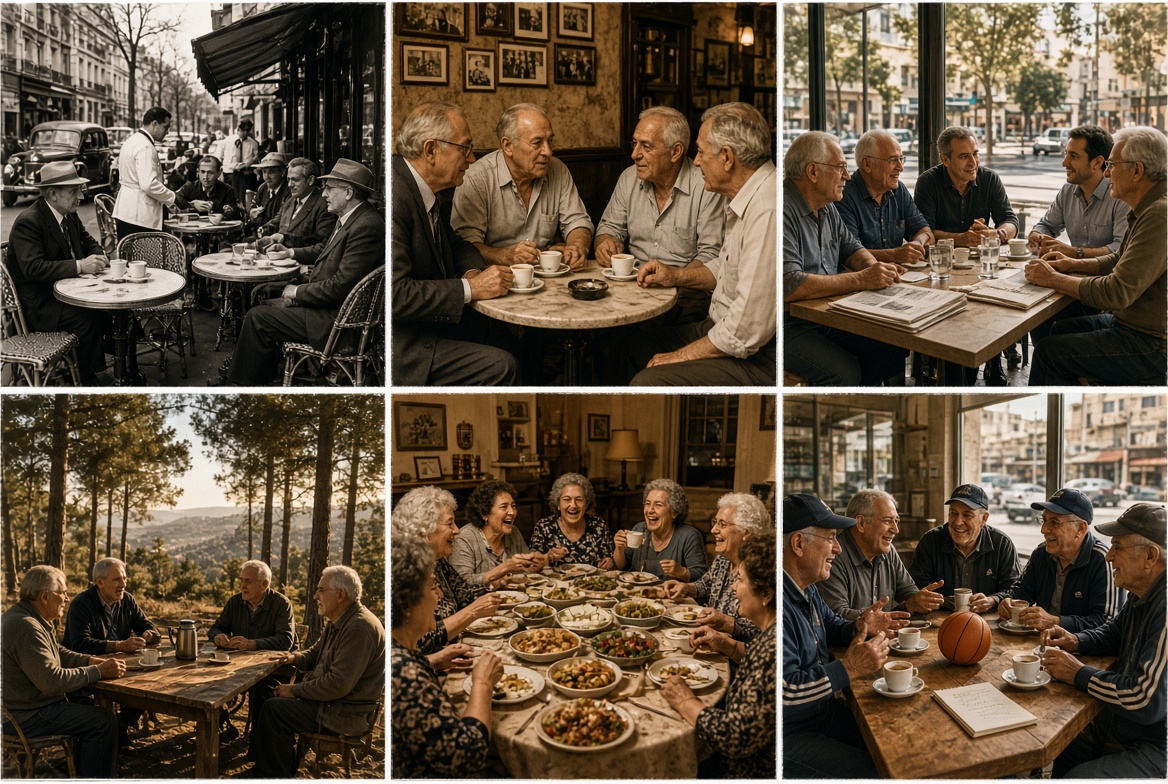

Grok AI
Shelly Schreter – “Political Arguments Can Break Up Friendships of Decades”: The Parliaments of Israel’s Senior Citizens
In Jerusalem they have been meeting for 40 years; at a café near the Habima Theater you can find Moni Moshonov’s crowd every day; and in Afula they argue about sports and politics. The “parliaments” of Israel’s senior citizens prove that sometimes all you need is a regular table, a few chairs, and plenty to talk about. | Ninth article in a series about Israelis of retirement age
Weekend Magazine, Ynet, September 18, 2026
Yael Weltzer

“We’re old people,” Shuki Ben-Ami, 79, tells me with complete seriousness. “It’s hard to fool us, and nevertheless, we still try to hope that things will get better.”
Ben-Ami’s veteran parliament is only one of thousands throughout the country—groups of senior citizens who for years have made a point of meeting every week, usually in the same place, in a tradition known as a “parliament.”
Ben-Ami is one of the founders of the “Jerusalem Parliament,” a weekly gathering of friends that originated on Israel Radio’s Reshet Alef on Friday mornings.
“There are many parliaments in Jerusalem and throughout Israel,” he says. “The trick is keeping a parliament going for years. I don’t know many others like ours that have been meeting regularly for 40 years—and will continue to do so.”
It’s All Talk

קפה דה פלור ב-1949 (צילום: AP Photo/Heckly)
For senior citizens, the parliament is a way of adding meaning to life, relieving loneliness, maintaining contact with old friends and continuing to feel relevant.
The term “parliament,” derived from the French parler—to speak—is generally associated with a legislative body, but in Israel it is also used for regular weekly gatherings of friends, where longtime acquaintances sit and talk for hours, usually at the same café.
One of the associations that comes to mind is the Café de Flore in Paris, which during the first half of the twentieth century became one of the centers of the city’s intellectual and cultural life. Jean-Paul Sartre and Simone de Beauvoir virtually made it their permanent office. Its patrons over the years included Albert Camus, Ernest Hemingway and Pablo Picasso, and later Yves Saint Laurent and Brigitte Bardot.
Israel’s first parliaments began in Tel Aviv and Jerusalem even before the establishment of the state, and most participants were poets and artists. At Café Kassit and Café Batya in Tel Aviv, Nathan Alterman, Avraham Shlonsky, Alexander Penn, Leah Goldberg and others were regulars. Between drinks they discussed weighty matters—or engaged in gossip.
Over the years other prestigious gathering places were added, among them the legendary Café Tamar on Sheinkin Street in Tel Aviv, where media and cultural figures sat and “ran the world” under the watchful eye of its owner, Sarah Stern. In recent years places such as Tahtit, Café Habima, Nechama VaHetzi, Cantina, and Reviva and Celia have joined this distinguished list.

Moshe “Kasit” (right) and Arik Einstein (left) at the “Parliament” in Café Kasit
(Photo: Tova Reshef, *HaOlam HaZeh* archive)
In Israel today, the parliaments consist primarily of people over 60 who have established a regular tradition of meeting once or twice a week in neighborhood cafés or private homes. Usually they gather to discuss personal, social, public and political matters. Most parliaments, it should be noted, are exclusively male.
One particularly popular venue is the Dubnov 8 bar-bistro in Tel Aviv. Groups of lawyers and accountants, businesspeople and politicians meet there regularly, particularly on Fridays. Partnerships have been formed, deals concluded, and close friendships established there.
Another regular meeting place is Café Noir, a well-known Tel Aviv culinary institution for the past 40 years, where groups from the worlds of business, media and the arts can regularly be seen.
An Island of Sanity
“For the past three years, almost every day at 11:00 in the morning, I come to Ben Zion Boulevard, to a café near the Habima Theater, where our regular parliament, ‘Moish’s Parliament,’ meets, and I stay until 2:00,” says theater and television actor Poly Reshef, 76.
“The regular core is about eight people, mainly people from the cultural world and journalists, but additional friends join us every day. On weekends it can reach 20 people. Most of us are seniors, but not everyone. My son, Nimrod Reshef, also joins us two or three times a week.”

Ziv Rubinstein (center) and Moni Moshonov (to his left) at Moish’s “parliament” (Photo: Moti Kimchi)
Among its regular participants are attorney Michael Levin; actor Moni Moshonov; creator and musician Ziv Rubinstein; press photographer Moti Kimchi; actors Michael Aloni and Tomer Sharon (“Tomash”); and film lecturer Yonatan Gat.
“At first,” Reshef continues, “we met at Café Tamar. After it closed we moved to Rothschild Boulevard, but when the place became too partisan and too right-wing and people started shouting, Ziv and I migrated to our present location.
“We talk politics here too, and although most of us are on the left side of the political map, when people from the right join us the discussion remains substantive and doesn’t become heated. We talk about everyday matters and a great deal about art and film.”
What need does regular participation in the parliament satisfy for you?
“Primarily an intellectual need. We have become accustomed to the conversations, the friendships and the intellectual stimulation between us.
“At Rosh Hashanah, chef Leon Alkalai, who used to be a regular member, called us. He now lives in Berlin and called to tell us how much he misses the parliament.
“The parliament has become a family for us. There are weeks when I see Moish, Ziv and Michael more often than I see my family. Sometimes the wives join us, including my partner Ronit Hershkovitz, but those are isolated occasions.
“I need these meetings. They are an island of sanity amid conversations about the insane things unfortunately happening here. Together we try to understand what is going on, and we hope for the best.”

Poli Reshef (right) at Moishe’s “Parliament” (Photo: Moti Kimchi)
Missing Haim Banai
The conversation with Ben-Ami of the Jerusalem Parliament takes place at the Zippori Center in the Jerusalem Forest, where the members have been meeting monthly for about two years.
“We started coming here after Radio Jerusalem threw us out by force, even though our program was very popular,” Ben-Ami says, sounding partly angry and partly amused.
Threw you out?
“You have to understand: when I began broadcasting with the parliament on the radio, I was the youngest participant, the ‘Benjamin’ of the group. Today I’m among the tribal elders, and I know a thing or two about life.
“Two years ago I learned what you aren’t allowed to discuss in the Israeli media. We talked about two things that apparently you’re not allowed to discuss in Israeli democracy: the prime minister and the Messiah. So in June 2024 they kicked us out.”
After leaving, the members looked for alternative meeting places. Eventually they began meeting every Friday at Protea BaYaar in the pastoral community of Shoresh.
“There we continue listening to and talking about the stories of the week that has passed, crying over what we don’t have and what we do.”
The names of the Jerusalem Parliament’s participants, as Ben-Ami lists them, in many ways tell the story of the country.
Ben-Ami himself is known as “the Chief,” both because of his role and because of time he spent on Native American reservations after leaving the ultra-Orthodox world.
Participants have included Israel Prize-worthy national figures and veterans such as Uri Ehrenfeld, a Yom Kippur War POW who folded the Israeli flag at the Mezach outpost after it fell to the Egyptians; social activist and advertising executive Sami Alkalai; Itzik Shechter; writer and storyteller David Monshain; municipal adviser Ofer Ayubi; Danny Avihail; and Meir Micha, owner of the Pinati restaurant.
Ben-Ami also recalls members who have died, among them Haim Banai.
He tells of a trip they once took to Dimona. After hearing about an excellent restaurant serving stuffed dishes, they stopped a woman to ask directions. She made a phone call in Moroccan Arabic, then asked them to drive her and said she would direct them.
They arrived in an old neighborhood.
“‘Where’s the restaurant?’ we asked. When we got out of the car, we met the woman’s husband standing there waiting for us with a towel over his shoulder. We went into their home, and it was one of the best meals we ever ate. We stayed until evening.”
Do you discuss politics?
“Look, political arguments break up families and can break up parliaments. Most of the people in our parliament do not support government policy, so in our case there aren’t political arguments. There is discussion and presentation of facts.
“In addition to the meetings at Protea, once a month we meet at our new home at the Zippori Center. There we hold a meeting with an audience dealing with important current issues. At our most recent meeting, for example, the subject was law, with judges and lawyers, serving and retired, as guests. It was fascinating.”
How involved are wives and families in the parliament?
Ben-Ami responds with a story about a parliament member who bought a metalworking shop from the widow of another member. Among the former owner’s papers he discovered a partnership agreement containing a clause stating that as long as the partnership continued, wives would not visit the workshop.
When he asked the widow whether she had known about it, she said yes, explaining that when women get involved in men’s businesses, nothing good comes of it.
“The moral is that a parliament is a parliament, and women have nothing to do with how it operates. When people complain to me that there are no women, I say, tafaddal—you’re welcome. I’ve always invited them. But those who did come stopped after a few meetings. Women are less interested in nostalgia; they like the future and always want to feel young.”
What do all these meetings give you?
“There’s a story about a man who regularly sat beside the Western Wall beginning in 1967. About 40 years later, a woman approached him and asked what he got out of sitting there all the time. He looked at her and asked, ‘Have you ever tried talking to a wall?’
“We’re the same. We talk to a wall, but in this way we relieve tension and contribute something to one another. It creates a framework.
“Look at nearby countries such as Greece and Cyprus, and parts of Europe too. Men sit and talk, with a cigarette and prayer beads in their hands. Sometimes they play ball; sometimes they roll the beads.”
Jerusalem has more than 20 parliaments in various neighborhoods, some of them part of the “Parliaments in Cafés” project. Through its Department for Senior Residents in the Welfare Division, the municipality has created a social-support network intended to reduce loneliness among older residents who regularly attend these gatherings.
Farther north is the Emek Parliament, one of northern Israel’s legendary cultural institutions, bringing together veteran residents of the Jezreel Valley. Since 1981, its members have met regularly in an old building near a horse farm at Kibbutz Yifat. Under director-general Moshe Tarshish, it holds Israeli song gatherings, discussions of current and social issues, and appearances by Israeli artists.
There are also many private parliaments in the north.
“My parliament has more than 70 people, aged 50 and over, as well as some younger people,” says Nizar Mahamid, the owner of a café in Umm al-Fahm. “Everyone comes regularly, once a week, to my café. We sit and talk about everything—women and men together. Sometimes we meet at my home. We have a barbecue and talk about the situation.”
What do you talk about?
“We’ve been meeting for several years. In the past we also joked around a lot, but unfortunately the situation in the Arab community is very difficult and sad right now.
“Every day people are being killed and murdered, and there is no police force acting to stop this terrible situation. What is this? Where are we living? Am I in Gaza?
“How can children be afraid to go to school, wake up at night to the sound of gunfire, while more and more people are murdered and nothing is done?
“We’re all worried and waiting for the elections. Netanyahu and Ben-Gvir will go home, and someone good will come who will change everything.”
Who is this “someone good”?
“There are enough good people. Everyone in the group wants peace. We all had a problem with October 7. We were hurt and saddened by it. No one here would dare shout ‘Death to the Jews.’ The Quran forbids killing a Jew; it forbids burning children. It’s terrible.
“We talk about the situation and agree that we’ll be happy when we no longer have to fear what is happening in our community, and when all of us can go hand in hand and bring peace and quiet to the country.”
The Women’s Answer
“We’re ten women who have been meeting at least once a month for 30 years,” says Ricky Adin, 67, from Afula.
“Each time we meet at a different home, in Afula or the surrounding area. We also go out together and take trips. We’re all over 60, and some of us—including me—are still working.”
A parliament that has lasted even longer than many marriages do these days.
“That’s right,” she says, laughing. “Our formula works. Every meeting has content, good food prepared by the hostess, and the happiness of seeing one another. We’ve been together for 30 years. We’ve been through good times and bad; we are partners on the journey.”
What does it give you?
“There’s a feeling of togetherness, of belonging. The group is closed: no new friends come in, nor do spouses.
“Over the years a true friendship has developed. We know one another, listen to one another, help one another and go through life together. The older you become, the more important a group like this becomes.”
Erik Katz, now over 88, has also run a parliament in Afula for the past four years, an all-male group centered on sports.
Katz, formerly a physical-education teacher in Afula, brings together a group of men every Monday from 9:30 to 11:00 at Café Greg. All are successful former athletes or former physical-education teachers.
The parliament was founded by Yossi Harari (“Boiler”), formerly one of the city’s outstanding basketball players and coach of Elitzur Netanya in the late 1980s, who serves as the parliament’s chairman, together with Nimrod Brin, another well-known local athlete.
“We have about 25 regular parliamentarians,” Katz explains.
So is the whole world sports?
“No. The conversations are about sports, but not only sports. We also discuss current events and other subjects. However, we have a tradition of hosting someone connected in some way with sports at every meeting.
“For example, recently we hosted retired Major General Tal Russo for a lecture, and he brought Barak Peleg, coach of Hapoel Galil Elyon, who established a new basketball team in the Gaza border region six months after October 7.
“We have a long list of speakers, although recently the members asked for fewer lecturers and more time for our own conversations. We’ll continue doing both.”
What does it give you and the others?
“I recently read Keep Sharp by Dr. Sanjay Gupta, which presents research-based insights about maintaining cognitive health at any age. One of its insights concerns the importance of social connections—having a reason to get up in the morning after you’ve finished working, and volunteering.
“The parliament makes a social and intellectual contribution to every one of us. For me, the value of each of these weekly meetings is beyond measure.”

Riki Adin (third from right) with her women’s parliament.
Summary
Weltzer’s article examines the distinctively Israeli institution known as the “parliament”: an informal, recurring gathering—usually in a café—whose members meet to talk about politics, current events, culture, sports, memories and their personal lives. Although the term is humorous, the article argues that these groups perform a serious function for older Israelis: they provide friendship, intellectual stimulation, routine, belonging and protection against loneliness.
The tradition has deep roots. Before statehood, cafés such as Kassit and Batya served a similar function for writers and artists including Nathan Alterman, Avraham Shlonsky and Leah Goldberg. The modern version is predominantly a phenomenon of people over 60, meeting once or twice a week, and remains disproportionately male.
The article profiles several variations. “Moish’s Parliament” in Tel Aviv, attended by cultural figures including actor Moni Moshonov, functions as what Poly Reshef calls an “island of sanity.” Its members discuss politics but consciously try to prevent political disagreement from destroying friendship. For Reshef, the group has become almost a substitute family and satisfies an important intellectual as well as social need.
The Jerusalem Parliament, associated with 79-year-old Shuki Ben-Ami, is the most venerable example, having existed for about 40 years. Ben-Ami makes one of the article’s central observations: “Political arguments break up families and can break up parliaments.” His group therefore discusses politics but attempts to avoid destructive political confrontation. The parliament also provides continuity: members remember deceased friends, exchange stories and meet publicly to discuss current affairs with experts.
Weltzer deliberately broadens the picture beyond the older Jewish male café culture. In Umm al-Fahm, Nizar Mahamid runs a mixed-gender parliament of more than 70 people. Their conversations increasingly concern the epidemic of violence and murder in Israel’s Arab community, frustration with policing, October 7, Jewish-Arab relations and hopes for peace.
She also presents a distinctly female counterpart: ten women in Afula who have met monthly for 30 years. Ricky Adin describes the group not principally in terms of debate but of belonging, listening, mutual assistance and “going through life together.” Her observation perhaps states the article’s underlying point most clearly: as people grow older, groups of this kind become more important, not less.

Arik Katz’s Parliament (Photo: Private collection)
Finally, the Afula sports parliament led by Erik Katz, over 88, illustrates the connection between regular social contact and successful aging. Its members are former athletes and physical-education teachers who meet weekly to discuss sports and current affairs. Katz explicitly links the parliament to cognitive health: retirement creates a need for social connection, intellectual engagement and a reason to get up in the morning. He considers the weekly meeting “beyond measure” in value.
The article’s larger theme is therefore aging through community. These “parliaments” may outwardly consist of little more than older people sitting around a table talking, but Weltzer portrays the talking itself as important: it maintains friendships and identity, combats isolation, preserves intellectual engagement, provides routine after retirement, and gives participants a continuing sense that they remain connected to—and have something to say about—the society around them.