
Sabine Sterk – You Reap What You Sow, The Netherlands
When a Nation Normalizes Hatred, It Should Not Be Surprised When Terror Comes Knocking
On October 7, 2023, the world witnessed one of the most barbaric massacres of Jewish people since the Holocaust. Hamas terrorists invaded southern Israel, slaughtered families in their homes, murdered young people attending a music festival, burned houses, mutilated bodies, committed acts of sexual violence, and dragged innocent civilians into Gaza as hostages. Babies, children, women, elderly people, and entire families became targets of an organization whose ideology glorifies the destruction of Israel. Approximately 1,200 people were killed, and 251 were taken hostage. These atrocities were not invented by Israeli propaganda departments, nor were they fabricated by the Israeli government. They were documented through eyewitness testimonies, forensic evidence, photographs, videos, and investigations by international human rights organizations. Human Rights Watch concluded that Hamas and other armed groups committed war crimes and crimes against humanity. Yet, astonishingly, we live in a world where people continue to deny, minimize, justify, or even celebrate what happened that Saturday morning.
What disgusts me almost as much as the massacre itself is the extraordinary speed with which the victims became the accused and the perpetrators became the supposed heroes of resistance. Before Israel had even begun its military response, people were celebrating the slaughter of innocent Israelis. The familiar excuses appeared almost immediately. Context, occupation, resistance, liberation. Apparently, there are people who believe that political grievances can somehow justify executing civilians in their bedrooms, attacking music festivals, or kidnapping elderly women. Let me make something perfectly clear. No political cause, no territorial dispute, and no historical grievance can justify the deliberate massacre of innocent people. Anyone who cannot understand that has lost the most elementary sense of human decency.
And nowhere does this moral confusion disgust me more than in my own country, the Netherlands. A country that proudly lectures the rest of the world about human rights, international law, tolerance, democracy, and morality, while simultaneously allowing an atmosphere to develop in which hatred of Israel is increasingly normalized and antisemitism is conveniently disguised as political activism. Of course, people have every right to criticize the Israeli government, protest the war, and demand protection for civilians in Gaza. But there is an enormous difference between legitimate political criticism and glorifying an internationally designated terrorist organization. There is an equally enormous difference between demanding peace and creating an environment in which Jewish people feel threatened simply because they are Jewish.
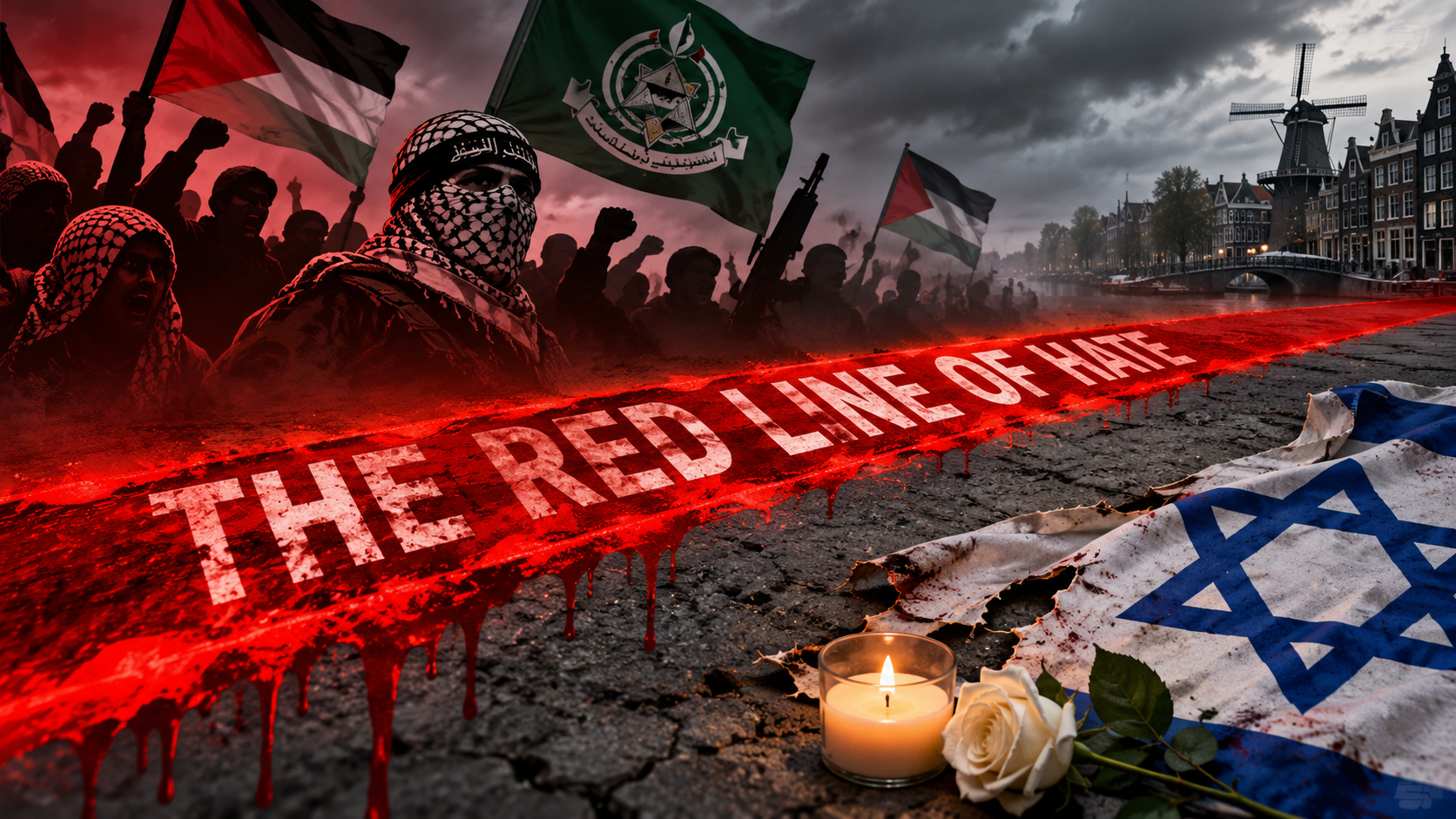
And now, on Sunday, November 8, another so called Red Line demonstration is scheduled to take place in Amsterdam. Among the announced speakers are Omar Barghouti, cofounder of the international BDS movement, and Medhat Alamawi, associated with the Palestinian Community in the Netherlands, PGNL. Both have been mentioned in reporting concerning organizations or networks with alleged connections to Hamas or other extremist groups. These reported associations do not establish that either man is personally a Hamas member, and that distinction matters. Nevertheless, I find it deeply disturbing that such questions apparently do not warrant greater public scrutiny before these individuals are welcomed onto a prominent platform at a demonstration supposedly dedicated to human rights. Have the organizers examined these allegations? Have they publicly explained their decisions? Or has opposition to Israel become such an overriding priority that uncomfortable questions about the people invited to address thousands of demonstrators are simply brushed aside?
I have absolutely no objection to peaceful demonstrations, even when I profoundly disagree with their message. Freedom of expression is one of the foundations of democracy. But freedom of expression does not exempt organizers from moral responsibility. When speakers have been associated in credible reporting with controversial networks, transparency should be the minimum requirement. And when a demonstration claims to represent justice, humanity, and peace, surely its organizers should be particularly careful about any possible association with movements that excuse or glorify violence against civilians. Otherwise, what exactly is the red line supposed to represent? A universal moral boundary, or merely a political boundary that disappears whenever Israelis are the victims?
The Dutch intelligence service, the AIVD, has warned about a Hamas network operating in the Netherlands, involved in propaganda, lobbying, and fundraising. Its reporting has also raised concerns about activities connected to broader activist environments. That does not mean every demonstrator is a terrorist supporter, nor does it establish that the Red Line demonstration is organized by Hamas. But it does mean the Netherlands has a genuine security problem that deserves serious attention. We are not discussing imaginary threats invented by people who support Israel. We are discussing warnings from the country’s own intelligence authorities.
And still, the Netherlands continues to behave as though the greatest danger to its democracy comes from people who dare to expose these developments.
I have spent decades defending Israel, and I have watched the transformation of Dutch society with growing disbelief. What once would have been universally condemned as terrorist propaganda is now too often presented as revolutionary language. Slogans are repeated without understanding their implications, violent extremists are romanticized as freedom fighters, and anyone questioning the ideology behind these movements risks being branded an extremist themselves. How profoundly absurd that people defending a democratic country against a terrorist organization are treated as morally suspicious, while those making excuses for terrorism are sometimes celebrated as courageous human rights activists.
And remember Amsterdam in November 2024, when Israeli football supporters were hunted, assaulted, and terrorized in the streets of our capital. Jewish and Israeli visitors were forced to seek shelter while attackers pursued people they associated with Israel. This happened in the Netherlands, a country whose history should have taught it precisely where the normalization of hatred can lead. Yet even after those horrifying scenes, public discussion rapidly descended into arguments about what the victims might have done to provoke the violence. Apparently, for some people, even being hunted through European streets requires an explanation other than antisemitism.
I am absolutely fed up with this hypocrisy.
The Netherlands cannot continue pretending that ideological extremism becomes harmless simply because it is wrapped in the language of human rights. It cannot ignore intelligence warnings while congratulating itself on being tolerant. It cannot allow antisemitic intimidation to become an acceptable feature of public life and then express astonishment when that hatred translates into violence. And it certainly cannot assume that an organization responsible for atrocities against Israeli civilians will automatically respect Dutch civilians, Dutch democracy, or Dutch institutions.
This is precisely where my deepest concern lies. Terrorist organizations do not necessarily restrict their ambitions to one geographical location. Their propaganda travels, their networks cross borders, and their ideological influence can reach people who have never set foot in the Middle East. Does that mean a terrorist attack in the Netherlands is inevitable? No. But does it mean that dismissing the danger would be dangerously irresponsible? Absolutely.
The Netherlands should remember that terrorism does not require an invitation written in Dutch. It requires opportunities, networks, radicalization, and people willing to translate ideological hatred into violence. Every time terrorism is excused, every time the deliberate murder of civilians is portrayed as legitimate resistance, and every time antisemitic intimidation is dismissed as understandable anger, another moral boundary is weakened.
And please spare me the predictable accusation that criticizing Hamas means hating Muslims or denying the suffering of innocent “Palestinians”. It means nothing of the sort. Millions of Muslims reject terrorism, and civilians in Gaza have suffered enormously. Their suffering deserves compassion and protection. But compassion for one population does not require abandoning moral judgment when another population is massacred. Human rights are not supposed to depend on nationality, religion, or political convenience.
I am not demanding that the Netherlands abandon freedom of speech or prohibit peaceful demonstrations. Quite the opposite. A democratic society must defend those freedoms while ensuring that terrorist financing, incitement to violence, intimidation, and criminal activity are investigated and prosecuted under the law. Protesters must be judged by their own actions, not automatically by the associations of others. But organizations with demonstrable connections to terrorist networks deserve serious scrutiny, not political indifference.
For years, I have warned that the hatred directed at Israel would not necessarily remain confined to Israel. Today, I am more convinced than ever that the Netherlands is playing a dangerous game with its own security and its own moral foundations. A society that repeatedly refuses to distinguish between legitimate protest and the glorification of terrorism risks discovering that hatred, once normalized, is extremely difficult to contain.
And when that hatred eventually produces another tragedy, whether through antisemitic violence, radicalization, or an actual terrorist attack, I do not want to hear politicians claiming that nobody could have anticipated the danger. The warnings already exist. The intelligence reports already exist. The violence in Amsterdam already happened. The evidence of what Hamas is capable of has been available since October 7, 2023.
The Netherlands has a choice. It can confront extremism consistently, defend its Jewish citizens without hesitation, protect democratic freedoms, and stop treating terrorist propaganda as merely another fashionable political opinion. Or it can continue looking away until the consequences become impossible to ignore.
You reap what you sow, the Netherlands. And if you continue sowing tolerance for intolerance, do not be surprised when the harvest is fear, hatred, and violence.