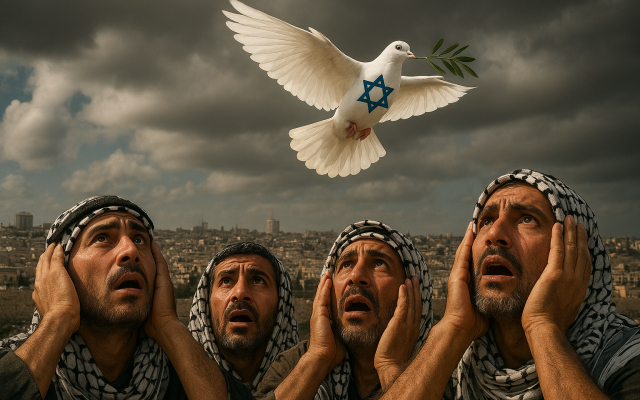

Sabine Sterk: Imagine… A World Without Hate
Imagine that a miracle occurs, and Hamas lays down its arms. Imagine that, for once, their leaders surrender not to Israel, but to their own conscience. Imagine that tomorrow, all the hostages, the living and the dead, are returned home to their families.
Imagine that the Arabs in Gaza finally recognize the State of Israel, not as their eternal enemy, but as their neighbor. Imagine that, instead of building tunnels of terror, they build schools and hospitals. Imagine that the billions of dollars in foreign aid aren’t funneled to rocket factories, but used to make Gaza the Singapore of the Middle East.
Imagine that UNRWA, the organization that has institutionalized refugeehood for generations, is finally dismantled. Imagine that the schoolbooks in Gaza stop teaching children to hate Jews and start teaching real moral values, history, and truth.
Imagine.
Now, what would happen to the hundreds of thousands of “pro-Palestine” protesters across the globe who have made a career out of outrage? What would they do if peace actually came? What would happen to the activists who found meaning in destroying universities, blocking ambulances, vandalizing campuses, and chasing Jews through city streets, always “in the name of justice”?
Imagine their despair if their favorite villain, Israel, no longer existed in their slogans. Imagine their rage when the keffiyeh goes out of fashion because there’s no more war to accessorize it with. Imagine the disappointment of those who must return to real jobs once the funding from Qatar dries up.
Imagine the chaos in the cultural scene. The Eurovision organizers would be devastated, no more convenient excuse to exclude the only Jewish state. Imagine their frustration when Israel wins again and again, not just for its music but for its brilliance, creativity, and resilience.
And tourism? Imagine the heartbreak in Europe’s travel industry when millions start flocking to Israel, to see the innovation of Tel Aviv, the holiness of Jerusalem, the beauty of the Galilee, and the ancient roots of the Jewish people. Imagine the silence of the “Gaza flotilla” activists, left wandering the Mediterranean in search of their next narcissistic cause.
What a sadness that would be, if peace really came.
Because let’s be honest: peace is not convenient. Not for those who thrive on hatred, who build careers, NGOs, and entire political movements around the eternal image of Palestinian victimhood. Not for regimes that use the Palestinian cause as a distraction from their own corruption. Not for Western governments that need a crisis to signal their moral superiority from a safe distance.
The harsh truth is that too many countries profit from war.
Wars bring strategic gains, territories, influence, and bargaining power. They help political leaders at home to rally their citizens, silence opposition, and gain popularity. Wars secure resources, stimulate industries, and justify technological advancements, all while costing lives that are too often not their own.
War unites nations, at least for a while. It creates a shared identity even if that identity is built on hate. And when the smoke clears, those who started it write the history books, award the medals, and plan the next conflict.
But the “benefits” of war are illusions. The human cost is too heavy, the moral cost irreversible. Every war destroys not just cities, but the conscience of humanity.
And yet, when it comes to Israel, the world seems to prefer conflict. When Israel defends itself, it is condemned. When Israelis die, the world is silent. When Jews dare to live safely in their ancestral homeland, the UN calls it “occupation.”
Imagine if that double standard disappeared. Imagine if the world finally understood that Israel does not seek war, it endures it. That Israel values life, while its enemies glorify death. That Israel, time after time, has extended its hand in peace and received rockets in return.
From 1947 to Camp David, from Oslo to the Abraham Accords, Israel has always said yes to peace. And time after time, its Arab neighbors, its Palestinian counterparts, have answered no.
So imagine, just once, a world where the Jews are allowed to live freely, safely, proudly, in their indigenous homeland. Imagine that their children grow up not learning how to run to bomb shelters, but how to build a better world.
Imagine a world that truly desires peace, not protest.
Imagine and then ask yourself why so many are afraid of that world.
Because peace would expose the truth: that Israel was never the problem. It was always the proof, the proof that freedom, democracy, and life can thrive in the Middle East, even when the world prefers its chaos.
Imagine that.