
Image by Nikki Casey
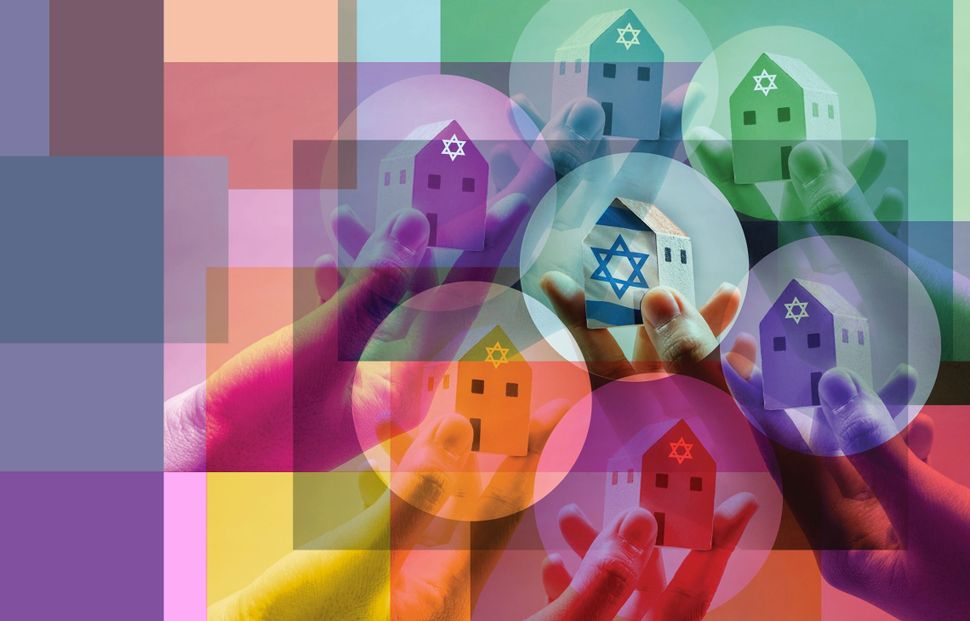
Prof. Sam Lehman-Wilzig: Israeli and Diaspora Jews are Growing Apart: Here’s Why
The phenomenon of Jews in Israel and the Diaspora growing apart goes well beyond the Gaza War. Indeed, it’s just the latest example of a much deeper factor pushing the world’s two central Jewish communities to go their separate ways. In a sense, this is a repeat (or extension) of Jewish history – at least over the past 2500 years.
The divide is no less a matter than two profoundly different ways of seeing the world. Most Israeli Jews are animated by a particularistic ethos rooted in Jewish peoplehood, survival, and the country’s unique circumstances – neighborhood antagonism being the main mover. On the other hand, diaspora Jews – especially those in North America and Europe who make up the majority of world Jewry outside Israel – tend to express a universalistic ethos. There, Jewish values are inseparable from broader humanistic values and commitments.
Whose perspective is more attuned to historical Judaism? Neither. Particularism and universalism are equally a basic part of the Jewish tradition. On the one hand, “You shall be to me a treasured nation”; on the other, “A light unto the nations.” The difference between them is historical; it depends on which “part” of Jewish history we’re talking about.
The first millennium or so of Jews in the Land of Israel was rife with conflict. The Bible is a litany of struggle: slavery in Egypt; fighting off marauding tribes (e.g., Amalek) on the way to Canaan; Joshua’s long campaign of conquest; repeated wars against “recalcitrant” locals; constant fighting with the Philistines (e.g., Samson); expansionist wars by King David; and so on. In such unstable circumstances, the need for “rallying around the flag” of a particularistic religion became predominant.
Around the 6th century BCE, the Jewish diaspora story began (the Babylonian exile; true, the exile of the Ten Tribes to Assyria occurred two centuries earlier, but they then disappeared forever). The diasporic effect on the Jewish ethos can be seen (among other places) in the Book of Esther that took place in Persia (present-day Iran): Mordechai allows his niece Esther to take part in the (non-Jewish) king’s beauty pageant! The happy end of the story has Esther as queen and Mordechai as head of state (under the king) – as quasi-assimilationist a message as one will find in the entire Bible, similar to the Joseph story (changed his name, his garb, married an Egyptian) that was just completed in this Sabbath’s Torah reading.
An even more striking difference between the mostly particularistic Hebrew Bible and the later diaspora ethos can be perceived in what is NOT in the bible: the Book of Maccabees. One can fairly ask: why would the rabbis in the 2nd century CE include the Book of Esther and not the Book of Maccabees? The clear answer: the former told of a Jewish triumph through clever subterfuge within the Gentile’s political system; the latter’s victory was gained through military might. But after the Roman destruction of the Second Temple, and the later devastation as a result of the Bar Kochva Revolt, the Talmud’s rabbis had seen enough disastrous outcomes of the overly militaristic ethos. That’s why they chose the following sentence to conclude the Haftorah reading during every shabbat Hanukkah (Zechariah 4: 6): “Not by might, nor by power, but by my spirit, says the Lord of hosts.”
And that’s basically the way things stayed for the next 1800 years, until modern Zionism reentered the historical picture. The early pioneers brought with them their diasporic universalism, but constant Arab attacks – continuing to this very day – with the Zionist state finding itself under existential threat undermined such an ethos. Undergoing wars, intifadas, and terror, Israeli society inexorably gravitated towards greater nationalist particularism, a manifestation of tribal solidarity. In Israel, the repeat of ancient history’s fight for national survival has pushed aside the past two thousand years-worth of growing universalism. The general motto expressing this is ancient: “If I am not for myself, who will be for me?” (Mishneh: Pirkei Avot, 1:14).
This is in relatively stark contrast to large swaths of Diaspora Jewry, particularly American, British, and Canadian Jews. For most, collective survival is not the core; rather, social integration and moral guidance drives most non-Israeli Jews overseas. Jewish identity is often shaped and expressed by participating in universal justice causes, from civil rights (LGBTQ+ and racial equality) to refugee resettlement and climate activism. Among other Jewish media, synagogue bulletins routinely elevate tikkun olam – repairing the world – as the highest Jewish calling. Maintaining a moral voice, fighting anti-Semitism and Islamophobia, and supporting democracy are all variations on a common theme: Jews are part of the larger world.
The Oct. 7 attack and its bloody, reprisal aftermath provided a public stage for these divergent instincts. The almost universal response in Israel was fury, with public conversation and the media emphasizing internal unity, resilience, and the rightfulness of its military response – with little patience for international criticism or empathy for Palestinian suffering.
In contrast, many Diaspora communities were anguished not only by Israeli losses but also with Palestinian suffering. Social media paired Israeli and Palestinian flags. Paradoxically (given rising antisemitism), for many younger Diaspora Jews the war increased their universalistic Jewish identity, leading to Israeli accusations of “disloyalty” or historical naivete.
Thus, the war in Gaza was but the latest sign of growing division between the world’s “two Jewries.” There were (and continue to be) other major issues within this divide:
1) Israel recognizes only Orthodox conversions and marriages, opposed to the more inclusive approach of the majority, non-Orthodox, Jewish denominations in America and Europe.
2) Diaspora Jews often gravitate toward interfaith activism, increasingly including interfaith marriages; most Israelis view non-Jewish partnerships as diluting communal strength.
3) Diaspora protests against settlement policy are perceived by Israelis as attacks by “family” members lacking skin in the game.
Where do Jews go from here? It’s complex. On the one hand, the gap is growing in no small part due to (but not only) the Gaza War. On the other hand, with antisemitism increasing around the world, most Jews in Diaspora tend to react with a greater emphasis on Jewish particularism. The internal tug of war continues – not only between Israel and the Diaspora, but also within each Jew, trying to mesh “If I am not for myself…” with “If I am only for myself…”.