
National Library of Israel – The Song of Songs: What’s an Erotic Love Poem Doing in the Bible?
The Song of Songs is an ancient biblical text that contains some of the most passionate words found in the Bible. Some of the passages get quite explicit, even venturing into erotica. How can we explain this? And what or who do the figures in the song actually represent?
An Illustrated Song: The Tale of a Book
The Song of Songs is meaningful on multiple levels. For the author, who came across a unique copy of the famous biblical text, it represents a formative experience of youth, one that extended into adulthood and continues to hold meaning today.
The black book had stood on our living room shelf for decades, near The Complete Works of Shakespeare and Carl Sandburg’s six-volume Lincoln biography. I’d noticed the slim, sleeveless book, but may not have known its subject when my mother offered it to me, and I accepted, as she downsized before moving apartments in 2004.
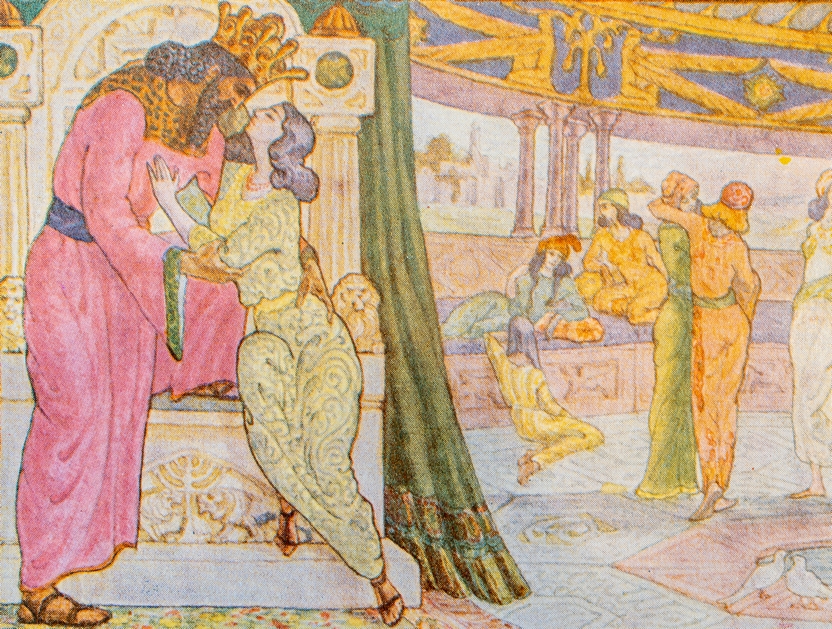
Subsequently, I’d open it occasionally to appreciate its calligraphy and wondrous watercolor paintings, all done by Ze’ev (here spelled Zeew) Raban, a native of Lodz, Poland, a city from where our family springs. Raban moved to pre-state Israel in 1912, studied and taught at the Bezalel art school in Jerusalem and was a leading artist in the country until his death in 1970.

The book’s title appears in Hebrew, English and Latin: Shir Hashirim, The Song of Songs and Canticum Canticorum, respectively. I’d always examine the volume before the Shabbat of Passover, the one occasion each year that the work is recited in synagogues worldwide.

From The Song of Songs, illustrated by Ze’ev Raban, HaSefer, Berlin, 1923. Only 500 copies of this edition were printed; this one is kept at the National Library of Israel. Photographed by Hanna Taieb
That’s because, for several years, I was one of those readers: first at Kesher Israel Congregation in Washington, D.C., and then at Baltimore’s Ner Tamid Greenspring Valley Synagogue. In the latter, I split the duties with the congregation’s rabbi, Chaim Landau, who also enjoyed chanting it. My portion always included the first three or four chapters of the eight.
Another rabbi, Jerry Acker, had taught me the unique trop (the cantillation corresponding to the musical notes) used when reading the Song of Songs. That was a side benefit of attending the prayer services overseen each Shabbat by Rabbi Acker and attended by teenage boys and girls in a gray Victorian house, known as The Annex, on the grounds of the Kew Gardens Synagogue, in Queens, New York. Each of the boys who wanted to would serve as chazzan (cantor) for the various sections of prayers and chant the assigned portions of the week’s Torah and haftarah (a selection from the Books of Prophets) readings. Others would undertake such roles as opening and closing the ark when the Torah was removed and returned. The tasks — and the youth minyan (services held by a congregation) itself — imbued us with the skills and confidence needed to assume those roles as adults.

From The Song of Songs, illustrated by Ze’ev Raban, HaSefer, Berlin, 1923. Only 500 copies of this edition were printed; this one is kept at the National Library of Israel. Photographed by Hanna Taieb
“Whoever wants to is invited to return at 3:00 p.m. today for a program I’ll be offering for several months on learning the trop for the Book of Esther,” Rabbi Acker announced one Shabbat morning at the close of the youth minyan, or words to that effect. I would regularly attend the class to learn the unique cantillation for reading the scroll reserved for the holiday of Purim each March. Some time later, he made a similar announcement for a class covering a different trop, employed when reciting three scrolls: The Song of Songs, Ruth (read each Shavuot, or Pentecost), and Kohelet, Ecclesiastes (read on Sukkot, or Tabernacles). I joined that class, too. Eventually, I taught myself the separate trops reserved for yet another scroll, Eichah, Lamentations, recited on the Tisha B’Av fast; for the weekly haftarah; and for the High Holy Days. My father already had taught me how to chant the Torah.

From The Song of Songs, illustrated by Ze’ev Raban, HaSefer, Berlin, 1923. Only 500 copies of this edition were printed; this one is kept at the National Library of Israel. Photographed by Hanna Taieb
The skills instilled by Rabbi Acker led to my habit of volunteering over many years to handle those readings. Doing so helped me to connect with each holiday. I enjoy the unique aspects of every trop, but have long favored the one used for The Song of Songs, Ruth and Ecclesiastes for its softness, emotional depth and slower pace. Only after many years of reciting Ecclesiastes and The Song of Songs did it occur to me to read the English translation to better understand the words chanted. (I’d been taught the story of Ruth in school.) I took The Song of Songs to be a beautifully poetic account of many facets of romantic love. Very traditional interpretations, however, perhaps due to discomfort with romance and physical attraction, aver that The Song of Songs is about the love between the Jewish nation and God.

From The Song of Songs, illustrated by Ze’ev Raban, HaSefer, Berlin, 1923. Only 500 copies of this edition were printed; this one is kept at the National Library of Israel. Photographed by Hanna Taieb
My friend Michael Kidorf, who sat with his children a row before me in Baltimore, reveled in my book’s annual reemergence. I’d bring it for the Passover service, even though I wouldn’t be reading directly from it. On arrival, I’d hand it to him. For the rest of that morning’s services, Michael would be engrossed in the book. “There was something very dignified about the copy you have, and I looked forward to seeing it,” Michael said in a recent conversation. When flipping through the pages, Michael explained, he felt inclined to say the Shehecheyanu blessing that’s uttered to mark such unique occasions as eating a season’s first fruit — “that we’re at this time [of year] that we get to see it again.”
Most of the flipping involves the crinkling of the yellow, onion-skin pages, known as tissue guard, separating the paintings. That’s how beautiful books were created once upon a time, in this case by the HaSefer (Hebrew for “The Book”) publishing company in Berlin. The opening inside pages state in English and Hebrew that it was printed in 1923 on the Graphische Gesellschaft (German for “Graphic Society”) press on “especial paper bound in hand-made covers.” The pages note that 500 books were printed, but I’ve been unable to locate the number on mine, perhaps because part of the spine is missing.

From The Song of Songs, illustrated by Ze’ev Raban, HaSefer, Berlin, 1923. Only 500 copies of this edition were printed; this one is kept at the National Library of Israel. Photographed by Hanna Taieb
Another mystery deals with the relationship between the couples who were the first owners of the book. It is inscribed with a black fountain pen: “To Alice A. and Edgar J. Kohler for their day of days, with our heartfelt hope that their togetherness may prove another Shir Hashirim.” It’s signed: “Louise & Stephen Wise, June 2, 1924.”
The couples lived in New York. Wise, a well-known rabbi and social activist, was a leader of the Reform movement who established The Free Synagogue, now known as the Stephen Wise Free Synagogue, in Manhattan. Maybe the occasion was the Kohlers’ anniversary or wedding. A few weeks later, Wise served as a delegate to the Democratic National Convention and was one of 23 clergymen to deliver an invocation to open a day’s session. Edgar Kohler was a lawyer.
Yet another question is how my mother acquired the book. I suspect that it came from her grandfather, Isaac Unterman, a rabbi and a publisher of Yiddish newspapers who then lived in New Jersey.

From The Song of Songs, illustrated by Ze’ev Raban, HaSefer, Berlin, 1923. Only 500 copies of this edition were printed; this one is kept at the National Library of Israel. Photographed by Hanna Taieb
Rabbis Acker and Landau, the spiritual leaders I more closely associate with The Song of Songs and whom I recall fondly for their encouraging manner, have passed away in recent years. Some of the pages at the front of my hardcover volume, which measures 9½ inches x 13½ inches, are brittle. I’ll occasionally find tiny flakes of the pages on the floor, similar to those from scrapbooks settled at the bottom of my box of century-old family pictures. Parts of the book’s spine are holding on for dear life.
I handle the book carefully whenever removing it from a shelf to show a visitor who’s an art devotee. The next time Michael and his family visit, they’re sure to see it, too. And every so often, I smile, as happened in early April, at the sight of a sign of a poetic nature, like the one in Tel Aviv’s Nahalat Yitzhak neighborhood that designates Pri Megadim (“Pleasant Fruits”) Street.
The name comes from the Song of Songs.
This article is presented in celebration of the European Days of Jewish Culture, in cooperation with NLI’s Gesher L’Europa (A Bridge to Europe) initiative. The 2026 EDJC theme is LOVE – read more here.
Writer-editor Hillel Kuttler may be reached at hk@HillelTheScribeCommunications.com.