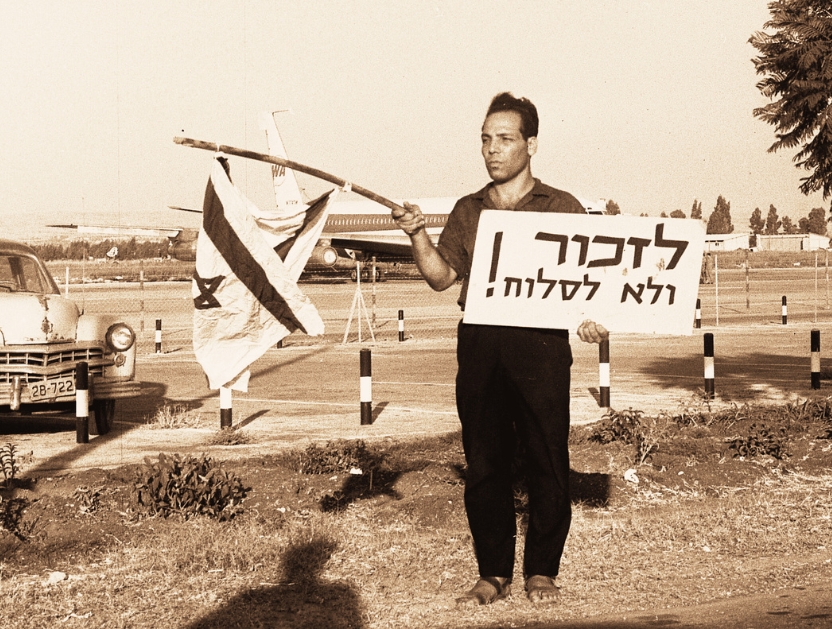

“Remember, and Do Not Forgive!”- A Hebrew sign welcoming the arrival of the first German ambassador to Israel, 1965. Photograph from the Dan Hadani Archive, the Pritzker Family National Photography Collection, National Library of Israel.
National Library of Israel – Forgive, Don’t Forget: A History of Jewish Forgiveness
Today, we live in a world in which asking for and receiving forgiveness – even without any significant price to pay – is accepted, natural, and almost taken for granted. But is this gift really inevitable? A look at some of the earliest instances of wrongs and sins being forgiven in Jewish history can teach us a great deal about the nature of forgiveness, and about its delicate place along the vast spectrum between forgetting and punishment.
The first thing we did, more or less, as a people, was rebel.
Was it the “terrible twos” (or, more accurately, the terrible ninety days or so)? An attempt to test boundaries? A misguided group within the people that managed to drag everyone else down with it? A massive misunderstanding? There are quite a few interpretations of this formative event. But whatever the explanation, the facts themselves were very simple:
The group of slaves who had only just been redeemed, through signs and wonders, from the world’s greatest open-air prison – Egypt – had begun to take shape as a people. And in one of the most substantive moments in religious history, they received the ten foundational principles of their new faith.
Sounds promising, doesn’t it? At the very least, it would seem that this was the moment when their devotion to the One who had redeemed them, and who had led them out of a life of slavery, should have been complete and absolute.
And yet, as soon as Moses, their revered leader, turned his back on those future Jews for even a moment, they gathered together and, in a grand and somewhat grotesque display of rebellion – or perhaps stupidity – blatantly trampled upon one of the first commandments they had received:
“You shall have no other gods before Me. You shall not make for yourself a graven image, nor any likeness.”
When Moses returned from his heavenly encounter, carrying the two Tablets of the Covenant – the physical embodiment of those Ten Commandments that had just been delivered before their astonished eyes – he was horrified to his very core and instinctively shattered the tablets. On the face of it, this appeared to be an irreparable rupture in the brand-new covenant that had only just been forged between the people and their Redeemer.
But then, something historic, almost unprecedented, happened.
Moses received, on behalf of the people and for their sake, God’s forgiveness. The same God who, until that point, had forgiven none of the groups of sinners whose stories the Torah had told so far: the Generation of the Flood, the Generation of the Dispersion, and Sodom.

The intact Tablets of the Covenant have since become a quintessential Jewish symbol. Pictured: a banknote printed in Theresienstadt, from the National Library of Israel’s Collection of Currencies and Banknotes.
After Moses completes the practical business of dealing with the sin – the Golden Calf is burned and the sinners are punished – he ascends once again to plead with God, on behalf of the people, for forgiveness. At first, it seems that the people have gone one step too far, and that this will be the end of them. But forty days and forty nights of pleading come to an end with words that, thousands of years later, are still heard in Jewish synagogues around the world: “I have forgiven, as you have asked.”
But what exactly does that mean? To forgive?
When Moses pleads with God for forgiveness on behalf of his people, he declares that if forgiveness is not granted, he wants no connection to anything that has happened up to that point: “Erase me from Your book,” he asks. If the people cannot, somehow, move forward and rise from this sin, then erase me completely from the story.
Is this what forgiveness looks like in return? Does accepting atonement mean completely erasing the sin? Forgetting it, as though it had never happened? Does forgiveness depend on repairing what has been broken? And what do we do when the damage cannot truly be repaired?
***
Let’s jump forward more than three thousand years.
The days on the Hebrew calendar during which Moses pleaded with God on behalf of the people became established as days of forgiveness and atonement. They begin on Rosh Chodesh Elul, the first day of the month of Elul. Throughout the month, various Jewish communities recite special prayers known as Selichot, in which worshippers once again ask God for forgiveness – not this time for one specific, national sin, but for all their own individual sins, great and small.
And, of course, their culmination comes forty days later, on the tenth day of the month of Tishrei: Yom Kippur, the Day of Atonement. This is the historic day on which Moses descended from the mountain after receiving forgiveness and the new tablets.
“The heavens were pure,” S. Y. Agnon wrote of these days, “and the earth was quiet, and all the streets were clean, and a new spirit fluttered through the air of the world” (S. Y. Agnon, Days of Awe).
There is something in the air during these days. Even if Agnon’s lyrical language does not speak to you, even if you are not a believer, even if the heavens are not pure, the earth is not quiet, and the streets are not clean –a new spirit really does flutter among us every year at this time.
On the surface, this is the renewal of the Hebrew year, the one whose existence we almost forget in our day-to-day lives, who we are reminded of only on holidays and festivals. But it is more than that.
In Jewish tradition, there is a close connection between the beginning of a new year and the reality of forgiveness and absolution. For many of us, this connection seems logical, almost embedded in the way we understand the world. We were born into it.
With the beginnig of a new year, what could be more natural than using it as an opportunity to “clear the slate” – to ask forgiveness for our part in the things that went wrong during the past year, and, on the other hand, to open the door to forgiveness for those who come to ask it of us?
But the truth is that this connection is not self-evident. And were it not for those words – “I have forgiven, as you have asked” – spoken on precisely this day, it is not certain that it would ever have developed.
In different cultures, “forgiveness” refers to different ways of repairing a wrong – whether through payment, punishment, or restoring things to their previous state when possible. In Judaism, too, over the centuries, various customs took root that sought to give a tangible and practical dimension to the request for forgiveness or atonement.

The text of a Kapparot prayer, probably from Italy, 19th century. The item was donated to the National Library of Israel by Mr. Ezra P. Gorodetsky.
The best-known example is the scapegoat sent into the wilderness during the Temple period. The sins of the entire people were symbolically “loaded” onto it, and it was sent with them into the abyss, to the death awaiting at the bottom.
Communal customs in different periods ranged along a broad spectrum – from repairing wrongs, through punishing sinners, to “transferring” sins onto something that could then be destroyed.
In Babylonia, it was customary to release a prisoner or help a poor person on the eve of Yom Kippur, as a symbol of the forgiveness we seek for ourselves. In Hasidic communities in Eastern Europe, people would use the day to settle disputes through formal ceremonies involving a public handshake. Among Ashkenazi communities, the custom of Tashlich spread in the 15th century – the symbolic casting of sins into water. In some communities, people would even submit to thirty-nine lashes. And above all, there is the custom that has survived to this day – despite the deeply divided opinions of Jewish sages concerning it – Kapparot, in which sins are symbolically “transferred” to a chicken, a fish, or a sum of money, which is then given to charity.
And yet, none of these external measures truly reflects the essence of forgiveness. After all, the sins are not actually cast into the wilderness, and their consequences remain here with us – sometimes forever, sometimes beyond any possibility of repair. Forgiveness does not really erase our wrongdoing. So, what does it do?

Illustrated postcard depicting a woman performing the Kapparot ritual. From the Ben-Zion Kahana Collection, Yad Izhak Ben-Zvi. This record is part of the Israel Archives Network (IAN) project and is available through a collaboration between Yad Izhak Ben-Zvi, the Ministry of Jerusalem and Heritage, and the National Library of Israel.
Long before the first divine act of forgiveness, the Torah tells us about another kind of forgiveness: human forgiveness.
Joseph’s brothers commit an almost unimaginable act against one of their own. They make their father Jacob believe that Joseph, his beloved son, is dead, and sell him into slavery – a chain of events that leads to years of suffering and imprisonment, through no fault of his own.
But after an almost unbelievable succession of events, the story is turned upside down. Joseph becomes viceroy of Egypt, while his brothers, who have come to seek food in his new country, are now entirely at his mercy.
They are terrified. “But we are guilty,” they say to one another – and they mean it. They know they have sinned. They know that what they did to Joseph cannot be undone. Can they give back to him and to their father Jacob all those lost years? Can they erase the way they treated him? The terrible helplessness he experienced at their hands?
But Joseph does not ask them to suffer or to repay him for what he endured. He does not even try to humiliate them. The only thing he does is test them. In what initially seems like a somewhat cruel game, he wants to know whether their remorse is genuine. Will they behave differently toward another brother, Benjamin?
He puts them to the test: What will they do if he takes Benjamin from them? Will they abandon him to his fate in Egypt, just as they once abandoned Joseph, or have they learned something from the past? Have they become people who will now fight for their brother?
Once they pass the test, once it is clear that they truly regret what they did and that they are no longer the same people who once harmed him – that they are now people who choose differently – Joseph turns his gaze toward the future.
Joseph forgives them. Just as God will one day forgive the people of Israel. And in his response lies the true essence of forgiveness:
“I am Joseph your brother, whom you sold into Egypt. And now, do not be distressed, and do not reproach yourselves for selling me here, because it was to preserve life that God sent me ahead of you… to ensure for you a remnant on earth and to sustain you for a great deliverance.”
What happened cannot be changed, Joseph tells his brothers. You sold me. But out of your remorse, a new reality can emerge from the chaos and abyss of hurt, sin, and pain.
Like a new year.
Leave the past behind, he tells them. In the end, something good came from it. Let us look ahead. Bring our father. Come and live here. I will give you the best land there is.
Not erasure. Not denial. But remorse, and the use of the consequences of sin to become better people. If you will, new people. Clean people. People worthy of forgiveness.
***
In a small, worn booklet, stained by the marks of time, written in a language that most visitors to the National Library cannot read, the French-Jewish musicologist and philosopher Vladimir Jankélévitch sets out his philosophy of forgiveness.
He grapples with one of the greatest questions about forgiveness ever placed before the Jewish people – the question that gave rise to the words, “Never forget, never forgive.”
The great question that emerged after the Second World War and the Holocaust that accompanied it was this: Is it possible to forgive the catastrophe inflicted upon the Jewish people by the German people and antisemites across Europe?
What is remarkable is not Jankélévitch’s final answer – that in this particular case forgiveness is impossible, for a number of reasons – but the argument he makes along the way.
Even terrible, horrific sins, he suggests, are deserving of forgiveness. There is almost no atrocity from which one cannot, eventually, rise and move forward.
On the contrary: true forgiveness can exist only in the face of something that, at first glance, seems unforgivable.

Cover of the first English edition of Vladimir Jankélévitch’s Le Pardon.
At that time, the young State of Israel was deeply embroiled in precisely the same question. The Reparations Agreement was brought before the Knesset – a proposal that would provide economic relief to a poor, wounded, and isolated country in exchange for… what, exactly? That was never entirely clear. Was it forgiveness? Was it atonement? Or was it simply the bare minimum the Germans could do?
Many argued, as Jankélévitch did, that there could be no forgiveness for atrocities of this magnitude. Any attempt to extend a hand to the Germans, they argued, amounted to implicit forgiveness on behalf of those who could never forgive. This argument was reinforced by the title given to the agreement in Germany at the time: “Restitution for Wrong.” Could anyone seriously imagine that money, no matter how much, could actually repair such a wrong?
In the end, Israel accepted Germany’s reparations agreement, and normal relations were established with the new Germany. Was this, in fact, forgiveness? That depends on whom you ask.
But one thing from that debate became deeply etched in our national consciousness: forgiveness and memory became intertwined. The slogan “Never forget, never forgive” seemed to imply its opposite: if we forgive, we forget.
But that is not so.

Protest poster — “Never Forget, Never Forgive!” From the Pavzner Collection, National Library of Israel
Within the walls of the National Library of Israel, an institution whose very purpose is to preserve memory and resist forgetting, countless items are kept: manuscripts, books, photographs, newspapers, and even objects that preserve the memory of immense and terrible sins – the many atrocities endured by the Jewish people throughout their long and bloody history.
Alongside them are countless texts devoted to forgiveness and absolution: to the extraordinary gift given to us by God, and to the remarkable human capacity to put the past behind us and look ahead. Wounded, scarred, bleeding – but also wiser. Forgiving, and forgiven.
The sin of the Golden Calf was not erased from the written record. Quite the opposite: it became one of the defining events in the history of the people of Israel, something from which we must learn. Something whose words and lessons we recall again and again, every year.
After God forgave the people of Israel, Moses brought down a second set of tablets, new and whole. But the broken tablets were not destroyed. Their fragments did not disappear in the wilderness. They were preserved for generations alongside the whole tablets, in the Ark of the Covenant – the same Ark that stood in the Holy of Holies, where the High Priest would enter to plead for mercy and forgiveness on behalf of the entire people on Yom Kippur, when the Temple still stood.
We remember. And we are reminded.
We ask for forgiveness. And we forgive.

New Year’s greeting card featuring an illustration of Moses holding the second set of tablets, whole and intact. From the Greeting Card Collection, digitized and made available through a collaboration between the Ministry of Heritage and the National Library of Israel.