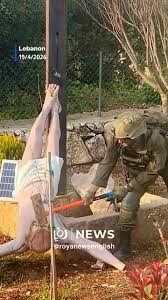

Jonathan Feldstein: The Uproar Over an Israeli Soldier Destroying a Statue of Jesus
In times of prolonged conflict, perspective can be difficult to maintain. After more than two and a half years of war between Israel and Hamas, Hezbollah, the Houthis, and Iran, we have grown accustomed to a constant stream of accusations, images, and narratives. There is often a natural reflex to castigate Israel over anything alleged, real, or made up. Experience has shown that not every viral image or report reflects reality, and that judgment is sometimes best reserved until the facts are clear, albeit after the judges, juries, and executioners have rendered and implemented their verdict: Israel guilty.
An example last year was alleged Israeli arson against the remaining Christian village in the Palestinian Authority, only to discover that it was Palestinian Arabs who set the fire.
It was in that spirit that initial reports emerged of an Israeli soldier destroying a statue of Jesus in a Christian village in southern Lebanon. At first glance, it seemed plausible that the image might be another example of misinformation, designed to inflame tensions and reinforce hostility toward Israel. Unfortunately, further details revealed that the incident was real. The image, taken by another soldier, appeared almost staged rather than spontaneous, deepening the sense of dismay and shame.
People lined up, tripping over themselves, to blame Israel – again – as “proof” of Israeli “ethnic cleansing,” “persecuting Christians,” and other tropes. For those already looking for excuses to blame Israel, this was welcome fuel on the existing flames. For most in Israel, specifically those building bridges among Christians as I do, this was a shameful act that’s properly been widely denounced and condemned.
The good news is that within a day, the IDF investigated, removed two of the soldiers from combat, sentenced them to jail, disciplined others who were present, and restored the statue in conjunction with the local Christian community.
Nevertheless, the incident is troubling on multiple levels. It represents not only the destruction of private property, but also the desecration of a religious symbol sacred to millions. Even beyond the destruction of personal property and a religious symbol, one would think that, within a war against Islamic terrorists in Lebanon, these soldiers would surely have something better to do.
For those who work to foster Jewish-Christian understanding, its particularly painful. Yet even beyond interfaith relations, the behavior stands in clear violation of basic moral and ethical standards. No justification – whether rooted in stress, ideology, or the fog of war – can make such conduct acceptable.
At the same time, the response to the incident offers an important counterpoint. The Israel Defense Forces acknowledged the incident and addressed it immediately, signaling that the act does not reflect Israeli values. As much as I condemn the act, I am proud of the widespread response, reinforcing the principle that wrongdoing must be confronted. This willingness to admit fault and pursue accountability is seen by many as a defining strength, particularly in contrast to actors in the region who rarely acknowledge or address their own abuses, in general, much less crimes and widespread persecution of Christians in Islamic nations to which most turn a blind eye.
Many Christian friends have asked how and why this could happen. The episode highlights deeper gaps in understanding that extend beyond a single soldier. Most Israelis, for instance, have limited to no direct interaction with Christians, locally or globally. Despite increasing recruitment into the IDF among Christian Israelis and strong political and spiritual support from Christian communities worldwide, particularly among those who see deep historical or theological connections to Israel, these relationships often remain abstract.
More often than not, when Christians come to and connect with Israel, this exists in parallel to Israeli society rather than in meaningful engagement with it. Although the Christian population in Israel is the only one in the Middle East able to practice and worship freely, and the only one that it growing annually, most Israelis simply have never met a Christian.
Often, when I am speaking in churches and among Christian groups, I share this reality in an additional context. We are a people who still celebrate our liberation and exodus from Egypt 3500 years ago. Not knowing any Christians, having substantial relationships as I do, or understanding the reality of Christian support for Israel, Israelis know of widespread Christian persecution of Jews from the very beginning of the Church, in the name of Jesus, less than 2000 years ago. The lack of connection to and awareness of the spiritual reality of widespread Christian support for Israel and the Jewish people allows people to think that this is the prevalent reality. It takes time and a proactive effort to understand and change attitudes, the same way many Christians still embrace replacement theology, a term most Israelis don’t know, but the history and consequences of which are all too real.
This disconnect contributes to a broader lack of awareness about Christianity, its practices, and the significance of its symbols. Don’t get me wrong, none of this justifies destroying a statue of Jesus. But a lack of awareness or connection can legitimately make someone think that there’s nothing wrong with it. I have experienced significant negative to hostile response from Jewish acquaintances over my work embracing Christians, but epiphanies from others who are not only eager to learn about the reality today, and are encouraged by it.
While Jewish tradition may view certain forms of imagery as problematic or even idolatrous, this theological perspective does not justify disrespect toward others’ beliefs. Ironically, many Christians (some who have contacted me) reject the use of statues and icons to depict Jesus or others for the same reason. Yet the obligation to “love your neighbor as yourself” and our prophetic calls for righteousness apply universally, especially in moments of tension and conflict.
The broader reaction to the incident has also revealed a complex dynamic. Many voices, both within and outside Israel, moved quickly to condemn it – an entirely legitimate and necessary response. However, others have used the event to generalize about Israel or the Jewish people as a whole. This tendency to extrapolate from individual misconduct to collective guilt raises concerns about fairness and consistency. Honest observers note that similar outrage is often absent when Christians face systemic persecution and violence in other parts of the world, suggesting the presence of selective indignation.
This does not diminish the seriousness of the act in Lebanon, nor should it. But maintaining credibility in the pursuit of justice requires an equal willingness to confront abuses regardless of the perpetrator or context. If one claims to be concerned about the destruction of a statue of Jesus by an Israeli soldier as an isolated incident and not say or do anything about the widespread state-sponsored persecution of Christians in the wider Islamic world, it demonstrates more hostility toward the Jewish state than to caring about the well-being of Christians.
Ultimately, the distinction between individual actions and national policy is crucial. One soldier’s behavior, however inappropriate, does not define an entire nation or its moral framework. At the same time, it does demand introspection and corrective action. The true test of a society lies not in the absence of wrongdoing, but in how it responds when wrongdoing occurs.
This moment, painful as it is, presents an opportunity. It can serve as a catalyst for deeper dialogue, stronger interfaith relationships, and more robust ethical standards within institutions. It can encourage both Israelis and our Christian allies to move beyond assumptions and engage with one another more directly and respectfully. Among those Christians who defame Israel, this can also become an opportunity for dialogue.
In a region where religious identity is deeply intertwined with history and conflict, such efforts are not merely idealistic; they are essential. Justice requires acknowledging wrongs without distortion. Truth demands resisting the urge to generalize or politicize.
Neither the destruction of the statue nor using this to defame Israel can be undone. But what follows – accountability, reflection, and renewed commitment – will determine whether it remains an isolated act of shame, or becomes the foundation for something better.
Just before this shameful incident took place, I began a conversation that I am not yet ready to reveal about a project that is designed to be proactive in widening relations between Jews and Christians. It’s too soon to go public, but in light of this, it’s all the more urgent. It’s not too early, however, to gather Jews and Christians who seek and share goodwill to be a part of it. The goal is not merely to prevent future incidents, but to foster genuine understanding rooted in mutual respect. Please join me.