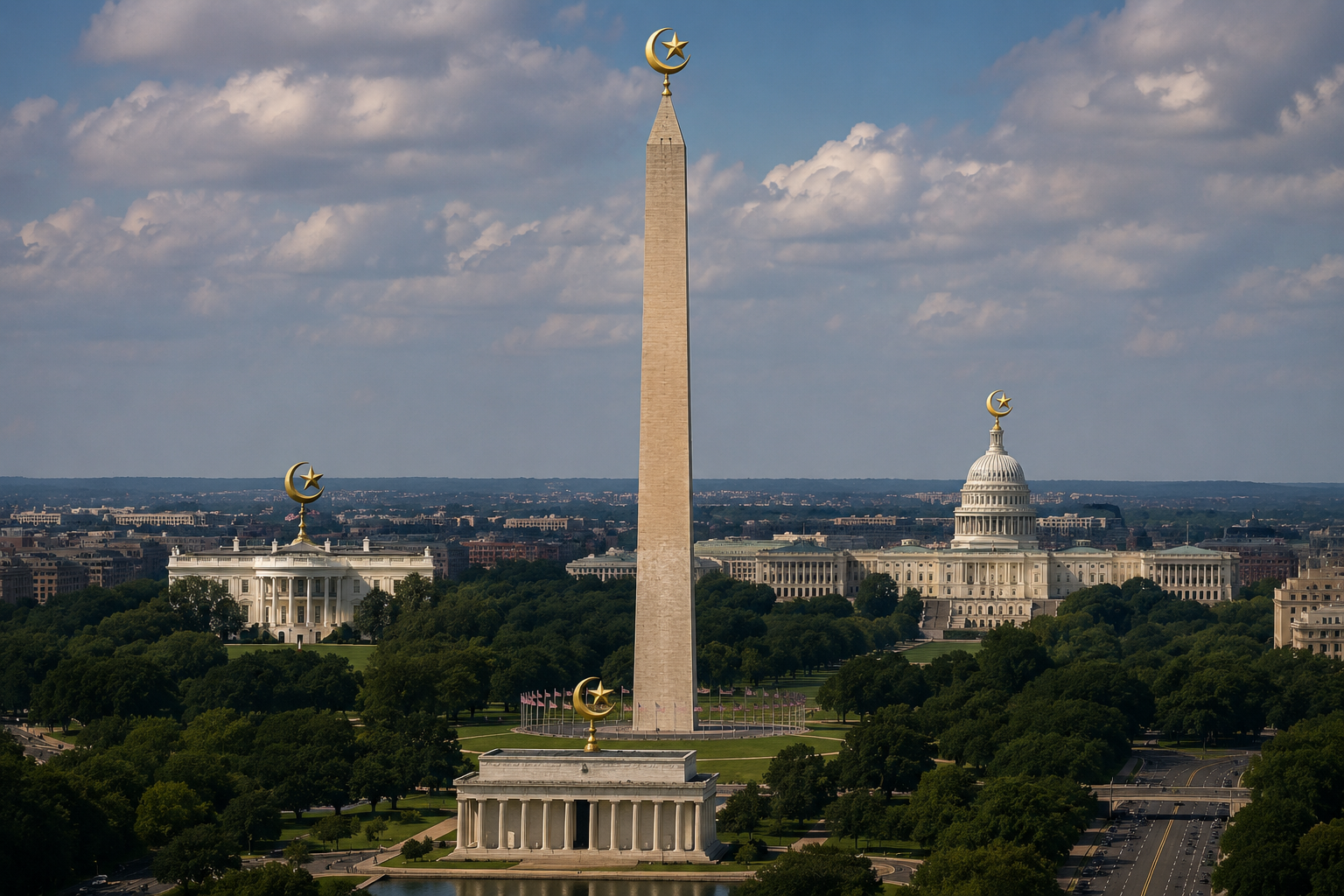

Jonathan Feldstein – Echoes of the Roman Conquest of Jerusalem in Today’s Islamic Conquest of the West
Across the world this week, Jews are observing the saddest day on the Biblical calendar, a day of mourning and fasting in commemoration of the destruction of the First Temple (586 BCE) and the Second Temple (70 CE), along with other calamities that have befallen the Jewish people on the same day – the ninth of the month of Av – across millennia. These are not a coincidence, and our observance and mourning are with deep introspection.
The destruction of the Temples in Jerusalem pulled the rug out from under the cornerstone of Jewish life, something which we still experience today. Sadly, there are parallels in the Roman siege and conquest of Jerusalem 1956 years ago with the current siege of Western society by Islamists today.
In the year 70, the Romans destroyed Jerusalem, burning it down, purging and scattering its people with no regard for humanity. Rather than governing a foreign province, Judea, even with a brutal heel they were known for, they completely eviscerated the foundation the economic infrastructure and all the values of the remnants of Jewish sovereignty in the Land of Israel until the last century.
The Romans’ breaching the walls of Jerusalem then, and the Islamic breaching of Western values and societies today portend the same calamitous outcome.
In 70 CE, the Roman legions under Titus encircled and then penetrated the walls of Jerusalem. Roman forces stormed the city, destroyed the Second Temple – the spiritual and national heart of Judaism – looted its treasures, and razed it. Josephus, the Jewish historian who witnessed the events, described famine, massacre, and enslavement on a massive scale. Rome celebrated with a triumphal parade, showcasing sacred looted artifacts like the golden menorah, the Table of Showbread, and trumpets through the streets.
The Arch of Titus, still standing in Rome, immortalizes this conquest, depicting the spoils as symbols of Roman dominance over a defeated faith and people. It is also among the elements of evidence etched into stone nearly 2000 years ago that depict the truth of Jewish sovereignty in the Land that was brought to an end.
Rome imposed its pagan order, dispersed the Jewish population, and used the plunder to fund projects like the Colosseum. Judaism survived through rabbinic adaptation, shifting from Temple sacrifice to textual study and diaspora resilience, but the physical and symbolic breach remains a profound rupture.
Today, the Islamic breach of the West has been a more gradual process of demographic, cultural, and ideological encircling, penetration, and breaking down literal and metaphorical walls, echoing Rome’s conquest. The modern Islamic conquest of the West and its challenge to an established civilization, this time the Judeo-Christian foundations of Europe and North America, is no less a threat today. While the contexts differ – one a direct ancient siege, the other a modern mix of migration, conversion, activism, and appeasement – the dynamics of intrusion, symbolic conquest, and value erosion invite comparison.
Roman expansion into Judea followed client kingship and rebellion. Islamic expansion after Mohammed’s death in 632 CE was explosive. Arab armies rapidly conquered Byzantine Christian territories in Syria, the Land of Israel (including Jerusalem in 637), Egypt, and North Africa, then crossed into Spain. Christian societies fell under Islamic rule, with dhimmi status for non-Muslims involving taxes (jizya), restrictions, and violence. Constantinople endured sieges before falling in 1453. These conquests redrew the map, turning former Christian regions Islamic and establishing caliphates that subordinated the conquered.
Today, the shift has morphed from overt military conquest to “breach” via migration, birth rates, ideological influence, and using Western liberalism and freedoms as a fulcrum with which to propel their plans. Rather than eviscerating the countries in which European powers expanded their influence, Western colonialism opened the doors for Europe’s Islamic population growth from negligible numbers to estimates of 5-6% continent-wide, with much higher concentrations in cities like Paris, London, Brussels, and Malmö.
This is not a typical “invasion” as the Romans and Babylonians did. Through stealth immigration, we see the phenomenon of no-go zones in some European suburbs, demands for Sharia accommodations (halal-only schools, prayer rooms, gender segregation), and Islamist networks. Groups linked to the Moslem Brotherhood pursue “civilizational jihad,” using Western freedoms – democracy, free speech, welfare – to advance gradual Islamization, as outlined in documents like the 1991 Explanatory Memorandum uncovered in U.S. trials. The Islamic breach is gradual, but its potential impact is the same. Unlike the Roman conquest, where the Jews of Jerusalem were outnumbered and unarmed, the Islamic invasion can be pushed back if there is the resolve.
Rome “decorated” its victory literally: the Arch of Titus displayed looted Temple vessels as trophies of pagan supremacy, signaling the subjugation of Jewish monotheism. Islamic history features parallel symbolic assertions – the conversion of Hagia Sophia by Islamists in Turkey from basilica to mosque, or the Umayyad Mosque in Damascus built over a church. In the West today, critics point to mosque constructions on sensitive sites, calls to prayer dominating urban soundscapes, and cultural accommodations that prioritize Islamic sensitivities (e.g., blasphemy concerns over depictions of Mohammed versus unrestricted critique of Christianity or Judaism), and even attempts to create a Sharia city in Texas.
Judeo-Christian values underpin the West: the dignity of the individual (imago Dei), rule of law from biblical ethics, progress through reason informed by faith, and pluralism born of Reformation and Enlightenment refinements.
Secular Western elites often respond with denial or appeasement, akin to late Roman accommodation of barbarians. Multicultural policies blur distinctions between compatible immigrants and those rejecting core western values like women’s equality, free inquiry, or civil rights. Islamist ideology views democracy as a means to impose Sharia law, not an end. Honor killings, grooming gangs in the UK, and terror attacks (Charlie Hebdo, Bataclan, etc.) highlight frictions. Christianity’s decline in Europe leaves a spiritual vacuum that radical Islam fills, and is propelled by. Woe to us if the pushback does not begin immediately.
Judaism endured Roman destruction by emphasizing portable tradition (Torah, community). The West’s strength lies in its adaptive institutions, technological edge, and residual Judeo-Christian ethics.
The Roman breach ended one era for Jerusalem but preserved Jewish identity. An unchecked Islamic breach could transform the West into something unrecognizable – less freedom, less innovation, eviscerating of its founding values. History warns that civilizations fall not just from external force but from internal failure to defend what defines them. Let us learn from the history of the Roman conquest and destruction of Jerusalem, and resolve to prevent a destruction of Western society that will be equally a calamity for humanity.