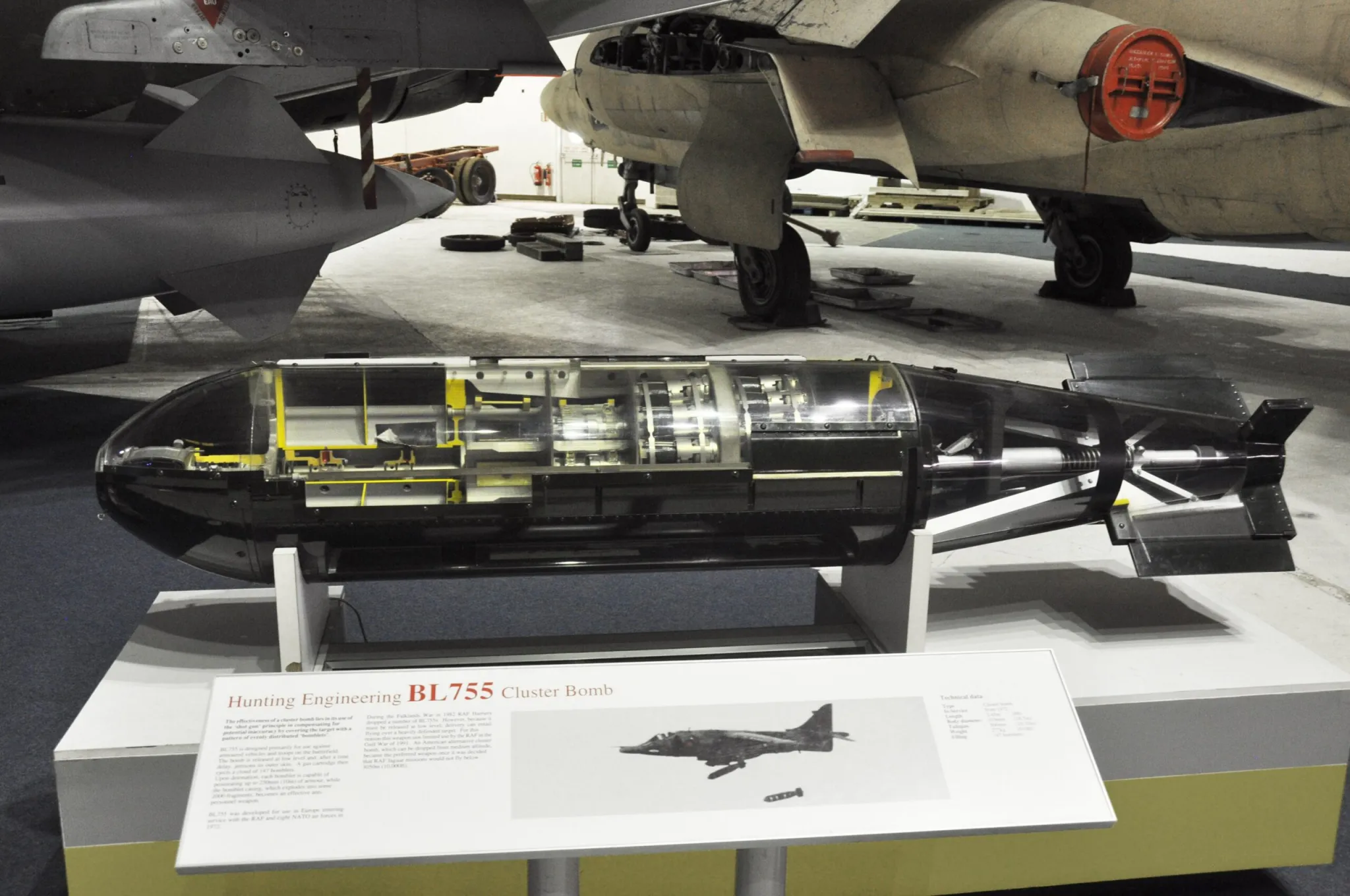

Cluster munitions. (User:The Land/Wikimedia/CC BY-SA 3.0)
Jerusalem Center for Security and Foreign Affairs: Daily Alert Mar. 23, 2026
In-Depth Issues:
Why Iran Is Far from Collapse – Dr. Raz Zimmt (Ynet News)
It is difficult to form definitive assessments in the midst of war. What is clear at this stage is that there is no indication the Iranian regime is nearing a breaking point or is prepared to make any concessions.
On the contrary, it now seems to be seeking to exploit the war as a strategic opportunity to reshape the regional order. Iran aims to establish regional arrangements based on recognition of its status and its capacity for harm.
There is no evidence of a loss of control by the security forces. Arrests and executions of civilians accused of espionage or collaboration with the regime’s enemies have continued and even intensified.
The recent increase in launches from Iran indicates it is capable of continuing missile fire – at least at the current scale – for several more weeks.
Iran has identified the potential of the energy issue through its control of the Strait of Hormuz and attacks on regional energy infrastructure. From Tehran’s perspective, this is a strategic card that allows it to prolong the war until it secures guarantees that serve its interests.
The writer is director of the Iran and the Shiite Axis Program at the Institute for National Security Studies.
It is difficult to form definitive assessments in the midst of war. What is clear at this stage is that there is no indication the Iranian regime is nearing a breaking point or is prepared to make any concessions.
On the contrary, it now seems to be seeking to exploit the war as a strategic opportunity to reshape the regional order. Iran aims to establish regional arrangements based on recognition of its status and its capacity for harm.
There is no evidence of a loss of control by the security forces. Arrests and executions of civilians accused of espionage or collaboration with the regime’s enemies have continued and even intensified.
The recent increase in launches from Iran indicates it is capable of continuing missile fire – at least at the current scale – for several more weeks.
Iran has identified the potential of the energy issue through its control of the Strait of Hormuz and attacks on regional energy infrastructure. From Tehran’s perspective, this is a strategic card that allows it to prolong the war until it secures guarantees that serve its interests.
The writer is director of the Iran and the Shiite Axis Program at the Institute for National Security Studies.
Iran’s Top Officials Underestimated Mossad’s Reach – and Paid the Price – Akhtar Makoii (Telegraph-UK)
& nbsp; Iran’s security chief Ali Larijani believed he would be safe at his daughter’s house, 12 miles outside Tehran. And then 20 one-ton bombs were dropped on him.
Hours later, Gholamreza Soleimani, commander of the Basij paramilitary force, was tracked down to a combat tent in a wooded area on the outskirts of the capital with other Basij commanders.
Ali Younesi, Iran’s intelligence minister from 2000-2005, said competing intelligence agencies focused on the surveillance of domestic critics and fighting each other for bureaucratic advantage, instead of working together against foreign agents.
The pattern of Israeli intelligence operations showed systematic infiltration that should have triggered comprehensive security reforms. But it did not.
During this war, it has been discovered that Israeli intelligence has accessed Tehran’s traffic camera network, using the surveillance system meant to protect the capit al to track the movements of targets through the city.
Iran has arrested hundreds on espionage charges and executed several, but officials acknowledge these actions are meant to “show that the system is still functioning” rather than addressing systematic infiltration.
Every additional day of war gives Israeli intelligence more time to target surviving officials, recruit additional sources, and establish the infrastructure for post-war operations.
& nbsp; Iran’s security chief Ali Larijani believed he would be safe at his daughter’s house, 12 miles outside Tehran. And then 20 one-ton bombs were dropped on him.
Hours later, Gholamreza Soleimani, commander of the Basij paramilitary force, was tracked down to a combat tent in a wooded area on the outskirts of the capital with other Basij commanders.
Ali Younesi, Iran’s intelligence minister from 2000-2005, said competing intelligence agencies focused on the surveillance of domestic critics and fighting each other for bureaucratic advantage, instead of working together against foreign agents.
The pattern of Israeli intelligence operations showed systematic infiltration that should have triggered comprehensive security reforms. But it did not.
During this war, it has been discovered that Israeli intelligence has accessed Tehran’s traffic camera network, using the surveillance system meant to protect the capit al to track the movements of targets through the city.
Iran has arrested hundreds on espionage charges and executed several, but officials acknowledge these actions are meant to “show that the system is still functioning” rather than addressing systematic infiltration.
Every additional day of war gives Israeli intelligence more time to target surviving officials, recruit additional sources, and establish the infrastructure for post-war operations.
Missile Interceptions and Falling Debris Are Striking Cities across Jordan – Waseem Abu Mahadi (Media Line-Jerusalem Post)
Iran fired 240 missiles and drones at Jordan in three weeks of war, the Jordanian military said Saturday.
The Royal Jordanian Air Force shot down 222. Eighteen got through. On the ground, civil defense teams logged 414 debris incidents across the kingdom.
Jordan’s armed forces spokesman, Brig.-Gen. Mustafa al-Hayyari, rejected suggestions that Iranian projectiles were merely transiting Jordanian airspace on their way to Israel.
The missiles and drones targeted Jordanian sites, he said, “vital installations inside Jordanian territory.”
Iran fired 240 missiles and drones at Jordan in three weeks of war, the Jordanian military said Saturday.
The Royal Jordanian Air Force shot down 222. Eighteen got through. On the ground, civil defense teams logged 414 debris incidents across the kingdom.
Jordan’s armed forces spokesman, Brig.-Gen. Mustafa al-Hayyari, rejected suggestions that Iranian projectiles were merely transiting Jordanian airspace on their way to Israel.
The missiles and drones targeted Jordanian sites, he said, “vital installations inside Jordanian territory.”
Iran Is at the Center of Regional Instability, Not the Palestinians – Gary Cohen (Jewish Chronicle-UK)
In the Guardian last week, Nesrine Malik argued that everything now convulsing the Middle East flows from a single “original sin” – Israel and the plight of the Palestinians.
But this argument does not withstand even the most basic scrutiny. The organizing force at the center of regional instability is not the Palestinians. It never has been.
The inconvenient truth, for those who advance this view, is that the Islamic Republic of Iran, and the IRGC, are driving instability in the region and further afield.
It is their extremist revolutionary ideology, regional ambitions, and decades-long investment in building, funding and directing a network of proxies to project Iranian power, encircle, threaten and ultimately destroy the state of Israel, intimidate its neighbors, and challenge the West.
The Iranian regime has been engaged in the systematic repression and slaughter of its own people.
Tens of thousands of Iranians have been killed in brutal crackdowns, shot in the streets, arrested, tortured, mutilated, disappeared or executed. Victim s’ families are intimidated into silence.
These atrocities have nothing whatsoever to do with Gaza or the West Bank.
The same regime slaughtering its own people and denying them the most basic freedoms, pours vast resources into Hamas, Hizbullah, the Houthis, and every other proxy willing to take up arms against Israel.
When Iranians chant “Neither Gaza nor Lebanon, I sacrifice my life for Iran,” they are rejecting the obsession with the annihilation of Israel, and the cynical diversion of their country’s wealth and future into wars that serve no one but the regime.
In the Guardian last week, Nesrine Malik argued that everything now convulsing the Middle East flows from a single “original sin” – Israel and the plight of the Palestinians.
But this argument does not withstand even the most basic scrutiny. The organizing force at the center of regional instability is not the Palestinians. It never has been.
The inconvenient truth, for those who advance this view, is that the Islamic Republic of Iran, and the IRGC, are driving instability in the region and further afield.
It is their extremist revolutionary ideology, regional ambitions, and decades-long investment in building, funding and directing a network of proxies to project Iranian power, encircle, threaten and ultimately destroy the state of Israel, intimidate its neighbors, and challenge the West.
The Iranian regime has been engaged in the systematic repression and slaughter of its own people.
Tens of thousands of Iranians have been killed in brutal crackdowns, shot in the streets, arrested, tortured, mutilated, disappeared or executed. Victim s’ families are intimidated into silence.
These atrocities have nothing whatsoever to do with Gaza or the West Bank.
The same regime slaughtering its own people and denying them the most basic freedoms, pours vast resources into Hamas, Hizbullah, the Houthis, and every other proxy willing to take up arms against Israel.
When Iranians chant “Neither Gaza nor Lebanon, I sacrifice my life for Iran,” they are rejecting the obsession with the annihilation of Israel, and the cynical diversion of their country’s wealth and future into wars that serve no one but the regime.
For Regime Supporters, the Biggest Barrier to the Return of the Messianic Hidden Imam Is the Existence of the State of Israel – Kasra Aarabi (Telegraph-UK)
Images and video footage of large crowds holding Islamic Republic flags, Hizbullah banners and images of the new supreme leader, Mojtaba Khamenei, are being continuously aired on Iranian state TV.
The people we are seeing are certainly real, but they represent a very narrow and extreme segment of Iranian society, the hard base of the regime.
The Islamic Republic has gradually lost the support of almost all social constituencies in Iran except for the hard base, which views the existence of the Islamic Republic and the pursuit of its ideological policies as a necessary means to facilitate the return of the messianic Hidden Shia Imam, Mahdi.
The doctrine claims that the Hidden Imam will one day return to restore justice to the world and, in doing so, will wage an apocalyptic war that will end the lives of infidels and Jews everywhere.
Historic Shia narrations, on which thi s doctrine is based, claim that there will be rivers of Jewish blood. According to this doctrine, the biggest barrier to the return of the Hidden Imam is the existence of the State of Israel.
The writer is director of Islamic Revolutionary Guard Corps (IRGC) Research at United Against Nuclear Iran (UANI).
Images and video footage of large crowds holding Islamic Republic flags, Hizbullah banners and images of the new supreme leader, Mojtaba Khamenei, are being continuously aired on Iranian state TV.
The people we are seeing are certainly real, but they represent a very narrow and extreme segment of Iranian society, the hard base of the regime.
The Islamic Republic has gradually lost the support of almost all social constituencies in Iran except for the hard base, which views the existence of the Islamic Republic and the pursuit of its ideological policies as a necessary means to facilitate the return of the messianic Hidden Shia Imam, Mahdi.
The doctrine claims that the Hidden Imam will one day return to restore justice to the world and, in doing so, will wage an apocalyptic war that will end the lives of infidels and Jews everywhere.
Historic Shia narrations, on which thi s doctrine is based, claim that there will be rivers of Jewish blood. According to this doctrine, the biggest barrier to the return of the Hidden Imam is the existence of the State of Israel.
The writer is director of Islamic Revolutionary Guard Corps (IRGC) Research at United Against Nuclear Iran (UANI).
|
News Resources – North America, Europe, and Asia:
News Resources – Israel and the Mideast:
Global Commentary and Think-Tank Analysis:
Iran
U.S.-Israel Relations
Palestinian Arabs
Observations:
How Targeted Killings Set the Stage for the Iranian Regime’s Collapse – Aviram Bellaishe (Jerusalem Center for Security and Foreign Affairs)
|
||