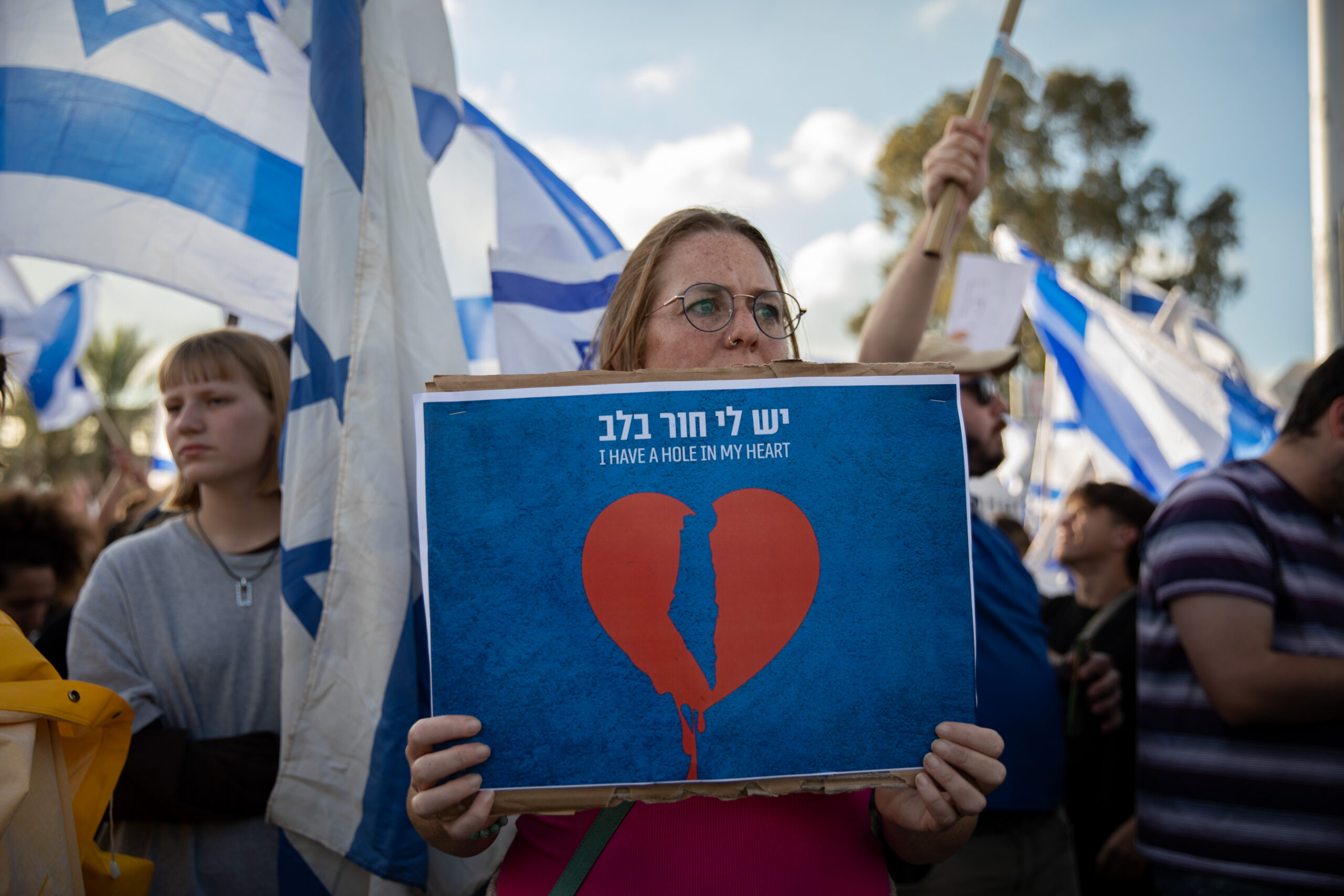

Photo by Shir Torem/Flash90
Tel Aviv University: Israel’s National Polarization Index 2026
Tel Aviv Conference – The Future of Israel Launches the National Polarization Index:
Comprehensive Study by the Agam Institute and the Department of Communication at Tel Aviv University
Israel’s National Polarization Index 2026:
Red Alert – Polarization in Israel Reaches Peak of 8.3 out of 10
- Nearly 1 in 3 Israelis (30%) supports (or does not oppose) taking any action necessary to save Israeli democracy – even if it involves violence.
- For the first time, polarization between secular and ultra-Orthodox (Haredi) Jews is the most hostile divide in Israel – even higher than Jewish-Arab polarization.
Presented for the first time at the Tel Aviv Conference held at Tel Aviv University in collaboration with the Kadar Foundation (Tuesday, May 12): The Dan Department of Communication at Tel Aviv University and the Agam Institute launched the National Polarization Index 2026 – a broad, first-of-its-kind trend study examining the strength of social cohesion in Israeli society. The Index presents a disturbing picture: Israel’s social polarization score stands at 8.3 out of 10, indicating a red risk level that reflects a sharp escalation in social rifts and a troubling rise in fear of violence. The Index also shows that, for the first time, polarization between secular and ultra-Orthodox Jews is the most hostile in Israel (48 points), surprisingly even higher than Jewish-Arab polarization (41.5 points).
The National Polarization Index 2026 was launched at the Tel Aviv Conference held at Tel Aviv University in collaboration with the Kadar Foundation. The study was led by Dr. Nimrod Nir, the Agam Institute, and Asa Shapira, Head of the Marketing Track at TAU’s Dan School of Communication. The Index is a multidimensional research initiative that aims to create a unified and comparable standard of measurement, enabling in-depth examination of unity vs. polarization levels in Israel, changes over time, and imminence of social disintegration.
60% of the Israeli public believe internal threats to be graver than external threats
According to the Index data, about 60% of the Israeli public believe that internal threats – rifts, hatred and violence within the nation – are graver than external threats (Hamas, Hezbollah, Iran). In addition, 30% of Israelis contemplate leaving the country.
Furthermore, 43.6% believe that the main rift in Israeli society is the struggle between a traditional/religious state and a modern/universal state. Only 13.5% of Israelis believe that the principal breach revolves around political issues, and the Ashkenazi-Mizrahi divide receives only 2.5%.
Dr. Nimrod Nir and Asa Shapira emphasize that the main divide in Israel has shifted from the question “What is the right policy?” to “What is the State of Israel?” “This represents a dramatic transition from political disagreement to an identity crisis – especially along the axis of religion vs. state, and tradition vs. progress. This polarization reflects a negative peak compared to previous measurements and also in global comparison.”

For the first Time, polarization between secular and ultra-Orthodox Jews is the most hostile in Israel
Since the outbreak of the Iron Swords War – polarization levels have risen sharply, even though wars usually reduce polarization: Regarding polarization between groups, the index indicates that polarization between secular and ultra-Orthodox Jews stood at 34.7 points shortly before the Iron Swords War (August 2023), and has escalated sharply ever since – reaching 37.7 points in May 2024, and surging to 48 points in the latest measurement (May 2026). A similar trend was also observed on polarization between voters of the coalition and opposition: 35.7 in August 2023, points, 37.5 in May 2024 and 46.8 in May 2026.
In contrast, Jewish-Arab polarization, which stood at 39.6 points in August 2023, peaked at 49.8 during the war (May 2024), and then declined to 41.5 points (May 2026).
The Index indicates a sharp increase in legitimization of political violence
Nearly 1 in 3 Israelis (30%) supports (or does not oppose) taking any action necessary to save Israeli democracy – even if it involves violence. In addition, 32% of coalition voters and 21% of opposition voters say they will not necessarily accept the results of the next elections.
In this context, it should be noted that over 70% of the public claim that the voters of the opposing camp jeopardize state security, and 43% agree to (or do not oppose) living in a society without people from the opposing political camp. Additionally, 30% of Israelis do not want a family member to marry someone from the other camp.
Regarding the state’s character – the Index shows that 48% of the coalition’s voters support a halachic state, while 64% of the opposition’s voters prefer a complete separation of state and religion. The creators of the Index note that this is not merely a political disagreement, but a competition between two different types of identity and national character.
The Index also includes several bright spots: for example, 69% of the Israeli public are willing to compromise and give up some of their camp’s principles in order to preserve national unity. 71% of the public are open to friendships with voters from the opposing camp, and 77% reject violence under any circumstances.
In conclusion, Dr. Nimrod Nir and Asa Shapira emphasize that “Israel is entering an election year at a red risk level. The faultlines are deep, legitimacy is eroding, the rules of the game are cracking, and the potential for violent escalation is high. To spark a crisis, we don’t need a majority for violence. A significant minority and mutual fear are enough. At the same time, this is not a despairing study – but an emergency study. The substrate for rupture already exists, but not all brakes have collapsed just yet. This is the time for everyone – policymakers, the law enforcement and legal systems, and the broader public alike – to pull themselves together and understand that we must join hands to strengthen what we still share, before that too fractures.”