
Daniel Gordis: Far from the international headlines, Israel is mired in a frustrating war we don’t know how to win.
Far from the international headlines, Israel is mired in a frustrating war we don’t know how to win. by Daniel Gordis

Daniel Gordis is Koret Distinguished Fellow at Shalem College & author of 13 books, including the award-winning Israel: A Concise History of a Nation Reborn. He blogs and podcasts at “Israel from the Inside” on Substack. To Subscribe: https://danielgordis.substack.com/
Imagine that someone asked you right now, “What would you guess are the main stories on the front pages of Israel’s papers?” What would you list? The elections and the merger of the Bennett and Lapid parties? The Strait of Hormuz? What else?
As we’ll see below, while all the stories that appear on today’s front pages have made the international press, their place in the Israeli public’s mindset is quite different from what one might assume. So today, we’re taking a quick look at Israel’s papers to give a sense of what the country is thinking — and worrying — about.
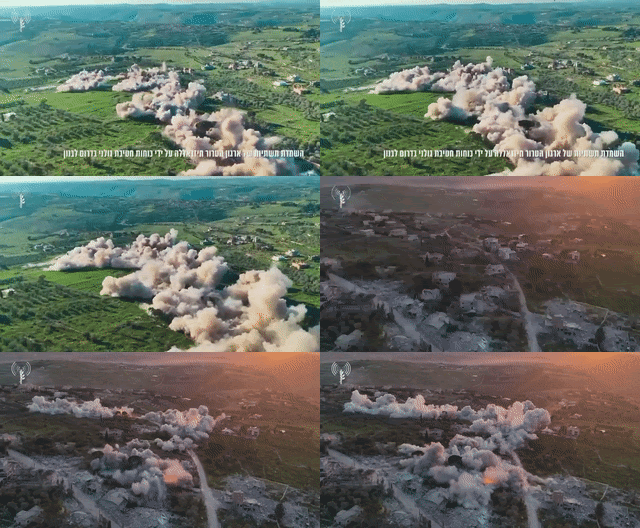
The (undated) video at the top, released by the IDF spokesperson’s unit (you can see their logo on the top left corner of the frame) is meant to communicate to Israelis that the army — in this case, the Golani brigade — is steadily destroying Hezbollah’s infrastructure.
The people I’ve heard comment on the video have walked away with a different conclusion. What people are noticing is not how the IDF is blowing up Hezbollah’s tunnels, but rather, how vast the terrorist infrastructure is, and how now, there’s nothing to report, because the US is preventing the IDF from destroying it.
If you lived in the north and you began to intuit that the threat just across the border is not going to be removed, would you stay there?
As is often the case, it can take a personal interest story to get a country focused on an issue, and that’s precisely what happened this week.
The role of Tatzpetaniyot (Field Intelligence Observers) has long been a part of the IDF, but became much better known after October 7, when many Tatzpetaniyot stationed near the Gaza border were among the first to see the invasion beginning and reported the suspicious activity leading up to it. Many were killed or taken hostage when their bases were overrun by Hamas; some of the highest profile female hostages — among them Liri Albag, Agam Berger, Daniela Gilboa and Karina Ariev — were Tatzpetaniyot.
Tatzpetaniyot, in the aftermath of the disaster, is now a position people pay attention to.
When Idan Fooks, z’l, was killed in Lebanon this week, he was tragically the latest in a series of IDF losses in Lebanon. What made the incident stand out, though, were two factors. First, Fooks was killed not by bullets, or a rocket, or an anti-tank shell or an IED, but by a Hezbollah drone, a threat the IDF has not yet figured out how to address. Second, Fook’s girlfriend, a Tatzpetanit, was coincidentally monitoring the very area in which he was operating, and on her screen, she watched him get killed in real time. It was that horror which brought the north back to the attention of the country—and the picture isn’t pretty.

Today’s front pages give a sense of the frustration brewing in the country and the sense that we’re stuck on all fronts: Hamas is regrouping, Hezbollah is being protected by a cease fire that has citizens of the north enraged, Iran is jostling to keep its enriched uranium and its nuclear program intact, and the Prime Minister doesn’t have much say when it comes to Trump these days. The press can point that out in ways that Bibi cannot, which as we’ll see below, is precisely what it’s doing.
We start with today’s Ma’ariv front page. In the large yellow rectangle, the main headline reads “The Declaration and the Retreat.”
Ie, Bibi declared one thing, but reality is quite different.
The smaller headline, black on white just below the yellow rectangle reads:
“Despite the Prime Minister’s promises, several IDF units are scheduled to depart Lebanon for other missions ◼️ The decision to cut down on forces in Lebanon stems from the American cease-fire and American limitations on IDF activity which have yet to be lifted. ◼️ Head of Hezbollah rejects any option of negotiations: “Out of the question.”

The story in the pink rectangle is about Idan Fooks, z’l, while the story in the green is about the murder of Yemanu Binyamin Zelka, a 21-year-old Ethiopian-Israeli who was killed in Petah Tikva on Israeli Independence Day.
Zelka, who worked as a shift supervisor at the pizzeria, asked a group of teenagers to stop spraying party foam inside the restaurant and harassing customers. After he finished his shift around 1:00 AM, the group of teenagers waited for him outside. Security footage showed approximately 10 minors encircling, beating, and stabbing him. He was left critically wounded and died the following day at Beilinson Hospital.
At least eight suspects, aged 12 to 17, have been arrested. Police reported that some of the suspects “acted like veteran criminals,” turning off their phones and hiding in an attempt to evade capture.
Zelkah’s murder was not the only one in Israel this week, and not the only one committed by minors. What this is all about is not clear, but Israelis are worried about a deep social problem that has long been neglected.
Yisrael Hayom shows a photo of an exploding drone (due to the Fooks story above), with the headline that says “A Race to Develop a Response to Hezbollah’s Drones.”
In the purple at the bottom, “Residents of the North say: There is a war going on here. Don’t hide it.”
And in the light blue: “Almost without school since Covid and all the wars: this is how violence among Israel’s youth has become a national plague.” Back to the murder of Zeklah, among others.

Yedi’ot has a large white headline that says “We’re not moving from here”, which is a double entendre. Are we not moving the army out of Lebanon? Or are the residents of the north determined to stay? Or, given that the army is leaving Lebanon in dribs and drabs, are residents of the north going to head south, too?
And then what happens to the county’s northern sector?
Which is why the headline in the yellow rectangle says
“This is how the cease fire in southern Lebanon has turned into a strategic problem.”

In the red rectangle on the bottom right of the front page:
AT THE FRONT: the IDF attacked the Beqaa Valley in Lebanon yesterday but the army is still being held back by the political echelons ⚫️ Dealing with the threat of IED’s and drones, the clash of interests between the USA and Israel, Hezbollah’s efforts to derail the negotiations, the close linkage between the various fronts and the deep frustration of the IDF’s senior commanders.
In the purple rectangle at the bottom left:
AND ON THE HOME FRONT: Mor Peretz received a photo in real time of her nine year old son lying on his classroom floor protecting his head ⚫️ Neta Senesh, eleven years old, and her friends lay down on the floor of the school bus while above them Hezbollah drones were flying: “I’m really afraid. Why do they send us to school when they’re shooting at us and we could be injured?”
Ha’aretz looks at two major internal issues:
In the red rectangle:
“A crisis of trust between [David] Zini [head of the Shin Bet] and the heads of branches and units in the Shin Bet.”
Zini’s appointment was controversial from the start and there are now widespread concerns that the intelligence community is suffering from deep internal divisions.
In the yellow rectangle:
“It’s essentially a revolt”: [IDF Chief of Staff] Zamir cannot ignore the enormity of the discipline problem throughout the IDF.

Finally, Calcalist, one of Israel’s most important financial papers, ran this headline, in the green rectangle:
Netanyahu put the security of the north in the hands of an unstable American President, and this is how things look.
Not much comment needed there.

When people around here see videos from the army such as the one at the top of this post (the IDF isn’t sending any out right now, because there are no real accomplishments to report), they tend to roll their eyes.
“What we need,” they say, “is not videos of tunnels being destroyed. We need a plan. For the south. For the north. For Iran. For the handcuffs in which the Americans have placed us.”
And implicitly, of course, they think, “We know who was at the helm when we got into all of this. Is there anyone who can extricate us?”