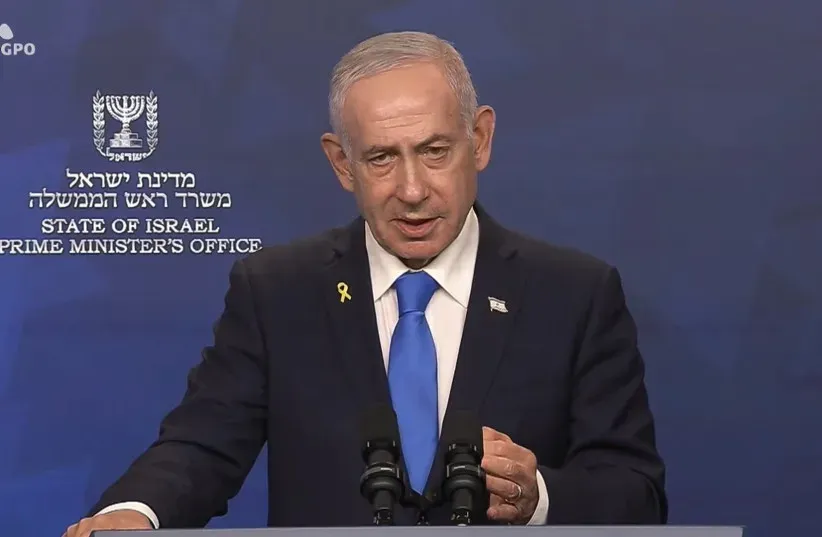

Prime Minister Benjamin Netanyahu addresses the nation in November, 2025 (PMO)
Michael Oren: Should Israel Pardon Netanyahu to Save Itself?

Ending Netanyahu’s corruption trial would mean an admission of guilt and could be the end of his political life.
Back in 2019, while serving as a deputy government minister, I was approached outside a Knesset meeting by Yossi Yona, a former philosophy professor and member of the opposition Labor Party who I’d come to admire. He told me that he had a great idea: that Benjamin Netanyahu should get a pardon in his corruption trial. Evoking the pardon of Richard Nixon in 1974, he argued that pardoning Netanyahu would allow Israeli society to finally move on from more than two decades of Bibi. “Once pardoned,” Yossi explained, “Netanyahu can retire from politics and Israel will be spared years of dangerous rifts. It’s time for the state to move on.”
I recalled Yona’s words this week as the embattled prime minister formally appealed for a pardon. In his appeal to Israel’s president Isaac Herzog, Netanyahu argued that while his personal interest would be best served with the trial running its course, it was time for the country to move on. Echoing a letter sent by President Donald Trump last month, Netanyahu said for the sake of Israel’s national unity, it was time to move on.
It feels like forever since my Knesset conversation with Yossi. The charges against the prime minister—for fraud, breach of trust, and accepting bribes—have gone to a trial dragging on for more than five years. The hearings have proceeded during the divisive struggles over the government’s judicial reform program and its refusal to draft ultra-Orthodox Jews, and for the last two years, in a war many Israelis regarded as existential. Throughout that conflict, perhaps absurdly, Netanyahu has been compelled to appear in court as frequently as three times per week and often for a full day.
For Netanyahu’s detractors, the trial represents a minimal comeuppance for a politician they view as irredeemably corrupt and corrosive to Israeli politics. For his supporters, the charges against Netanyahu are part of a protracted witch hunt waged by a dwindling liberal elite against the country’s most dynamic conservative leader who legitimately defeated them at the polls.
The controversy can best be seen as yet another facet of the Kulturkampf plaguing Israeli society. On a whole host of issues, the metropolitan, secular elites face off against a coalition of traditional Likudniks, the orthodox and religious Zionists. The split continues today in the left’s demand that the IDF reservists who allegedly abused Hamas prisoners should be court-martialed, and the right’s insistence that the soldiers are innocent and praiseworthy.
What is widely acknowledged, even by most Netanyahu critics, is that the charges against him of trying to manipulate the press and to trade government tenders for favorable media coverage—the so-called Case 2000 and 4000—are unlikely to lead to convictions. That leaves Case 1000. Involving gifts of hundreds of thousands of dollars of cigars, champagne, and jewelry to the Netanyahu family by their affluent friends, such acts could easily be dismissed as misdemeanors if not for the accusation, as yet unproven, that Netanyahu provided financial favors in return. To preempt that possible finding, Netanyahu need only plead no contest to accepting the gifts and perhaps pay a fine and be presidentially pardoned for the rest.
That resolution, though seemingly straightforward, is still not acceptable to all.
A pardon, wrote Times of Israel commentator Shalom Yerushalmi, “would mean. . . that Netanyahu is worthy of continuing to lead the country, even after the October 7 disaster.” Yuval Yoaz, a lawyer and legal analyst, suggested that, while a pardon might bridge some of the schisms in Israeli society, the price would prove prohibitive. “Granting a pardon. . . would constitute an affirmation. . . that Netanyahu was, in fact, persecuted without fault by the law enforcement system,” he posited. “That would be the end of the rule of law in Israel.”
Looming over these arguments is the question of whether Netanyahu will admit any guilt. Such an admission is required by law as a prerequisite for receiving presidential pardons, but it comes with a “moral turpitude” clause prohibiting the confessed from seeking further office. Netanyahu, who by most accounts is planning to run for reelection in 2026, is highly unlikely to sign this admission.
Rather, he is looking to a precedent set by Isaac Herzog’s father, former president Chaim Herzog, who in 1986 preemptively pardoned Shin Bet agents accused of killing captured terrorists. At the time, the elder Herzog explained his decision as necessary to preserve national unity. His son, Netanyahu hopes, will evoke the same justification.
In recent years, presidential pardons have become common in the United States. Indeed, one of Joe Biden’s last and most controversial acts was to preemptively pardon members of his family before Trump took office, a move that was then followed by Trump pardoning hundreds of people involved in the January 6, 2021 riot at the Capitol. Not surprisingly, perhaps, Trump has repeatedly called—even before the Knesset—for pardoning Netanyahu.
While these American pardons are rarely controversy-free, few are issued with the intent to preserve America’s unity and resilience.
A pardon for Netanyahu will not be welcomed by some Israelis, though a sizable majority of them will feel relief that the prime minister’s long shadow may finally pass over the country.
Even major Netanyahu opponents like Naftali Bennett are today willing to embrace the idea first floated to me years ago by Professor Yona, that it’s time for the state to move on. But even if all of Israeli society can accept this pardon and move on, plenty of other rifts in the country remain to be bridged.
This article originally appeared in The Free Press on December 1, 2025.