
Sheldon Schreter: Calling Bibi’s Bluff, for the Sake of the Country
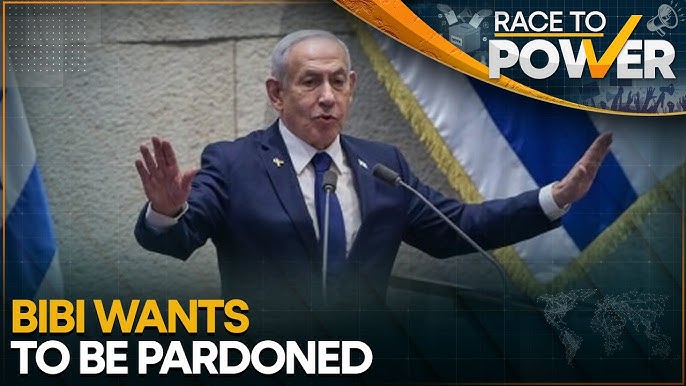
Israel is intensively debating Prime Minister Netanyahu’s request for a Presidential pardon. I agree completely with the critics of this “request”, in terms of its transparent objective of enabling Bibi to escape accountability for his numerous errors and misdeeds while seriously undermining the independence of the judiciary and the principle of equality before the law.
Calling this a “pardon” is a misnomer and a facade, because that entails acknowledgement of guilt and withdrawal from active politics, which Bibi unequivocally rejects. What he is demanding is the President’s direct intervention in Israel’s judicial process, to halt and invalidate his trial.
Our senior commentators are fascinatingly divided in their attitudes. A glance at the well-known ynet site today (December 1, 2025), provides ready examples. The veteran columnist Nachum Barnea is scathing in his critique and wishes Bibi would liberate Israel from his toxic domination of its politics in return for the cancellation of the trial, but knows that is not happening. Barnea implies that working out a deal to defuse the trial’s polarizing effect which is literally pulling the country apart, might well be worth doing.
Nadav Eyal and Yuval Elbashan argue that the President must refuse the request, notwithstanding the costs. Ben-Dror Yemini and Ari Shavit both recognize that Bibi will never step down voluntarily, but contend nonetheless that the benefits for Israel of his agreement to certain conditions are existentially important, hence worth it. If President Herzog declines or insists on the political retirement that Bibi refuses, we remain gridlocked, divided and weakened. Even those who say the President must decline, recognize that the country is suffering from the conflicts that the trials have generated.
What could a more creative response from President Herzog look like? Here are some ideas, based on the above commentators, with a few points of my own.
President Herzog should enthusiastically endorse the rationale of Bibi’s request, which focuses centrally on the necessity of rebuilding national unity. To achieve that critical goal, he should demand the Prime Minister’s active participation in neutralizing the main issues currently splintering the country. Specifically, he should condition the cancellation of the trial on:
- Withdrawal of all legislative proposals for radically modifying the judicial system and for exerting Government control over the mass media, for a minimum of two years – or longer – until some broader consensus can be worked out.
- Cessation of attacks by the Government on the Attorney-General, Gali Baharav-Miara, including the proposals for revamping her position by splitting it into two or three different positions.
- Appointment of a national (not a governmental) commission of inquiry into the events of October 7, 2023. The Chair should be a retired Supreme Court Justice, as specified by the law. But a supervisory role of the Commission’s activity should also be given jointly to the President, Isaac Herzog, and to his immediate predecessor, Reuven Rivlin.
The Prime Minister would not love such conditions, to put it mildly. But he would have real difficulty in rationalizing his rejection of such clearly unity-enhancing proposals, which provide a trajectory for pulling Israel out of its dangerous tailspin. The President would have granted his main wish for release from his criminal trials, without insisting on his disqualification from further political activity, in return for powerfully reducing Israel’s internal strife and taking great steps toward realization of a national consensus.
Critics will contend, not unreasonably, that the precedents created by such an approach are too dangerous and vulnerable to future malfeasance to be tolerated. Some of them will say that Bibi’s track record of violating agreements and twisting them to his advantage would make his consent to such terms – unlikely as that may be – inherently unreliable.
I do not belittle these concerns. My main point is that these are risks that must be taken for the sake of Israel’s future. The level of internal division in Israel is alarming, and the upcoming election season will surely exacerbate it. Regardless of one’s opinion of Bibi’s sincerity, his stated concern for Israel’s basic internal unity is absolutely correct.
One last thought. A future government of Israel must address the issue of the equality of the obligations of citizenship, which is at the heart of the social contract between the country and its citizens. The perception of fundamental inequality is demoralizing Israel dangerously.
All Israeli citizens – Jewish, Muslim, Christian, Druze – should have the option of choosing between military or other national service when they reach the age of 18. National service can take the form of integration into the Israel Police or Firefighting services, into Magen David Adom or Hatzala or the hospital system, into the “Mekorot” national water authority, into the various frameworks for eldercare and frail care via the national welfare authority (Bitu’ach Leumi), or into agricultural labour and food rescue efforts via Leket and other food security organizations. I’m sure more avenues for constructive national service can be found.
Equality of citizenship obligations must also entail equality of citizenship privileges, in national government, in municipal, police and town-planning services, in access to health and educational facilities, employment, transportation, and more. The two sides of this equation are mutually dependent and reinforcing, and serve to fulfil our highest aspirations for Israel as a democratic and Jewish state.