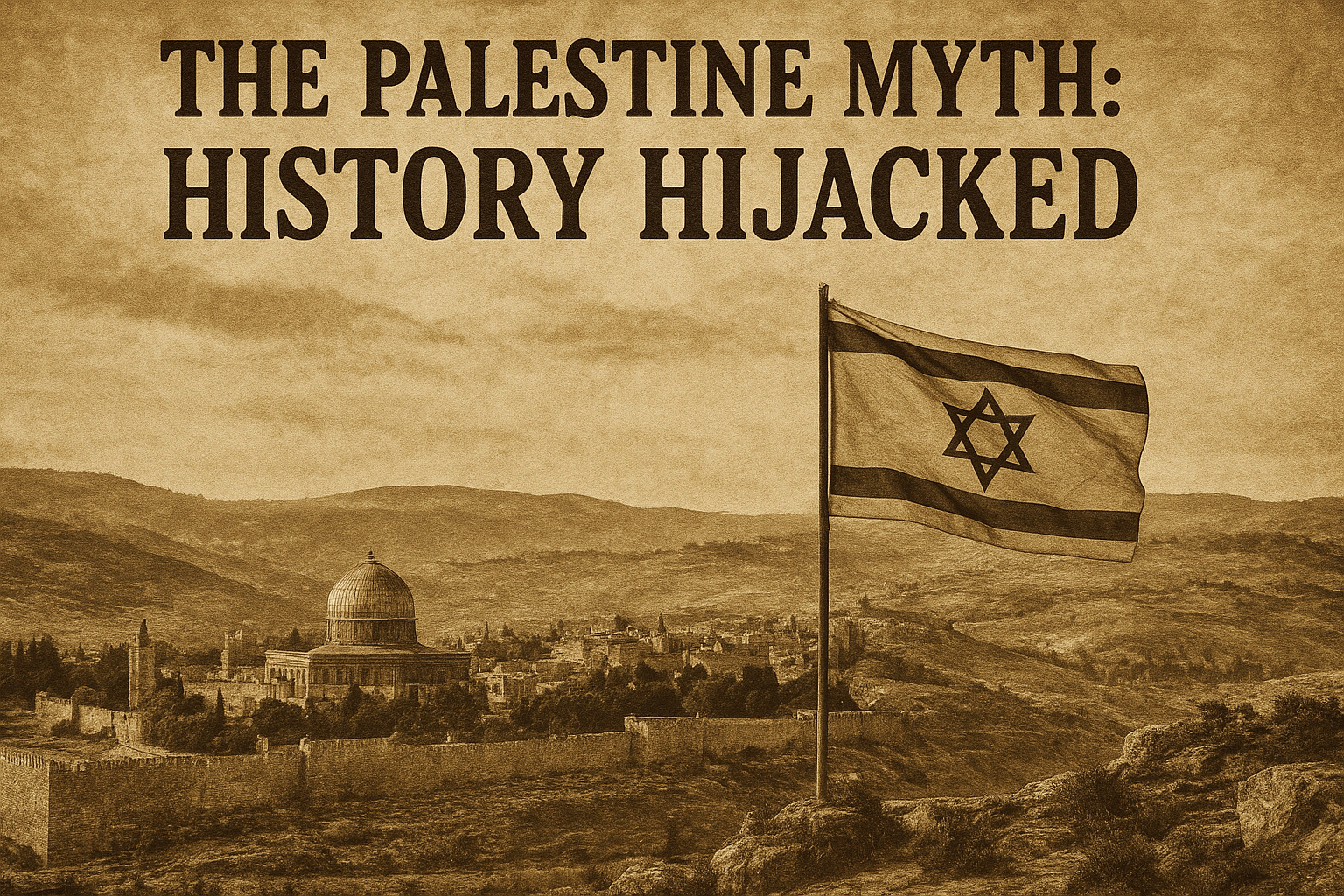

Sabine Sterk: When a Lie Becomes a Cause: The Making of a Modern Myth
For anyone who has spent a lifetime studying the Middle East, its archaeology, its religions, its ancient texts, its shifting empire, the ease with which a historical lie can become a global dogma is both astonishing and deeply alarming. I speak not as an academic observer, but as someone who lived in the region as a teenager, who walked through the museums of Syria, Jordan, Egypt, and Israel long before politics hijacked conversation, and who spent a lifetime reading the Torah, the Bible, the Talmud, and yes, even the Quran. All of them tell a story thousands of years older than modern slogans and viral hashtags: the story of the Jewish people rooted in their ancestral homeland.
Yet today, a growing number of individuals, including educated Westerners, repeat with unshakable confidence that “Palestine was always an Arab land” and that Jews are “European settlers,” as if history began in 1948 and the thousands of years before it never existed.
The tragedy is not only the ignorance itself, but the pride with which it is declared.
Today’s example came in the form of a message from a man in Australia responding to one of my articles on Time To Stand Up for Israel, the advocacy platform I run. His claim was typical: World War I memorials in Australia mention “Palestine,” therefore Palestine must have been a nation-state. The logic is riddled with holes, Britain also used “Mesopotamia,” “Transjordan,” and “Persia” on its memorials, none of which prove sovereignty, but logic was not his goal. He simply needed the familiar narrative to remain intact.
I responded with historical facts: it was the Ottoman Empire, the Roman renaming of Judea to “Palestina,” the absence of any sovereign Arab state by that name, the religious and historical evidence of Jewish roots reaching back millennia. His answer came instantly, and predictably: Jews, he said, were merely “European nationals who adhered to the Jewish religion.”
This is not simply wrong; it is historically illiterate. It erases archaeology, scripture, inscriptions, written records, and the collective memory of a people who maintained unbroken connection to their land throughout exile, dispersion, and persecution. And yet for many, the lie is easier to grasp than the truth.
The question is: Why?
The answer has less to do with history and far more to do with human psychology. We often imagine that misinformation spreads among the uneducated, the fringe, or the easily manipulated. But that is not true. Entire societies, including professors, journalists, and intellectuals, can fall for a false narrative when it satisfies psychological needs.
Above all, people crave belonging. A person’s identity is shaped not by facts they verify, but by opinions their environment rewards. If friends, media, and online influencers repeat the same story, the pressure to conform becomes overwhelming. Standing apart from the group feels dangerous; agreeing with the group feels virtuous. As long as the narrative appears moral and emotionally satisfying, people embrace it, regardless of its relationship to truth.
There is also the authority factor. A professor, a public figure, or a journalist repeating a falsehood gives it instant legitimacy. Many assume that someone else must have done the fact-checking, so they outsource their critical thinking. This is how historical myths become mainstream ideas.
Repetition strengthens this effect. When a claim is heard often enough, the brain begins to treat it as familiar, and familiarity feels like truth. Propaganda has known this for centuries. Social media has turned it into a science.
Fear also plays a role. Fear of being wrong. Fear of being called racist. Fear of losing social approval. Fear makes people surrender complexity for the safety of a simple narrative. This was true in the 1930s when economic desperation and national humiliation created fertile ground for conspiracy theories. It is true now, though the tools of propaganda are faster, slicker, and global.
Perhaps the most dangerous ingredient is moral self-righteousness. Many embrace anti-Israel narratives not because they know the region, its texts, its archaeology, or its history but because the narrative offers them an easy moral identity. “Palestine” becomes a symbol onto which they project their desire to be on the “right side.” Once this happens, evidence becomes irrelevant. Facts become irritating obstacles. Any contradictory information is dismissed as propaganda.
This is how intelligent people become emotionally invested in a falsehood.
But dismissing the problem as mere ignorance would be a mistake. What we are watching is the deliberate rewriting of Jewish history: the erasure of an indigenous people, the inversion of victim and aggressor, the transformation of a modern political conflict into a simplistic morality tale. This is not accidental. It is strategic. And it is working.
The psychological machinery behind mass belief, belonging, repetition, authority, fear, and moral signaling is the same machinery that fueled some of history’s darkest movements.
I do not say this lightly. But when entire societies confidently repeat a lie, demonize a minority, and replace historical truth with ideological fantasy, the echoes of the past become impossible to ignore.
Israel does not need the world’s pity. It needs honesty. The Jewish people do not need sympathy. They need the world to stop rewriting their past.
The only antidote to mass delusion is truth, repeated clearly, confidently, and unapologetically. And the truth is simple: Israel is the homeland of the Jewish people. It always was. It always will be.
History says so. Archaeology says so. Scripture says so. And most importantly, the people who have prayed toward Jerusalem for over 3,000 years say so.
That truth deserves to be heard above the noise.