
Oplus_16908288
Sabine Sterk: The Olympics Were Never Just Sport And We Are Watching Them Break
People like to pretend the Olympics are about running faster, jumping higher, and smiling politely on podiums. That fantasy has always been convenient and completely false.
From the very beginning, the Olympics were political. They were moral. They were philosophical. They were a controlled alternative to war.
The ancient Olympic Games, first held in 776 BCE in Greece, were built on a radical idea for a violent world. City-states that were actively at war agreed to stop killing each other. Not because they had suddenly become peaceful, but because they believed competition could replace bloodshed, if only temporarily.
The sacred truce, the Ekecheiria, was not symbolic. It was practical. Enemies laid down their weapons so athletes and spectators could travel safely. The message was clear. Fight, but do not annihilate. Compete, but do not conquer.
Victory brought Honor, not land. Glory, not domination. Strength was admired without being weaponized. Even while Greek city-states despised each other, the Games insisted on a shared identity that rose above constant conflict. Politics did not disappear. Violence was restrained.
That idea carried forward when Pierre de Coubertin revived the modern Olympics in 1896. His vision was almost naïve in its optimism, but powerful in its intent. Sport as a substitute for war.
Internationalism over nationalism. Dialogue through competition. Rules instead of force. Respect for the opponent.
The Olympic Charter still says it plainly. The goal of Olympism is to place sport at the service of the harmonious development of humankind, promoting a peaceful society.
And yet here lies the paradox. The Olympics try to be above politics while being permanently embedded in them.
Nations compete under flags and anthems. Hosting the Games is a geopolitical statement. Boycotts, propaganda, and protests are as old as the medals themselves. Berlin 1936 became a Nazi showcase. The Cold War turned medal counts into ideological warfare. The 1980 and 1984 Games were torn apart by boycotts. Athletes have always protested injustice.
The Olympics do not erase conflict. They expose it in a controlled, non-violent arena.
They exist to say this. Let us fight with rules, not weapons. Let us compete without destroying each other.
That is the core ideology. Or at least, it was.
Today, the Olympic stadium has turned into something uglier. A battlefield of prejudice.
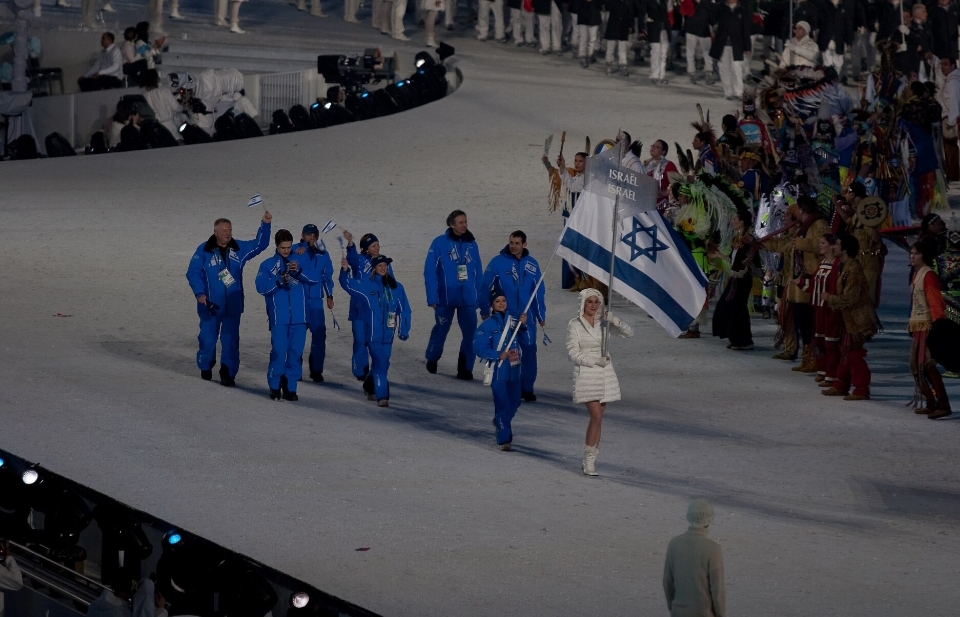
Israeli athletes walk into stadiums and are booed. Not for breaking rules. Not for cheating. Not for doping. But for existing. Their presence alone is treated as provocation. Meanwhile, athletes from regimes with documented war crimes, oppression, and mass human rights violations compete in silence, applause, and moral indifference.
That is not activism. That is selective outrage.
And this phenomenon does not begin in the Middle East. It begins thousands of kilometers away, on screens and phones, among people who have never been to the region, never spoken to an Israeli or a Palestinian, never shared a meal with a Jew or a Muslim, yet speak with absolute certainty about who is evil, who is innocent, and who should disappear.
This confidence is not rooted in knowledge. It is rooted in narratives.
Social media has erased the line between experience and opinion. A thirty-second clip, a slogan, a filtered image creates the illusion of expertise about a conflict spanning thousands of years, empires, religions, wars, peace offers, and repeated rejections of compromise.
Algorithms do not reward accuracy. They reward outrage. Israel becomes a cartoon. Jews become symbols instead of people. Palestinians become a single identity rather than millions of individuals with different histories, views, and responsibilities.
People who would never dare lecture a surgeon suddenly feel qualified to deliver moral verdicts on a conflict they discovered last week on Instagram.
Much of this is prejudice dressed as activism.
Antisemitism did not vanish after World War Two. It evolved. Today, it often hides behind the language of human rights, decolonization, and social justice. Old tropes return in modern packaging. Jews are portrayed as uniquely evil, uniquely powerful, uniquely manipulative. Israel is judged by standards applied to no other nation. Jewish history is erased. Jewish self-defense is reframed as aggression.
This is not a criticism of Israeli policy. Legitimate criticism exists and always has. This is something else entirely. It is an ancient hatred updated for the digital age.
The media ecosystem thrives on moral simplicity. One side must be pure victim. The other pure oppressor. Context disappears. Timelines vanish. Responsibility becomes one-sided. Terrorism is rebranded as resistance. Intent no longer matters. Only imagery does.
This environment is perfect for manipulation.
Narrative management is not imaginary. Messaging strategies are openly discussed in political activism worldwide. Selective storytelling, strategic omission, and emotional framing are not conspiracy theories. They are communication tactics.
Concepts like taqiyya are often misunderstood and misused in Western discourse, but the broader reality remains. Narrative shaping is deliberate. Language is chosen carefully. Facts are filtered. History is flattened to begin at a convenient moment that avoids earlier wars, rejected peace offers, and regional aggression.
This is not unique to Arabs. Every political movement does it. But in the Israel-Palestine conflict, it has been devastatingly effective.
Artificial intelligence does not fix this problem. It magnifies it.
AI systems learn from data. When misinformation dominates digital spaces, AI absorbs and reproduces that imbalance. Repetition creates perceived truth. Confidence replaces caution. If a lie circulates long enough, it becomes part of the dataset.
The most dangerous element is not disagreement. It is moral certainty.
People who have never lived with rockets dictate what Israelis should tolerate. People who have never experienced Jewish vulnerability define what antisemitism is. Nuance is dismissed as propaganda. Complexity is treated as guilt.
History is no longer studied. It is recruited.
If we care about peace, justice, or human dignity, we must choose responsibility over rage. Opinion without effort is not solidarity. It is performance.
The Olympics were meant to civilize conflict, not become another stage for the collective punishment of Jews.
The question is not whether people have the right to an opinion.
The question is whether they have earned it
About the Author
CEO of Time to Stand Up for Israel, a nonprofit organization with a powerful mission: to support Israel and amplify its voice around the world. With over 200,000 followers across various social media platforms, our community is united by a shared love for Israel and a deep commitment to her future. My journey as an advocate for Israel began early. When I was 11 years old, my father was deployed to the Middle East through his work with UNTSO.
I had the unique experience of living in both Syria and Israel, and from a young age, I witnessed firsthand the contrast in cultures and realities. That experience shaped me profoundly. Returning to the Netherlands, I quickly became aware of the growing wave of anti-Israel sentiment — and I knew I had to speak out. Ever since, I’ve been a fierce and unapologetic supporter of Israel. I’m not religious, but my belief is clear and unwavering: Israel has the right to exist, and Israel has the duty to defend herself. My passion is rooted in truth, love, and justice. I’m a true Zionist at heart. From my first breath to my last, I will stand up for Israel.