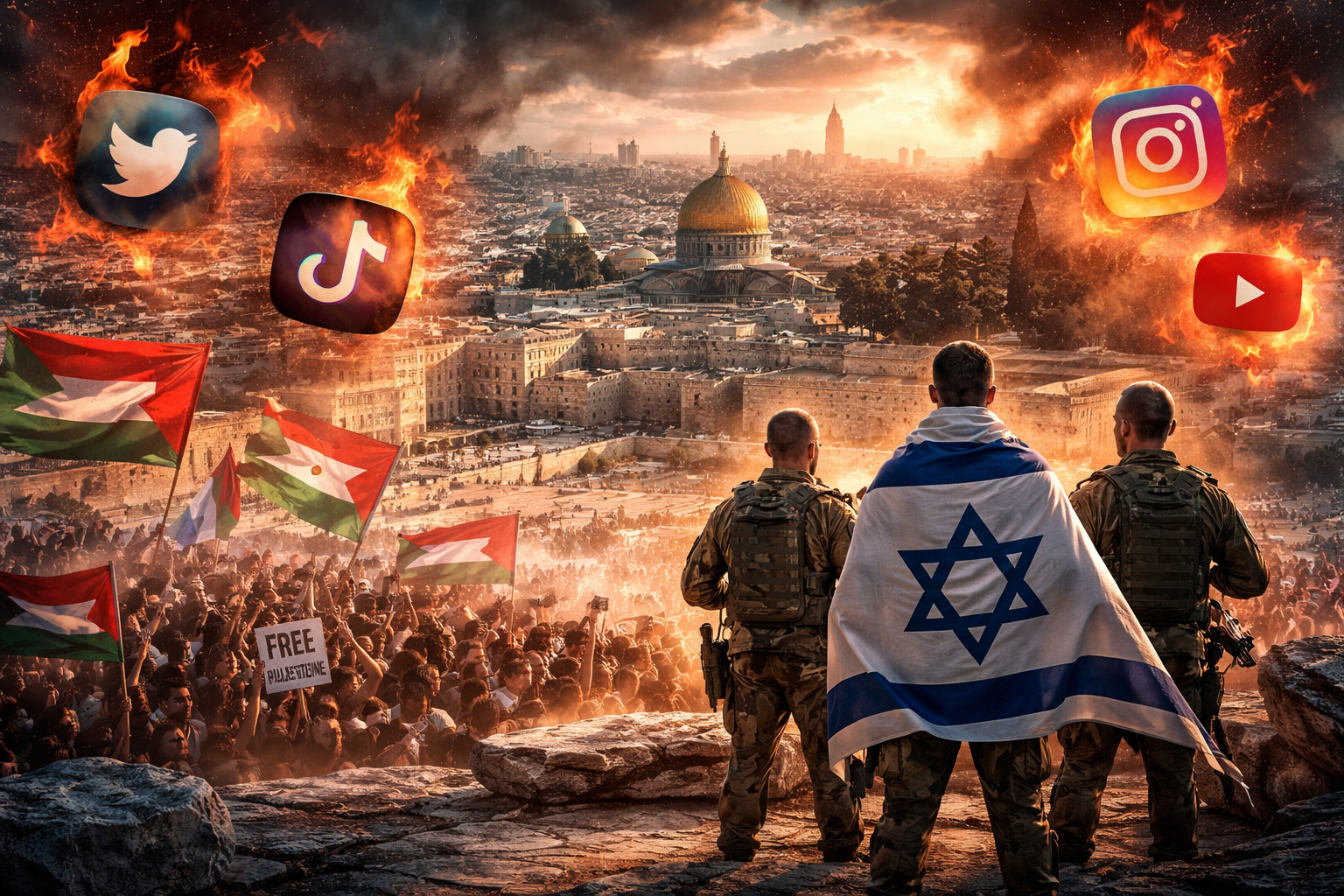

Sabine Sterk: Israel in the Era of Moral Shortcuts
Why a Complex Reality Is Reduced to a Slogan
I have lived in radically different worlds. I lived among radical Muslims in Syria. I lived among Orthodox Jews in Israel. I have read the Qur’an, the Bible, the Torah, and many other texts that shape how societies think, fear, and justify themselves. I did not travel to collect photographs or comfort, but to understand people from the inside, their assumptions, their narratives, their silences.
I am also a highly sensitive person. I notice atmospheres. I sense when something is distorted, when language no longer matches reality.
And from that place, personal, emotional, and intellectual, I find the world’s obsession with Israel deeply unsettling.
Not disagreement. Not criticism. Obsession.
The sheer scale of hostility toward one small country, across continents and cultures, among people who have never been there and know little about it, defies rational explanation. It feels disproportionate, emotionally charged, and strangely uniform.
So instead of stopping at the familiar conclusion, “antisemitism”, I want to examine the wider forces at work. Not to deny Jew-hatred, which is very real, but to understand why Israel has become the focal point of so much global moral fury.
Reality on the Ground Versus Reality Online
Living in Israel bears little resemblance to the Israel most people encounter through screens.
Israel is chaotic, argumentative, pluralistic, anxious, wounded, resilient, and intensely alive. Jews from Ethiopia, Yemen, Russia, Morocco, Iraq, Iran, Poland, and Argentina argue loudly in cafés. Arab doctors treat Jewish patients. Jewish doctors treat Arab patients. Secular and religious communities clash and coexist. Fear is present, not imagined fear, but fear shaped by rockets, suicide bombings, and massacres.
This is not an abstract place. It is a society under pressure, constantly negotiating survival, morality, and identity.
When I lived among radical Muslims in Syria, I encountered something strikingly different: antisemitic narratives were not fringe opinions. They were normalized. Jews were not individuals. They were an idea, a corrupt, malevolent force. Israel was not discussed as a country with citizens and dilemmas, but as an illegitimate evil that should not exist.
What shocked me years later was how familiar some Western activist language began to sound. The vocabulary had changed. The structure had not.
A Singular Obsession With a Small State
Israel is tiny. It does not lead the world in civilian casualties, ethnic cleansing, authoritarian repression, or territorial conquest. Yet it receives a level of scrutiny and condemnation unmatched by conflicts with far higher death tolls and far less moral ambiguity.
This imbalance demands explanation.
If concern were truly about human rights, many other regions would dominate headlines and protests. They do not. Israel does.
That alone should raise questions.
The Generational Divide
Attitudes toward Israel differ sharply by age.
Younger generations in Western Europe and North America are far more hostile than older ones.
This is not because young people are inherently antisemitic or immoral. It is because they grew up in a fundamentally different information environment.
They were raised on social media, not long-form journalism. On images, not history. On emotion, not context.
For many, Israel is not a real place. It is a symbol and symbols are easy to simplify, distort, and hate.
Education Without Understanding
Higher education is often assumed to produce deeper insight. In reality, it increasingly produces stronger ideological certainty.
Universities today prioritize frameworks of power, oppression, and identity. These tools can be useful, but when applied rigidly, they flatten reality. Israel becomes the “oppressor.” Palestinians become the “oppressed.” The story ends there.
The inconvenient facts; Jewish indigeneity, historical persecution, regional hostility, and internal Israeli diversity do not fit the model. So they are excluded.
What remains is moral clarity without moral responsibility.
Distance Creates Moral Absolutism
Geography matters.
Western Europe, far removed from daily security threats, often exhibits the harshest judgment of Israel. Distance allows idealism without consequences. It is easy to demand perfection when your children do not run to bomb shelters.
In regions that face real security dilemmas, people tend to understand Israel’s challenges far better, even when they disagree with its policies.
Experience tempers certainty.
The Absence of Firsthand Knowledge
Many of Israel’s most vocal critics have never been there. They have never spoken to Israelis or Israeli Arabs. Never sat through a Friday afternoon as sirens test emergency systems. Never experienced the contradictions of a society balancing democracy and survival.
Studies consistently show that structured exposure to Israel increases understanding. But when narratives harden first, even travel struggles to undo them.
Social Media and the Collapse of Shared Truth
More than any political factor, social media has transformed how Israel is perceived.
We no longer live in a shared informational reality. Algorithms curate personalized moral universes. Emotional engagement outweighs factual accuracy. Outrage spreads faster than explanation.
Israel suffers disproportionately in this environment because its reality is complex, slow, and morally difficult…everything algorithms punish.
Emotion Becomes Evidence
A burning building travels faster than the legal context. A crying child outperforms historical timelines.
Israel’s enemies understand this perfectly. Images stripped of context become weapons. Millions consume them daily without asking who filmed them, why, or what came before and after.
The Illusion of Knowledge
We live in an age of information abundance and context scarcity.
People read headlines, not articles. Watch clips, not debates. They absorb conclusions without foundations.
This creates confidence without competence. Many who speak loudest about Israel know the least about its history, regional threats, or internal debates.
Expertise Loses Authority
A viral influencer can outweigh a historian. A hashtag can overpower decades of scholarship.
Truth becomes whatever feels morally gratifying to share.
Journalism, academia, and nuance lose ground to popularity and speed.
Tribalism Replaces Thought
Social media rewards loyalty, not questioning. Binary thinking thrives. Good versus evil. Oppressor versus the oppressed.
Supporting Israel today often requires social courage. Silence is safer. Conformity is rewarded.
So Why Israel?
Because Israel sits at the intersection of everything modern culture struggles with: colonial guilt, religion, identity politics, post-truth media, and unresolved antisemitism.
It becomes the projection screen for global anxieties.
Final Reflection
Israelis themselves argue relentlessly about their government. That is democracy.
But the global hatred directed at Israel today is not proportional, not informed, and not honest.
Social media did not make people unintelligent. It made superficial thinking easier and socially rewarded.
Those who still think critically, read deeply, and resist slogans exist.
They are simply quieter.
And perhaps that is the most troubling reality of all.