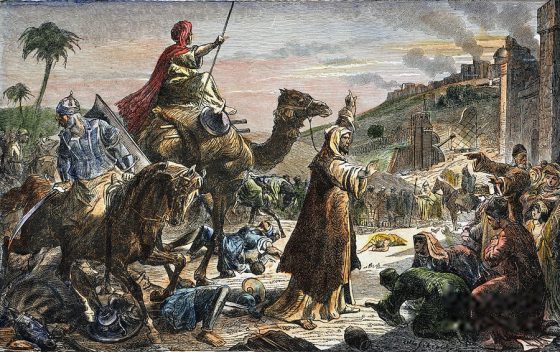

The entrance of Caliph Umar (581-644) into Jerusalem, 19th century colored engraving, via Wikipedia
Prof. Sam Lehman-Wilzig: Holy Shi(i)t(e)! Does Historical Conquest Legitimize Land Claims?
Given that Israel is now bombing the “proverbial” out of Iran, one might think that it has begun to “heed” U.S. Ambassador to Israel Mike Huckabee’s “suggestion” two weeks ago that Israel would have a legitimate claim to a good part of the Middle East because of the Bible’s promise to the Israelites to rule “from the Euphrates [Iraq] to the Big Sea [presumably the Mediterranean]”. Unsurprisingly, the Arab outcry against such a statement was immediate. Whatever one thinks of such a claim, a very interesting and highly fraught political question does arise: How far back in history may a country lay claim to territory that it lost in the near or distant past?
That’s not a purely “theoretical” question. After all, Iran’s radical Moslem regime wishes to destroy Israel in large part because it has “stolen” lands that belonged to the Arab/Moslem world. But then again, the “Arabs” stole the land from its inhabitants in the 7th century CE (636 to be exact). So whose land is it “really”?
Interestingly, international law has no official “expiration date” on territorial claims. Why not? Because it would open a Pandora’s Box of claims and counter-claims – especially against some of the world’s Great (and Middle) Powers, Israel, and other Arab states among them. A generally accepted doctrine, though, is called “intertemporal law”: the legality of an act – including acquiring territory – should be judged based on laws from the time it occurred, and not by contemporary standards. That means “now is history” (double entendre intended).
Over the course of humanity’s past, conquest created legal title: if you won the war and held the land, the world ultimately accepted it as yours. Such a “right of conquest” formed the basis of borders across Europe, the Middle East, the Americas, and beyond. However, that began to change after the two World Wars, with the UN Charter emphasizing two ideas: 1- Existing states’ territorial integrity must be respected; 2- Acquiring territory by force is not legally valid, even if you “win.” But again, these principles are prospective (present and future), not retrospective (what happened in the past).
This seemingly worthy approach underlies the central tension of contemporary international relations. Look at almost every border on the world map and you’ll find force, empire, and unequal treaties creating them in the past – with the modern system trying to freeze those borders to prevent endless wars over historical injustices.
Here are a few such contemporary flashpoints:
1) Russia invaded Ukraine, justifying its actions with the historical narrative that Ukraine is not a fully separate nation, that Crimea “has always been Russian,” and that Russian‑speaking areas are a natural part of Russia. This claim goes back many centuries. Conversely, Ukraine argues that its 1991 internationally recognized borders upon gaining independence are its legal foundation; any change must be peaceful and consensual.
The result: almost all countries refuse to recognize Russia’s annexation of Crimea in 2014 or the (partly successful) annexations of four provinces in 2022. The world’s “clock” is very short.
2) As is well known, Israel/Palestine presents a somewhat different problem: two peoples claim deep, continuous ties to the same land over millennia (Ukraine does not covet Russia land). Jewish claims are based on the Bible, ancient Israelite kingdoms, and continuous (albeit very small) Jewish communities living continuously in the Holy Land. From this standpoint, the 1948 creation of the State of Israel is merely official (international) recognition of such continuous territorial ownership.
Palestinian Arabs similarly emphasize centuries of residence, property ownership, and communal life (but never an independent country), constituting the demographic majority during at least the 19th and the first half of the 20th century.
From an international law standpoint, the main controversy revolves around the West Bank and Gaza that the U.N. assigned to the Palestinians who refused (and many still also today e.g., Hamas, Iran) to accept partition of the entire land. Nevertheless, U.N. resolutions have framed these lands as “occupied territories,” calling for Israeli withdrawal or a negotiated agreement.
But law is intellectually dry; historical memory evokes strong emotions. For those directly involved, the question of “how far back does one go” is politically and morally charged. The problem is that if one goes too far back – biblical kingdoms for Jews; early Islamic caliphates for Arabs – both sides view their own claim to the Land as paramount. But if “history” prior to the mid-20th century counts as much as the past eighty years, that too is morally problematic as it privileges the early modern era of brutal colonialism and empire expansionism, not to mention even earlier conquests (after all, as the Bible recounts, the Israelites conquered the Land from the Canaanite nations).
3) The U.S.–Mexico border is a classic case of territory taken by war and unequal treaty instead of mutual consent. Mexico, however, has long since ceased claiming that territory as its own; the United States treats those (eventual) states as part and parcel of the country – non‑negotiable. From an historical‑justice perspective, though, why are recent conquests illegitimate but ones such as the 19th‑century Mexican case OK? The answer is pragmatism, not morality: too much time has passed, the populations are no longer the same (ethnically or culturally), and over the ensuing years both the U.S. and Mexico have built distinct identities and economies within their respective new borders.
4) Similarly, elsewhere around the world. In Africa, territorial borders drawn by colonial powers were highly arbitrary (using a straight ruler to draw the map), but in 1964 the Organization of African Unity chose to respect inherited borders in order to avoid constant wars (again, choosing pragmatism over historical counterclaims decades of separate self‑government and (by now) a distinct political identity. Here too the international community has taken a pragmatic approach, treating the status quo as frozen: China’s claims are recognized diplomatically, but forceful unification is opposed. A somewhat similar approach is taken vis-à-vis India and Pakistan competing over Kashmir: keeping the post‑partition status quo and refusing to impose a final settlement.
So how far back does the world allow claims? Clearly, historical narratives matter morally but this is not the basis for legal title. One way around this “contradiction” is to accept traditional cultural, religious, or historical ties as supporting political autonomy, minority protections, or negotiated adjustments – but only in rare cases does it enable outright annexation or political secession.
What does all this mean for the Israel/West Bank-Gaza issue? “Time is of the essence” – literally and figuratively. How so? The U.S./Mexico story occurred almost two centuries ago: it’s over. Conversely, Russia’s land grabs are very recent, so they’re widely rejected. Israel’s occupation of the West Bank (and Gaza too?) is treated as “temporary” – but having lasted for several decades it has generated entrenched realities. Time might well be running out for the Palestinian cause as the longer political control exists, and the more people live their lives around it (half a million Jewish “settlers”), the more likely is the world to eventually seek a “pragmatic” ending.
To sum up, modern international practice points in one main direction: claims based on distant history are not well accepted; recent seizures are widely rejected as illegal. Anything in between these two polar situations is ambiguous but the reality on the ground will eventually determine the outcome de facto. Ambassador Huckabee (along with Israel’s “Return to Gaza” supporters) should take note; but so too should the Palestinians.