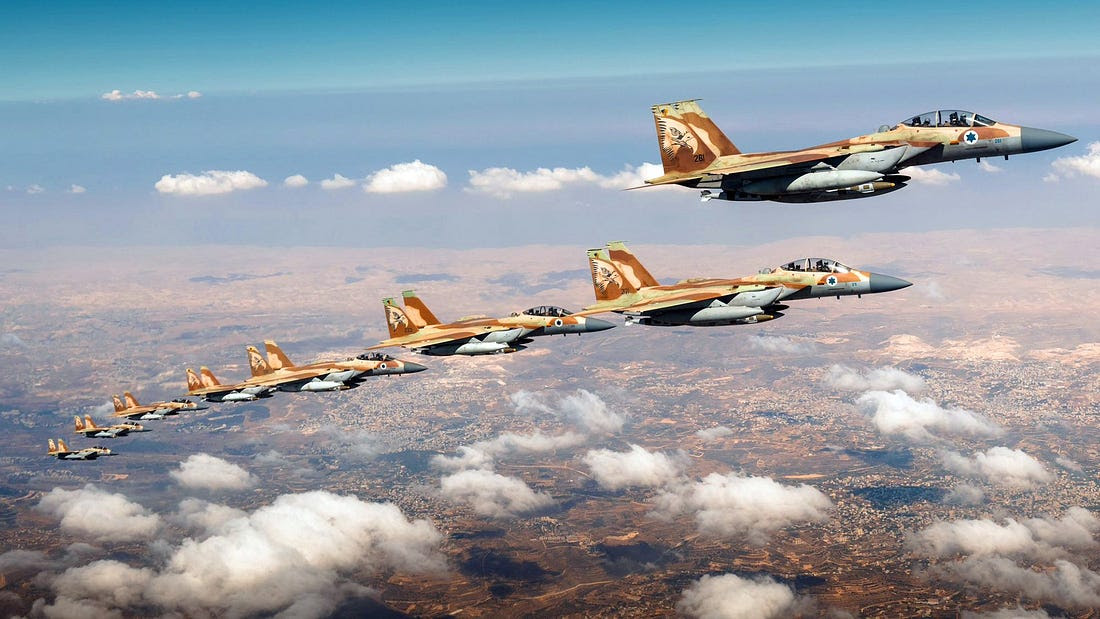

Israeli Air Force fighter jets on their way to attack Iran, June 2025 (Israeli Defense Forces Spokesperson’s Unit)
Michael Oren: Why Would Israelis Want War?
Today, after countless anti-war demonstrations, Israelis are again poised to protest in favor of war.

Contrary to what much of the world today believes, Israelis hate war. In our entire history, we have only wanted to go to war twice and both times when there was literally no choice. The first instance took place fifty-nine years ago, in June, 1967.
Starting in mid-May and continuing for three weeks after, Arab armies amassed on Israel’s borders and pledged to throw its inhabitants into the sea, yet still the government refrained from striking first. Prime Minister Levi Eshkol sought to exhaust all possibilities of resolving the crisis diplomatically before resorting to force. The IDF was fully ready to attack but Eshkol’s efforts continued one unbearable week after another.
Meanwhile, tens of thousands of reservists remained mobilized, leaving their homes, their families, and their fields. Finally, after enduring this traumatic “waiting period,” their soldiers’ mothers, wives, sisters, and daughters had had enough. They gathered outside the Prime Minister’s Office and protested not against war but in favor of it. “No more waiting,” they shouted. “War now!”
Today, nearly six decades later, after countless anti-war demonstrations, Israelis are again poised to protest in favor of war. And the reasons are similar to those that existed in 1967. The state is faced with strategic and potentially existential threats that cannot be removed through negotiations. There is simply no alternative.
That is the danger that Israel confronts today in Iran. Irrespective of whether the United States reaches an agreement with Iran on its nuclear program, the Islamic Republic will rush to manufacture many hundreds of ballistic missiles capable of destroying an entire apartment complex, if not a neighborhood. Under that ballistic umbrella, Iran can rebuild its “ring of fire” of terrorist proxies surrounding Israel and secretly break out to create atomic weapons. Unless we complete the work begun during last summer’s Rising Lion and Midnight Hammer Operations and fully neutralize the Iranian threat, Israel will return to the untenable situation that existed on October 6, 2023–and possibly much worse.
Preferably together with the United States but if absolutely necessary alone, Israel must act. The overwhelming majority of Israelis, even those identifying with the peace camp, understand that. At stake is not only the IDF’s historic achievements in this last war but its ability to wage one effectively in the future. We, alone among the nations of the Middle East, sincerely care about the Iranian people and wish to see them liberated from tyranny. We know that winning this war will come at a price and that the cost might prove to be heavy. and yet we are willing to pay that price for the simple reason that—as in 1967–there is no choice.
Three weeks passed and at last Eshkol, too, was satisfied. Diplomacy had failed, leaving Israel no alternative. The preemptive strike the IDF then launched saved the state and irrevocably changed the Middle East. Peace with Egypt and Jordan and later with other Arab countries became possible. Today, too, Israel will defend itself and, in doing so, render our region more stable and secure.
This article was adapted from a Hebrew version originally published in Ynet on February 19, 2026.