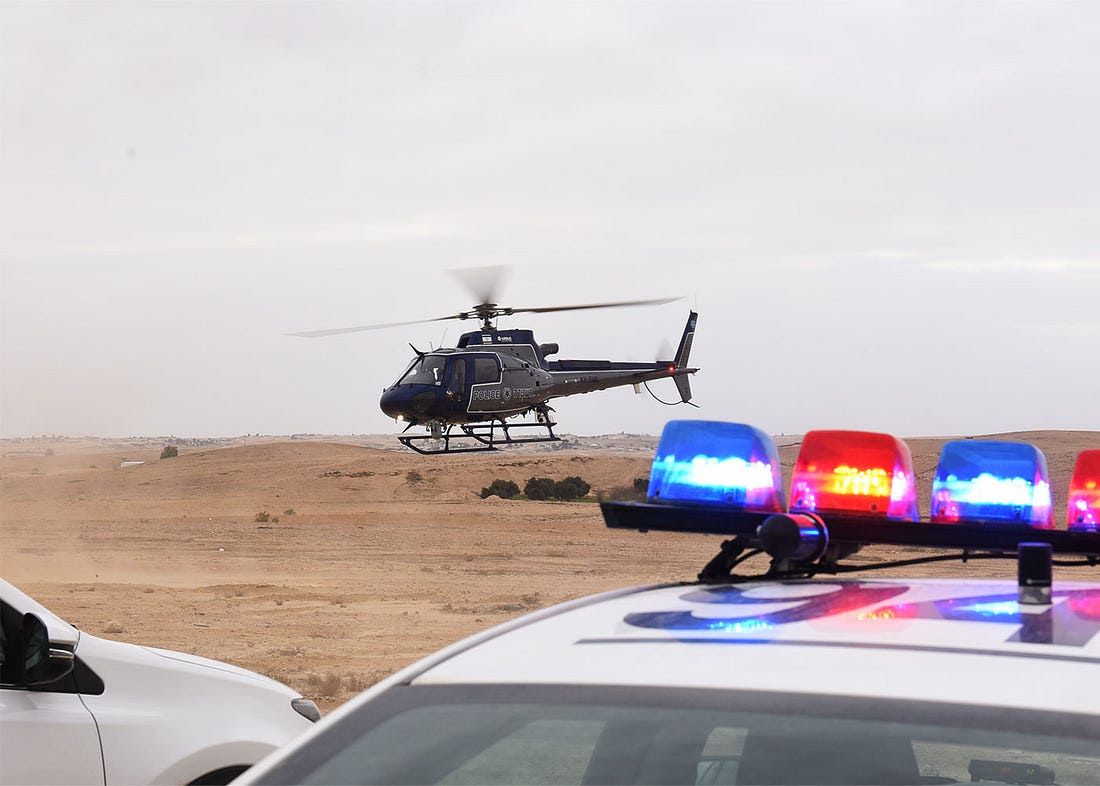

Israeli police helicopter and vehicle (Israeli Police)
Michael Oren: The Next Biggest Threat to Israel’s Security
With Israel’s main enemies significantly downgraded, the failure to assert our sovereignty poses the greatest threat to Israel’s long term survival.
At first glance, the tragic death of the Haredi teenager Yosef Eisenthal during an anti-government demonstration in Jerusalem last week seemed totally unconnected to the shooting, by Israel police, of a Bedouin man, Muhammad Hussein Tarabin. Nothing would apparently connect the deaths of Eisenthal and Tarabin with the attacks against Palestinians by a small group of radical settlers or the murder of hundreds of residents of Arab-Israeli communities over the past year. And yet, all four of these headlines that have recently gripped Israeli society are fundamentally related. They are all the result of Israel’s failure to enforce its sovereignty.
For two thousand years, the Jewish people did not enjoy sovereignty in our ancient homeland. We did not have to make and enforce civil laws and extend control over our own territory. Though the pre-state yishuv exercised a large degree of self-government, its authority did not extend to all the people living in the country nor to all its regions. Then, suddenly, in 1948, we found ourselves the proud owners of an independent state. Our first task was to establish our sovereignty—an onerous responsibility that Ben-Gurion sought to fulfill by ordering IDF troops to open fire on the Irgun and Lechi arms ship, Altalena. A sovereign state has only one army, Ben-Gurion explained, not two.
But the example of the Altalena, controversial and painful to this day, did not instill in Israel a deep appreciation for, or even an understanding of, sovereignty. Today, nearly 77 years later, there are large segments of our population and huge swaths of our territory over which Israel has no effective sovereignty.
Israel lacks effective sovereignty over the Haredim who do not serve in its army, do not contribute significantly to the economy, and do not provide their youth with the modern education essential to sustaining the state. Israel has less than limited sovereignty over the Negev—62% of the country—where illegal Bedouin building, drug and arms dealing, and polygamy run rampant. Violent settlers, though minuscule in number and in no way representative of the Jewish communities of Judea and Samaria, view themselves as outside the law and cause the state immense diplomatic damage. The scourge of honor and gang murders in our Arab communities shows that these areas, too, fall outside of sovereign Israel.
Today, with Israel’s main enemies significantly downgraded, the failure to assert our sovereignty poses the greatest threat to Israel’s fundamental security and long term survival.
I have been warning about this threat for many years, ever since my 2009 Commentary article, “Seven Existential Threats.” Entire chapters of my last book, 2048: The Rejuvenated State, are devoted to our unmet challenges of sovereignty. In a 2021 article in Tablet, I described American military aid to Israel as inconsistent with our sovereignty, and in Clarity last November, I wrote about the challenge to our independence posed by the presence of U.S. and other foreign troops on our territory. Slowly, Israelis are awakening to the great dimensions of the danger, but are not doing nearly enough to address it swiftly and decisively.
The task of establishing Israel’s sovereignty begins with acknowledging the potentially existential ramifications of failing to fulfill it. In addition to applying regulations and Supreme Court decisions regarding Haredi education and national service, Israel must end the lawlessness both in the Negev and in Judea and Samaria. Our police and border patrol corps must be significantly expanded and greater incentives offered to citizens willing to join them. Laws are useless unless enforced and sovereignty is impossible without police.
We must decide now, not years in the future when it is liable to be too late, that all the people of Israel, and all of its land, are equal before the law.