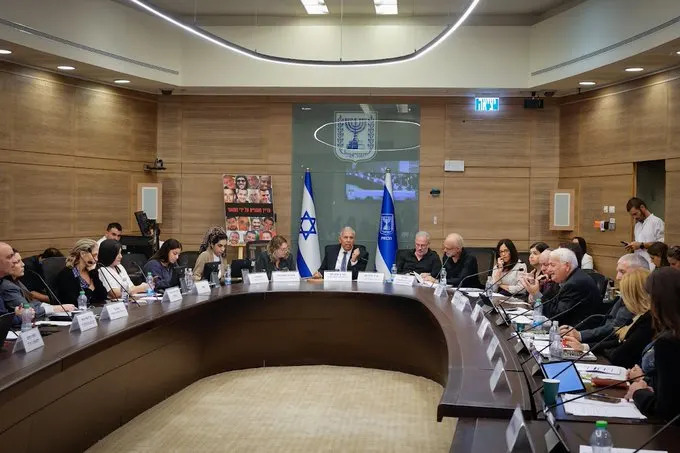

Knesset panel votes down proposal to form October 7 state commission of inquiry, October 22, 2025 (The Knesset)
Michael Oren: A State Commission is an Absolute Necessity

Beyond the coalition’s judicial reform plan and even more than the Gaza War in its final phases, the question of the October 7 inquiry will divide the state as never before. If the prime minister rejects an independent state commission and insists on appointing a government committee—its members selected by radical right-wingers Itamar Ben-Gvir, Orit Strock, and Bezalel Smotrich—not hundreds of thousands may take to the streets, but millions.
The reason is simple. Like the Ultra-Orthodox service in the IDF, the inquiry issue cuts across the political divide of right and left. Even among those who voted for the Likud in the past and supported its judicial reform are many who fought in this war or have family members wounded or killed in it, who demand accountability for October 7. Many will not be satisfied with a politically-appointed government commission unlikely to reach hard conclusions about the very ministers who appointed it.
Netanyahu and his government claim that a state commission of inquiry, appointed by the President of the Supreme Court, cannot possibly judge them impartially for the failures surrounding the 7th of October. Historically speaking, this justification seems weak. Both the Agranat Commission formed after the 1973 Yom Kippur War and the Winograd Commission convened after the 2006 Second Lebanon War placed the bulk of the blame for failures on the military rather than the political echelon. Chief of Staff David Elazar and Chief of IDF Intelligence Eli Zeira were forced to resign after Agranat, not Prime Minister Golda Meir or Defense Minister Moshe Dayan. Winograd resulted in the ouster of Chief of Staff Dan Halutz, not of Prime Minister Ehud Olmert or Foreign Minister Tzipi Livni. On the basis of those precedents, Netanyahu would appear to have little to fear from a state commission.
Still, times have changed and with them the government’s relationship with the Supreme Court. A court so recently in a pitched political battle with the government might not be expected to judge it entirely objectively. But that doesn’t mean that a different state commission cannot be formed, one that excludes sitting High Court justices.
The State of Israel is blessed with many respected figures representing diverse sectors of our society who can pass judgment on those responsible—or those not responsible—for October 7. Among these could be Miriam Peretz, the retired judge Elyakim Rubinstein, the philosophers Micha Goodman and Asa Kasher, and former Ben-Gurion University president Rivka Carmi. Nor is there a shortage of qualified military experts. These might include Brigadier General Dr. Alaa Abu-Rukun, formerly military secretary to the president, and General Yaakov Ayish, an esteemed IDF attaché in Washington.
At a time when Israel is facing renewed military challenges on every front, complex relations with the White House, and isolation in the world, Israel must do its utmost to maintain internal unity. The creation of a truly independent, impartial, and credible committee of inquiry is a national and strategic necessity. The intrepid and self-sacrificing people of Israel deserve nothing less.
This article was originally published in Hebrew in Ynet on November 25, 2025.