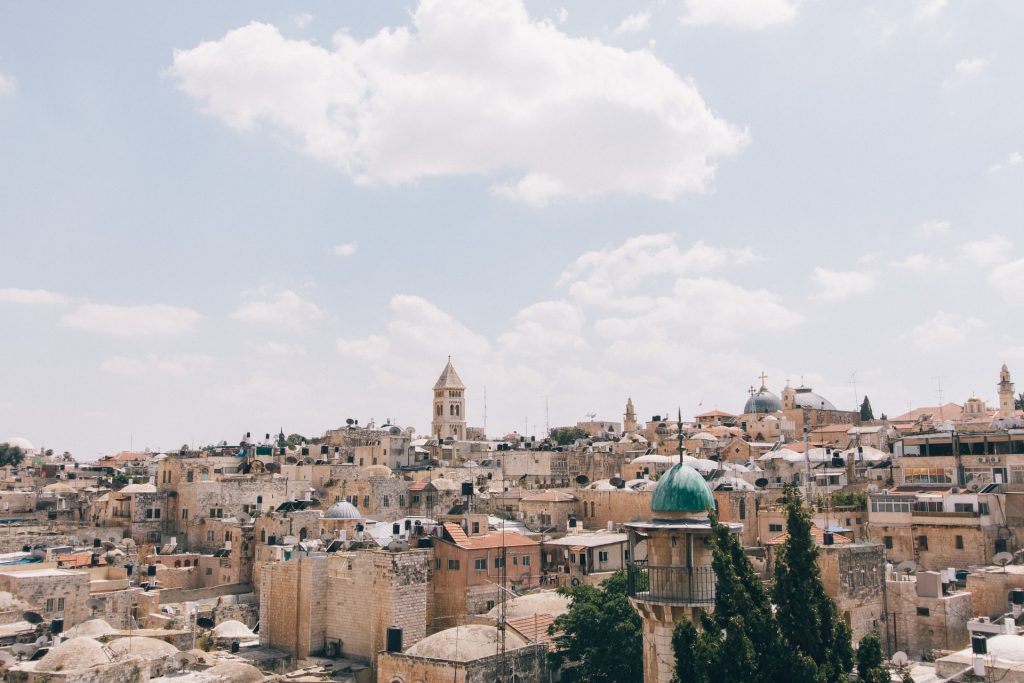

Jerusalem, looking towards the Christian Quarter | Photo: Robert Bye, Unsplash
Jonathan Feldstein: Christian Zionism Under Fire
Christian Zionism Under Fire: Analyzing the Jerusalem Patriarchs’ Controversial Statement and the Fallout
In a 280-word statement released on January 17, 2026, the eve of Orthodox Christmas, the “Patriarchs and Heads of Churches in Jerusalem” denounced Christian Zionism as a “harmful and damaging ideology.” This brief declaration, lacking any signatures or theological depth, sparked widespread debate among Christian and Jewish communities. Analyzing this and its implications, a wide-ranging conversation took place on “Inspiration from Zion,” dissecting the statement, why it was made when it was made, and exploring the fallout. The discussion highlighted Christian Zionism’s biblical roots, the signatories’ identities, motivations, and the document’s flaws, revealing tensions between theology, politics, and interfaith relations.
Although the actual identity of the statement’s signatories are deliberately anonymous, the “Patriarchs and Heads of Churches in Jerusalem” represent a coalition of traditional Christian denominations in the Holy Land. Panelists identified the “big three” as the Armenian Apostolic Church, the Greek Orthodox Patriarchate, and the Latin Patriarchate led by Cardinal Pierbattista Pizzaballa. Other possible members include the Syriac, Anglican, and Lutheran churches.
Nicole Jansezian, an American-born Christian Israeli journalist, noted that such statements typically emerge from these institutions, which oversee a tiny but diverse Christian population—about 2% the population in Israel, and even less in the Palestinian Authority. Dr. Andre Villeneuve, a Catholic theologian, clarified that the statement appeared on the Greek Orthodox and initially on Franciscan websites, but was absent from the Latin Patriarchate’s, raising questions about Pizzaballa’s involvement. The anonymity of the actual people behind this was and remains one of the outstanding questions.
Motivations for the statement appear rooted in local politics rather than deep theology. Panelists explained that it appears to have targeted the efforts of Lt. Col. Ihab Shlayan, an Israeli Christian advocating for greater Christian integration into Israeli society, including IDF service and Aramaic recognition. Shlayan, from Upper Nazareth, calls himself an “Israeli Christian” Zionist, rejecting the “Arab Christian” label. Panelists suggested the “patriarchs” viewed his efforts—backed by figures like U.S. Ambassador Mike Huckabee—as encroaching on their authority. Someone likened it to mafia turf wars. Villeneuve, who interviewed Shlayan, emphasized clericalism in mainline denominations, where clergy exert control over “their” flocks.
Broader pressures from Arab nations and communities, where Christians face persecution, force these leaders to tread carefully. Pastor Tod McDowell of Caleb Global added that traditional Middle Eastern Christians often inherit faith as cultural identity, not personal conviction, making pro-Israel stances divisive among indigenous Christians. He noted that both indigenous Christians and Arab converts from Islam often have a hard time coming to grips with and overcoming deep-seated hostility to Israel and Zionism, even as they embrace their faith, which many of the panelists cited as being synonymous with biblical Christianity, even noting that God Himself is the first Zionist.
The timing of the statement’s release, just before Orthodox Christmas and following an event hosted by Israeli President Herzog honoring Christian leaders and at which many present were those from the churches who promoted the controversial statement, maybe even those who initiated it, amplified suspicions of political maneuvering.
Panelists robustly defended Christian Zionism as biblically grounded, countering the statement’s vague condemnation. Shirley Burdick, founder of Ten Gentiles, described Christian Zionism, and Zionism in general, as “following God’s heart,” citing Luke 21:24 where Jesus prophesies Jerusalem’s restoration after Gentile domination—a New Testament echo of Old Testament promises. She linked it to Isaiah 60:10-12, warning nations against serving Jerusalem risk ruin, framing Zionism as a continuous biblical narrative from Tanakh (Old) to New Testament. McDowell traced it to Theodor Herzl’s 1897 definition: the Jewish right to a homeland, rooted in Scripture like Genesis 15 and 17’s everlasting covenant with Abraham. He argued God’s faithfulness to Israel underpins Christian salvation promises, calling passivity toward Israel a modern litmus test for faith amid rising anti-Zionism.
Villeneuve, emphasizing “biblical Zionism,” broke it down: Zionism affirms Jewish self-determination in their ancestral land, per UN Resolution 181 in 1947. As a Christian variant, it recognizes God’s unrevoked promises in the Hebrew Scriptures—over 200 prophetic references to Jewish ingathering—and New Testament affirmations in Romans 9-11. He quoted Psalm 132 as a cornerstone of God’s unequivocal stance, which Christians should understand: “The Lord has chosen Zion… This is my resting place forever.” Panelists agreed the “Patriarchs’” statement misrepresents Christian Zionism as divisive, ignoring its call for mutual respect and blessing all peoples, per Genesis 12:3.
The statement’s pitfalls were a recurring theme. Its brevity and anonymity undermine credibility—Villeneuve likened it to a theological statement lacking substance, possibly forged or selectively endorsed. No definition of Christian Zionism is provided, allowing misinterpretation as political extremism rather than theological conviction. Burdick saw it as perpetuating 2,000 years of replacement theology, contradicting Vatican documents like the 2015 “The Gifts and the Calling of God Are Irrevocable,” which affirm Judaism’s enduring role. McDowell criticized its fear-mongering tone, suggesting it stems from insecurity over growing evangelical support for Israel, as seen in events like a recent gathering of 1,000 Christian leaders. All noted the irony: while decrying division, the unsigned statement alienated evangelical Christians, creating public divisiveness rather than unity, excluding evangelicals from being considered at all “legitimate” representatives of Christianity in the Holy Land.
Ultimately, the webinar transformed controversy into dialogue, urging humility and relationships. Encouraging the “Patriarch’s” statement not to be seen as divisive, the intent of the panel conversation was to underscore Zionism as a shared biblical value, not exclusively Jewish, and not “harmful and damaging.” As anti-Zionism intensifies globally and is often used synonymously as antisemitism—evidenced by public harassments of individuals either identifiable as Jews or wearing pro-Israel symbols, and in other public spaces—the panel called for scriptural discernment over polarization. In a world where 280 words ignite firestorms, such discussions bridge divides, affirming God’s promises and transcending politics.
A subsequent question was raised as to whether anti-Zionism is antisemitism, does that make Christians who don’t support Israel antisemitic, and is it just a cover for such abhorrent and unbiblical views?
Follow the entire conversation on YouTube or the Inspiration from Zion podcast audio here.