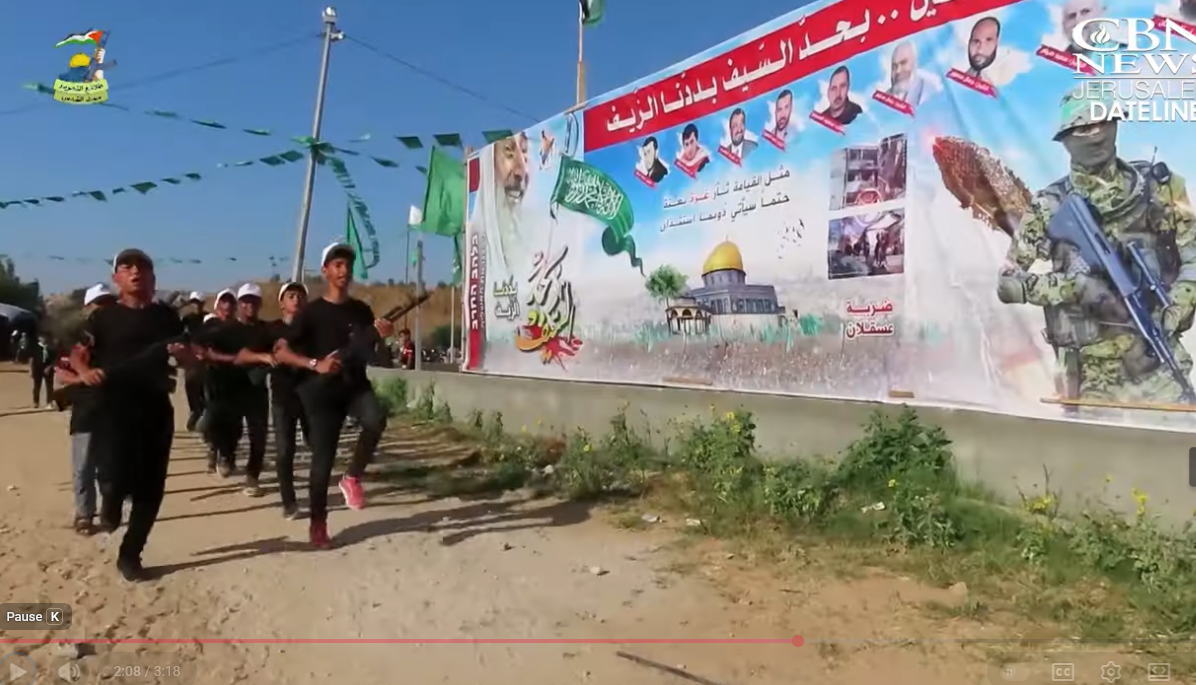

Inside the Gaza Summer Camps Training Children to be the Next Generation of Terrorists
David Bedein & Dr. Arnon Groiss: Peace Education Now
President Trump’s Gaza peace plan which was adopted by the UN Security Council on November 17, 2025 includes references to a reformed Palestinian Authority that would be able to regain control over the Gaza administration, which could serve as a pathway to Palestinian self-determination and statehood. Earlier this year, on September 12, the UN General Assembly approved by a large majority a French-Saudi Arabian initiative promoting the two-state solution to the Israeli-Palestinian conflict, which actually suggests the establishment of a Palestinian state.
Peaceful resolution of the Israeli-Palestinian conflict is a worldwide goal and is also the main core of the 1993-95 Oslo Accords, on which the PA’s very existence is based. The ongoing effort to upgrade its status from an autonomous entity to that of a state needs, therefore, some clarification as to what extent it is committed indeed to the idea of peace with Israel. Because, if it is not, any such move would raise Israel’s suspicions, cause counteractions and increase instability in the region.
An attempt to answer this question has been made in a study in which I examined the references to the conflict in over two hundred PA schoolbooks and teachers’ manuals of the latest editions. The criteria of analysis used were UNESCO’s guidelines.
The decision to use this particular source material was taken on the basis of the assumption that schoolbooks are the most reliable indicator of the ideals a society would aspire to instill in the minds of the younger generation. If such books are issued exclusively by the government, as the case is with the PA, they also best represent the deeper beliefs of that government as far as its political aspirations are concerned. In clearer wording: the PA’s attitude to the idea of peace with Israel is best shown in its textbooks.
The Oslo Accords and the ensuing establishment of the Palestinian Authority do exist in the books. Most interesting is a letter appearing there that was sent by Yasser Arafat, Chairman of the Palestine Liberation Organization (PLO) to Yitzhak Rabin, Prime Minister of Israel, prior to the signing of the Declaration of Principles (the initial agreement signed within the Oslo process) in September 1993, in which the PLO recognized the right of the State of Israel to live in peace and new security, accepted the UN Security Council’s resolutions Nos. 242 and 338, committed itself to the peace process in the Middle East and to peaceful resolution of the conflict between the two parties, declared that all the basic issues related to the permanent situation would be solved through negotiations, condemned the use of terror, as well as other violent actions, confirmed that the articles appearing in the Palestinian National Covenant that denied Israel’s right to exist were no longer valid, and took upon itself to present the necessary amendments within that Covenant to the Palestinian National Assembly in order to officially approve them.
This text is self-explanatory and could have served as a firm basis for peace education. Unfortunately, this is not the case. The entire PA curriculum is tuned to war. The moto is liberation from occupation, but the liberation struggle is violent and terror-involved – in clear contradiction to the commitment to non-violence in Arafat’s letter.
Moreover, the liberation of Palestine covers the country in its entirety – contrary to Arafat’s recognition of Israel’s right to exist. Cities inside Israel within its pre-1967 boundaries, such as Jaffa and Acre, are to be liberated specifically. In fact, the Palestinian students learn at school that Palestine is the only sovereign state in the country, and that sovereign Palestine has been under Zionist occupation since 1948. Israel’s pre-1967 territory is phrased “the territories occupied in 1948”. Accordingly, Israel is rarely mentioned by its name, and is rather referred to as “the Zionist occupation”. It goes without saying that Israel, within its pre-1967 territory, is absent from all maps.
It should also be noted that Israel’s 7-million Jewish citizens are presented as foreign colonialists and the cities they built, including Tel Aviv, are missing from the map. Their history in the country since antiquity is denied, as well as the existence of their holy places there, including the Wailing Wall in Jerusalem, the last remnant of their ancient temple there. The Jews’ national language, Hebrew, is erased – literally – from a coin of the British Mandate era before 1948 reproduced in a mathematics textbook.
Both Israel and the Jews are demonized to a point that presents them as an existential threat to the Palestinians within the current conflict, which contradicts any move towards peace with them. Jews are further demonized as enemies of Islam from its early days, as the Devil’s aides, and as enemies of God’s prophets, which makes them automatically enemies of God Himself in the eyes of young Palestinian students who mostly come from traditional environments. Thus, the liberation of Palestine from Zionist occupation becomes religious in character, with the traditional Islamic ideals of Jihad and Shahadah (martyrdom) being also involved.
The PA schoolbooks rarely deal with the question – what should be done with the surviving Jews after the liberation of Palestine from “Zionist occupation”. But an Islamic religious textbook brings within this context a traditional text speaking of the eventual annihilation of all Jews.
To conclude, any involvement of the PA in the Gaza administration, and, certainly, any future step toward the recognition of the PA as a state on the road to peaceful resolution of the conflict, should be pre-conditioned by changing its afore-presented educational line from a belligerent one into a decisive commitment to peace with Israel, exactly as it appears in Arafat’s letter to Rabin. The field of education has indeed been mentioned in the context of the needed reforms. The following are suggested specific changes:
- Inclusion of Arafat’s letter to Rabin in a number of textbooks of various grades in order to assert the PA’s strategic goal of peaceful resolution of the conflict with Israel.
- Use of the letter as a basis for the official recognition of the State of Israel on the part of the PA, to be expressed in all relevant textbooks, that is, showing the State of Israel within its pre-1967 boundaries on all political maps.
- Traditional Islamic ideals that carry a belligerent character, such as Jihad and martyrdom, should be disconnected from the current conflict and be left as part of past Islamic history.
- Current geographical reality should be reflected in the books, i.e., Tel Aviv and other main Jewish cities should appear on the map.
- Falsification of historical objects, such as British Mandatory coins and stamps, should be avoided.
- Recognition of the Jews’ history and holy places in the country and elimination of all materials expressing religious bigotry against them.
- Elimination of all materials exalting terror.
David Bedein
Director: Center For Near East Policy Research
David Bedein, Director

David Bedein is a community organizer by profession, a writer, and an investigative journalist. In 1987 he established the Israel Resource News Agency and Became the head of the Center for Near East Policy Research in 2005, which was renamed the Nahum Bedein Center for Near East Policy Research in 2012 (Nahum, David’s brother, succumbed to cancer in 2010).
Mr. Bedein has reported for media outlets such as CNN Radio, Makor Rishon, Philadelphia Bulletin and The, Jerusalem Post Bedein has covered Middle East negotiations in Oslo, Ottawa, Shepherdstown, The Wye Plantation, Annapolis, Geneva, Nicosia, Washington, D.C., London, Bonn, and Vienna. Mr. Bedein is the author of ROADBLOCK TO PEACE” How the UN Perpetuates the Arab-Israeli Conflict: UNRWA Policies Reconsidered; and Genesis of the Palestinian Authority, as well as the producer of numerous films, investigative studies and news reports..

Dr. Arnon Groiss, Associate
Dr. Arnon Groiss served as director of research for the Institute for Monitoring Peace and Cultural Tolerance, www.impact-se.org, between the years 2000-2010, and authored its reports on hundreds of schoolbooks of Egypt, Syria, Saudi Arabia, Iran, Tunisia and the Palestinian Authority. Dr. Groiss holds an MA and PhD from Princeton University’s Department of Near Eastern Studies and an MPA from the Harvard University J. F. Kennedy School of Government, in addition to a BA degree from the Hebrew University departments of History of the Middle East and Arabic Language & Literature. Dr. Groiss’ career spanned more than 30 years as an Arabic-language journalist and upon his retirement served as the deputy director of the Arabic Language Service of the Arabic Radio Service of The Israel Broadcasting Authority.Since 2000, Dr. Groiss has examined all 1000 text books that the nascent Palestinian Authority has provided UNRWA, the United Nations Relief and Works Agency. Dr. Groiss has authored and presented monographs on UNRWA education to the US Congress, British Parliament, German Bundestag, the Swedish Parliament and to the Israel Knesset Parliament.