Charles Abelsohn: Tribute to the Women of the IDF
Letter from Israel – Rosh Hashana 5786: Tribute to the Women of the IDF
Rosh Hashana 5786 12 September 2025
Shalom from Israel,
Who would have guessed in their wildest nightmares that the catastrophic war against Israel, initiated by the jihadist group, Hamas, on 7 October 2023, by attacking 22 Communities in the south of Israel, on Shabbat and Simchat Torah, would still be continuing this Rosh Hashana, two years later. 1,200 persons, including Jews, Arabs and Bedouin, together with other happy revelers from over 20 nationalities at a music festival in the south of Israel as well as farm employees from Thailand, were raped, murdered, mutilated and burnt to death and 252, both alive and bodies, were kidnapped by Hamas and other Palestinian groups and taken to underground tunnels in Gaza.
It is estimated that Hamas continues to hold 28 bodies, with about 20 people thought to be still alive.
Israel`s Defence Forces, the IDF, representing all sectors of Israel`s population, have been fighting non-stop for nearly two years. In this Letter, I will pay tribute to one sector in particular: the women of the IDF. I will first provide photos of women who fell in battle and then look at the history of women in the IDF`s combat units, followed by mentioning the combat units in which women currently serve, then a detailed look at women in combat on the 7th October 2023 in one battalion`s battle and end with a separate moving tribute which I found as a blog in the Times of Israel.
You are welcome to send this Letter to your friends and family or through your own distribution channel.
We pray that even before we meet the new year, we will see the return of the 48 hostages and bodies still held by Hamas and the end of hostilities. We wish all our readers that this coming year will be a year of good health, celebrations, pleasure from your family, peace and good news. We wish our Jewish readers and all your families a שנה טובה ומתוקה, שנת שלום והצלחה; a shana tova umetuka, shnat shalom vehatzlacha, a happy, healthy, successful and peaceful new year and a meaningful fast.
With Rosh Hashana/New Year Greetings from Israel,
Charles and Vivienne Abelsohn.
In memory:
In memory of the IDF female soldiers who fell in battle in this war while bravely defending the homeland until their last breath. May their memory be forever a blessing.
https://x.com/i/status/1940938613857939699
Women of the Israel Defense Forces: History in Combat Units
Videos:
Female Paratrooper Instructors (3.5 minutes)
Female Infantry Weapons Instructors (1 minute)
IDF Honors Women’s Service (3.5 minute)
The history of female combat soldiers in the IDF can be dividend into three distinct eras:
- 1948: Women on full combat status during the War of Independence
- 1948-Late 1990’s: No women allowed in combat roles
- Late 1990’s-Present: Majority of combat positions – including pilots and special forces – open to women
When it was first formed in 1948, the IDF was forced to use any and all available personnel as combat soldiers, regardless of gender. As Israel’s first Prime Minister, David Ben-Gurion said at the time:
“Since you rightly believe that the security of the State must be pursued night and day, I want you to know that that security will not exist if our nation’s women do not know how to fight. We are few – and our enemies are many. If, heaven forbid, a war falls upon us, the men will go to fight the enemy, and if, heaven forbid, the women who are protecting their children at home do not know how to use a weapon – what will be their end if the enemy falls upon them?”

Female soldiers in 1950
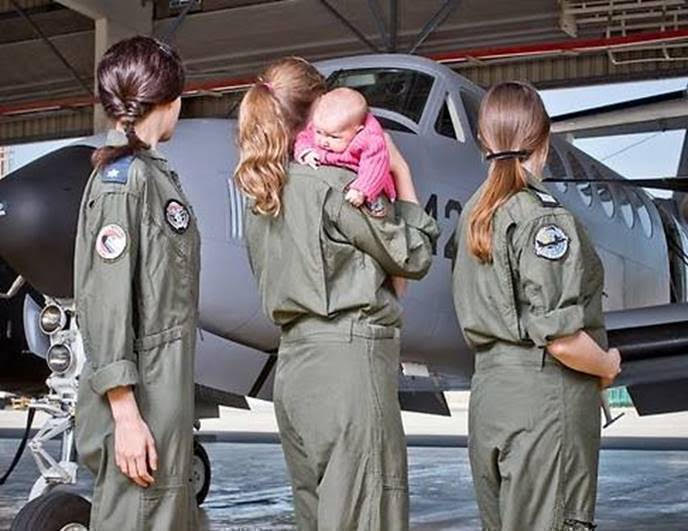
Female Pilots in the IDF
Following the War of Independence, however, and lasting until the late 1990’s, no women were allowed to serve in combat positions, aside from a short attempt in the 1950’s to accept women into flight school. However, women did take over almost all field instructing positions in the IDF.
In 1956, during the Suez Crisis, Lt. Yael Rom co‑piloted a Dakota transport aircraft carrying paratroopers into the Mitla Pass — making her the first woman to fly an operational mission deep into enemy territory
That all started to change in 1994 when Israel`s High Court of Justice, under appeal by a female immigrant from South Africa, ruled that some combat roles should be open to female soldiers. Three years later, in 1997, Alice Miller filed an appeal to the Supreme Court to be accepted into the IDF’s highly elite Air Force flight school. Miller won the lawsuit and the IDF officially began accepting women as flight candidates.
Since the Israeli Air Force (IAF) opened its elite pilots’ course to women in the 1990s, 62 women have graduated as pilots, serving across a range of flight and command roles — from the cockpit of fighter jets to the controls of transport and cargo aircraft and helicopters — and increasingly in leadership positions.

Several of the IDF`s female pilots

Alice Miller, the South African who opened the doors to the IDF`s female pilots, which in turn opened the doors to the IDF`s female combat soldiers.

In the middle, Major Roni Zuckerman, the IDF`s first female combat pilot
The First Female Combat Pilot was Roni Zuckerman, the granddaughter of two leaders of the Warsaw Ghetto Uprising. Zuckerman earned her wings in 2001 and flew F‑16s in operational squadrons, proving women could excel in the one of the most demanding combat roles in the IDF.
In January 2018, for the first time in Israeli history, a female pilot was named commander of a flight squadron. The 35-year-old known simply as Major T., was trained as a transport pilot and promoted to the rank of Lieutenant Colonel.
Female pilots have participated in high‑risk missions such as long‑range strikes and special forces raids. During the conflict with Iran in July 2025, 16 Israeli female fighter pilots were involved in attacking Iran — a regime that spent decades oppressing women is now being hit by them. Call it justice at 30,000 feet. pic.twitter.com/DK9XrAIKIw
— Sacha Roytman (@SachaRoytman)
During the war against Iran, and for the first time, an all-female team (pilot and navigator) flew an Israeli Air Force fighter jet.
A married couple flew sorties against Iran. Combat navigators, identified only as “Yud” and “Bet” both attacked Iran during the 12-day war. “Yud” is the first female deputy commander of a fighter squadron. Her husband, “Bet,” commands an air squadron and will soon command a fighter squadron. They have 2 children.
Hamas captivity survivor Agam Berger plays violin with the IDF band at an IAF pilot graduation. pic.twitter.com/Y0BjkMpYIv
— StandWithUs (@StandWithUs) (please unmute)
The Defense Service Law
In 2000, the Equality amendment to the Defense Service Law stated that the right of women to serve in any role in the IDF is equal to the right of men. Soon after, women were allowed to serve in nearly all combat positions. Women recruited for combat units had to serve for 30 months instead of the normal mandatory period for women of 21 months.
In early 2000, the IDF decided to deploy women in the artillery corps, followed by infantry units, armored divisions and elite combat units. The Navy decided to place women in its diving repair unit. The elite commando K9 unit, Oketz, also drafts females as dog trainers and soldiers. Altogether, by 2004, about 450 women were serving in combat units.
On May 26, 2011, then Defense Minister Ehud Barak oversaw one of the IDF’s most historic internal events when he approved the promotion of Brigadier General Orna Barbivai to Major General and to the head of the IDF Manpower Directorate. In so doing, Barbivai became the first female ever to attain the rank of Major General in the IDF.
In January 2014, the IDF announced that Major Oshrat Bacher would be promoted to the rank of Lieutenant Colonel and placed as a Brigade Commander in a Combat Intelligence unit. Major Bacher’s promotion marked the first time a female soldier commanded a combat brigade.
Today female soldiers can be found on combat status in the Artillery Corps, Combat Engineering Corps, Light Infantry, Military Police, Border Police and other units. The IDF’s first female tank commanders began their service in July 2018. The women are trained to conduct border security missions with their tank squadrons.
In October 2011, 27 female combat soldiers completed the IDF Ground Forces Officers Training Course along with 369 male soldiers and were promoted to the rank of second lieutenant. The new female officers serve in a wide range of combat units from artillery to Caracal and tanks.
The number of women in combat roles has been steadily rising. In 2012, 600 women joined co-ed combat battalions. By 2017, more than 2,700 women were recruited to mixed-gender IDF battalions. Today, approximately 7% of women in the IDF serve in combat roles today, as opposed to 3% in 2012. 90% of the combat assignments are open to women.
Some women are “lone soldiers” from countries such as South Africa, Italy, Germany, Australia, and the United States. Many don’t have family in Israel and are taken in by host families in Ra’anana and kibbutzim.
By May 2025, women, including many religious women who were previously exempt from military service on grounds of “modesty”, comprised over 20% of Israel’s combat soldiers, marking a historic high. The IDF emphasizes that regular mixed-gender units significantly reduce reserve reliance, with women now comprising 20% of the reserves — a sixfold increase since 2006.

The IAF’s five new women UAV operators, Dec. 9, 2020. Credit: IDF Spokesperson’s Unit.
Medical

A week before October 7, 2023, Maj. Dr. R. began her post as the chief medical officer of the IDF Commando Brigade. Since then, she has served on every front of the war, saving soldiers under heavy fire. In an interview with Ynet, Dr. R reveals her anguish witnessing her commander succumbing to his wounds on the way to her, and the moment a drone exploded where she had just been standing moments earlier.
She says, “We know how to care for everyone else. Caring for ourselves is the hardest.”

IDF armored forces at a staging area in southern Israel near the border with Gaza. January 01, 2024. (Photo by Tomer Neuberg/FLASH90)
“It’s amazing how, in this war, you see female doctors, paramedics and pilots. You hear them on the radio and you see them on the ground. Gradually the barrier was broken,” Lt. Col. Shani Kisri, medical chief of the Israel Defense Forces’ 162nd Division.
The integration of women into medical front-line positions, Kisri said, started approximately in the beginning of the ’90s. By 1996, there were female paramedics embedded in various battalions, with the Golani Brigade being the pioneer.
After graduating from medical school in 2010, Kisri became the first-ever battalion doctor for an Israeli infantry brigade.
During 2014’s “Operation Protective Edge,” Kisri noted, she was likely the only female doctor in the Gaza Strip.

Soldiers of the IDF’s mixed-gender Bardales Infantry Battalion prepare for urban-warfare training on a foggy morning in southern Israel, July 13, 2016. Photo by Hadas Parush/Flash90.
“I was in a special unit back then. The female paramedics were less present on the battlefield. Now you see them everywhere. There are more female pilots, paramedics, doctors and females in special operations units. This war gave us a chance to prove that it works,” she said.
“They proved they can do the job, handle the rough conditions and the long fighting period. ‘Protective Edge’ was a few weeks and it was hard. This war has lasted over a year now. I have paramedics who have been in the field for months. It’s not easy and they handled it perfectly,” she added.
“Gradually we will see that more and more females are integrated into more battlefield positions because at the end of the day, the army needs good people with motivation to serve and whether it’s a male or female, today, we know it doesn’t really matter.”

IDF Armored Corps soldiers at a staging area near the Gaza Strip on Jan. 1, 2024. Photo by Tomer Neuberg/Flash90.
There are a few difficulties, Kisri noted, especially for female medical corps soldiers.
“Usually, you’re the only female around, especially if you’re a doctor or paramedic at the platoon level. You might be the only female among a few dozens of men,” she said.
“You might find yourself, especially in this war, serving for weeks on the battlefield with no interactions with other females, no private quarters, no showers and everything that comes with joint service,” she continued.
Still, “I think we are getting better at understanding the difficulties and supporting the female paramedics and doctors,” she said. “They are very highly motivated, very qualified and there is a big demand for female doctors and paramedics in the battalions now. So it’s working.”
“The medical corps is more progressive in this aspect. When the medical corps puts a paramedic in a position, it does not take into account whether the person is male or female, it’s based on experience and qualifications,” she said.
“They get a lot of respect, they tell everybody what to do, they are very assertive and the soldiers take care of them. It’s not easy in battlefield conditions, but the male and female soldiers find solutions,” she added.
“Once you take care of the first wounded soldiers and have to perform under battlefield conditions, even the most skeptical are convinced,” she added.
With regard to the hostages kidnapped by Hamas on Oct. 7, 2023, Kisri said the big difference wasn’t between female and male soldiers but rather between soldiers and civilians.
“When you’re a soldier, you go into the army knowing what you’re getting yourself into and the risks you are willing to take, as a male or a female. I don’t think society should tell women that because of their gender the risk is higher. If somebody is willing to take the risk it’s their decision,” she said.
When she was in the field, “We were maybe three female doctors in infantry battalions,” she said. “Today it’s more than 50%. It’s not only about the type of positions that are open, it’s also about the number of women that fill those positions,” she said.
“If you open your mind to the female soldiers, you’ll do so with other minorities. There were other minorities being integrated even before females. Everything is intertwined,” she said.
“I think the army is one of the most progressive places. Sometimes Israeli society should aspire to be more like the army,” she added.

Ella, Shaked and Bar
Bar, a battalion doctor, spent sixty consecutive hours in a tank on the Gaza front, providing life-saving medical care to IDF soldiers. Ella and Shaked are paramedics who were drafted as reservists. Between them, Bar, Ella and Shaked have saved the lives of many wounded fighters.
The three courageous women are part of a group of 70 female medical professionals who fight alongside IDF forces in Gaza.
The Caracal Battalion
The Caracal company, a co-ed infantry unit subordinate to the Nahal Brigade, was established in 2000 to patrol Israel’s southern border with Egypt. The unit defends Israel’s borders with Egypt and Jordan, often dealing with drug smuggling, terrorist infiltration attempts and other security threats.
The Caracal Battalion is one of the Israel Defense Forces’ (IDF) mixed-gender light infantry units, part of the Border Defense Corps, and has played a trailblazing role in integrating women into combat.

Soldiers of the Caracal Battalion prepare for a hike as part of their training
To get into Caracal — which is made up of 70% women and 30% men — the female soldiers had to agree to serve an additional eight months.
“There’s a good chance that in the future, we’ll see the first female infantry battalion commander. I can’t tell you the name, but it’s going to happen,” said Lt. Col. Erez Shabtay, a previous commander of the Caracal Battalion, in 2021. “What I’ve seen in this battalion opened me up to a totally different world. We have female fighters and officers who are amazing, in terms of their cognitive ability, their creativity, their bravery and their courage,” he said.
The battalion includes an all-women Merkava IV tank company, made permanent in 2022 after a successful two-year trial. These crews usually patrol the Egyptian border, marking a significant expansion of combat opportunities for women in the IDF.
On October 7, 2023, female tank crews from Caracal were among the first responders during the Hamas assault, engaging in 17 hours of continuous battle, running down dozens of terrorists, and securing breached border points. Below, please see two articles on the successful battles of these Caracal female combat soldiers on the day of Hamas`s attack on 7 October 2023.

Lionesses of the Desert: Caracal`s all-female tank unit.
Maj. Or Livni became the first female officer to command the battalion, having previously been decorated for bravery after being wounded in a 2014 firefight on the Egypt border.
Allowing women into combat roles remains controversial. Some Israelis have a traditional, some might say sexist attitude that women need to be protected and that a country as small as Israel cannot afford to risk the lives of potential mothers. Another argument is that women are weaker than men and the IDF unfairly lowered its fitness standards for females to make it easier for them to qualify for combat units.
Shabtay said when asked about his battalion. “I have no question about the ability of women to be combat fighters. And we’ve also been tested under fire. Our soldiers, under fire, did their job amazingly. We don’t let up on them about anything — about physical fitness, about marksmanship. Whoever can’t cut it is out, just like a man.” He added, “I need my male and female soldiers to shoot well, to hit their targets, to use machine guns properly, to respond to incoming fire in the best way, and they need to know how to operate in a desert environment,” Shabtay said.
Shabtay’s unit incorporated all-female tank crews after the soldiers completed their training in June 2021.

One of the all-female IDF tank crews that fought on Oct. 7, 2023.
Source: Daily Mail (UK)
Here are two articles. The first article covers the Caracal Battalion in action on October 7th, 2023, the day of Hamas`s attack. In the second article, the female soldiers speak on their experiences on that fateful day.
The Caracal battalion in action on 7 October 2023 as told by the London Daily Mail.
Daily Mail, London, 25 October 2023
All-female Israeli ‘lionesses’ combat unit of just 13 soldiers ‘killed nearly 100 Hamas gunmen as they helped liberate kibbutz’
- Lt-Col Or Ben Yehuda and her 12 women soldiers fought off dozens of attackers
- The all-female battalion was joined by a Navy squad and fought for 14 hours
By NICK FAGGE, SENIOR REPORTER (GLOBAL)
Published: 07:39 BST, 25 October 2023 | Updated: 14:39 BST, 25 October 2023
An all-female combat unit of just 13 soldiers from the Israeli Defence Forces (IDF) took on and killed nearly 100 Hamas gunmen when they fought off a terror attack on an army base and helped liberate a kibbutz, it has emerged.
Lieutenant Colonel Or Ben Yehuda and her 12 women soldiers of the Caracal Battalion led the frontline fightback from armoured personnel carriers after racing to a military post on the Egyptian border that was being attacked during the Hamas onslaught.
With rockets raining down all around her, she learned that the terrorists had broken through Israel’s border fence with the Gaza Strip and were heading for the Jewish settlements of Shlomit and Bnei Netzer on October 7.
In a final message from the Sufa military base as it came under attack from dozens of Hamas fighters, a colleague who was killed just minutes later warned Lt-Col Ben Yehuda: ‘There are several terrorists here. They’re heavily armed.’
In a pre-battle address, Lt-Col Ben Yehuda then told the 12-woman unit that they were strong and would not be defeated.
She said: ‘We are going to eliminate terrorists. [An infiltration into Israel is happening, and it’s spreading. Stay alert. We might cross paths. We are a strong squad.’

Lt-Col Ben-Yehuda from the infantry combat Caracal Battalion unit
When the unit arrived at the military base, they discovered that Hamas had overrun the post and taken more than 50 Israeli military personnel hostage.
Some seven gunmen had taken up positions in the dining room, armed with anti-tank missiles.
As the officer and her 12-woman squad approached the base from all angles, a band of 50 heavily armed terrorists charged towards them from the surroundings. But the unit held its ground, shooting some dead and forcing others to scatter.
In one harrowing moment, Lt-Col Ben Yehuda was confronted face-to-face by a male terrorist, whom she shot at close range.
An officer from another unit arrived at the military base and proposed an attack on the building where the terrorists holed up.
But Lt-Col Ben Yehuda insisted that she would not put the lives of the hostages at risk and directed her attack fire at the terrorists who had taken up positions around the post.
Over the next four hours, the 12-woman unit engaged in a bitter fire-fight with Hamas, who sent wave after wave of gunmen against them.
Despite some of the soldiers getting wounded, the all-female unit continued to fight.
The Caracal Battalion unit was later reinforced by soldiers from a Navy Special Forces unit and together they continued to engage Hamas for the next 14 hours until the terrorists were either dead or had fled.
Lt-Col Ben Yehuda praised the ‘significant contributions’ the female soldiers had made to win the battle, saving the lives of the wounded and carrying out daring helicopter evacuations under fire.
She also acknowledged the bravery of an all-female tank crew under her command that led the attack on Hamas fighters who had ransacked the nearby Holit kibbutz, killing more than a dozen civilians.

Lieutenant Colonel Or Ben Yehuda
Lt-Col Ben Yehuda added: ‘There are no more doubts about female combat soldiers, who have triumphed in every encounter with terrorists.’
In total Caracal Battalion units are said to have killed about 100 terrorists – a fact that should dispel any doubts about the ability of female soldiers, she said.
Lt-Col Ben Yehuda said: ‘The training and performance [of the female combat units] on the battlefield have erased any doubts [about their ability]. ‘They fought bravely, saved lives and emerged as heroes.’
She added: ‘There are no more doubts about female combat soldiers, who have triumphed in every encounter with terrorists.
‘At present, we are responsible for 11 towns and are preparing for any potential ground manoeuvres to ensure the safety of the southern Gaza border area and the Egyptian border.’
The all-female tank crew has also been praised for leading the attack on Hamas terrorists who had overrun the Holit kibbutz. An officer, who cannot be named for security reasons, told the Yetznews website: ‘The female tank crew members were stationed close to our team, and they were amazing. They fought like lionesses. They are heroes.
‘I could hear them on the radio, including their commander, Or Ben Yehuda, operating at the highest level.
‘They broke through the fence and engaged with the terrorists that were there by the dozens.
‘They deserve to be decorated. They operated like a well-oiled machine, at a professional level that’s expected from a tank crew.’
The IDF has approximately 50,000 female combat troops out of a total of 200,000 active soldiers. Women must carry out military service alongside men and are called back to serve in the Army Reserve in times of crisis.
The Caracal Battalion is made up of 70 per cent female soldiers and has all-women units. It is based in southern Israel.

Female soldiers of the Caracal Battalion, the world`s first all-female tank unit.
Female IDF tank crews ran down dozens of Hamas terrorists on October 7: The soldiers talk.
The previous article was the Daily Mail`s description of the battle that took place on October 7th, 2023.
This article is about the female soldiers themselves and their perspective of the fighting on that date.
Israel`s TV Channel 12 interviewed soldiers from the all-woman company who say there was no time for fear or hesitation as they battled terrorists for 17 hours

A female IDF combat soldier inside a tank (screenshot: Channel 12, used in accordance with Clause 27a of the Copyright Law)
When a group of young Israeli women was woken up at 6:30 a.m. on October 7, they had no idea they would be making history as the first all-female armored crews in Israel, and perhaps the world, to participate in active battle.
The combat soldiers spoke of thundering along main roads to get to some of the 20 southern Israeli communities that came under massive assault that morning, running down terrorists, and securing breaches on the border with the Gaza Strip.
One of the officers in the unit, identified as Hagar, told Channel 12: “[My commander] comes into our room at 6:30 a.m., wakes me up and tells us that there’s a terrorist infiltration. We didn’t really understand the enormity of the event.”
On the morning of October 7, they left their base at Nitzana, on the Egyptian border, and drove north as fast as they could, in tanks and an armored Humvee. In one of a number of highly irregular decisions IDF commanders were forced to make that day, the tanks were given the okay to drive on civilian roads — at speeds far higher than recommended.
At first, they discovered breaches along the border with Gaza, along with dozens of terrorists. Leaving a tank there to protect the border and prevent more Gazans from flooding into Israel, they headed to Kibbutz Holit, while also sending a tank to battle Hamas terrorists at Kibbutz Sufa.
Keshet 12 News: pic.twitter.com/9HgmQowGkv (14 minutes) These are the female tank warriors who saved an entire community on Oct 7. Israel is the first country that incorporate women as warriors in tanks.
— Niv Calderon (@nivcalderon) (please unmute)
Another of the armored crew commanders, Karni, spoke of the devastation they witnessed on the approach to Kibbutz Holit: “We realized we’re at war.”
“They told me there were terrorists in all the trees around me, so we just started firing. We started firing bunker busters at the terrorists that were up close, and then mortar shells at those further away,” Michal, another officer in the unit, said in the Channel 12 report.
“I could see the hits, I saw [the terrorists] fall down,” she added.

Soldiers from the Caracal mixed-gender light infantry battalion (Screenshot: Channel 12, used in accordance with Clause 27a of the Copyright Law)
Hila, also a commander, told Channel 12 that none of them had been trained on the weapons system installed on the armored Humvee. “Within 10 minutes, we’d all become experts: how to run it, how to fire, how to slam the brakes,” she said. “We approached the border and saw burned bodies of terrorists hiding in the trees. We were still firing as we went through to make sure we got everyone,” Michal said.
Another commander, also called Michal, described her experience at one of the border breaches at the southern end of the Gaza Strip. “As we continued we realized that those 50 terrorists — that was just the beginning. Then we started getting eyewitness reports from Kibbutz Holit, so I left a tank at the border, told [the operator] she had permission to fire at will, and then set out for Holit.”
“We saw terrorists everywhere, and I told the driver — just run them down… We get there and the gate is closed, a shell-shocked soldier runs out shouting “terrorists, terrorists!… So we smashed through the gate,” she said.
Asked about their first time shooting at terrorists, the soldiers were stoic.
“I feel like it’s exactly what we trained for. We were really prepared for everything,” a commander identified as Tamar told Channel 12. “We just did what our brains and our hands knew how to do.”
“In the moment you don’t think, ‘Am I saving that person, or that home?’ You understand — there’s a terrorist and I have to kill him before he gets into one of the border communities,” she added.
The newly appointed commander of the Paran Brigade, Col. Shemer Raviv, couldn’t be prouder of his female armored crews, who battled terrorists for some 17 hours straight on that day.
“When the tanks arrived, they broke up the battles,” Raviv told Channel 12. “Once they took those two positions… the terrorists understood they could either run or they would die. And the girls in those tanks, the warriors, with three tanks at that point in the attack, they fought in a most impressive way. They operated in such a way that they were seemingly not trained for. They fired inside Israeli communities, drove on main roads, and I believe that thanks to their actions in that area, we prevented the attack from moving further south.”

A female IDF combat soldier operates a Merkava IV tank (Screenshot: Channel 12, used in accordance with Clause 27a of the Copyright Law)
But these soldiers weren’t quick to accept accolades for their “historic” battle. “So what? What does it matter? Did the terrorist know there were girls in the tanks? No. You think they saw Michal’s hair sticking out of the helmet? No. Boys, girls — what does it matter?” Hila said.
Tamar agreed. “You keep saying ‘heroines’ and ‘historic’… I don’t feel like a hero. I feel like I’m a soldier that was given a job, and I did my job. I think anyone would have done that.”
“This was not a battle with human beings. There was no humanity here, and my aim is to protect people. Their aim was to kill people,” Hila added.
For her part, Hagar said that there was no time to be scared. “You think about the civilians trapped in their homes and the people that needed us. You understand that there was no room for fear.”
On October 7, 2023, Tal-Sara was one of seven female Israeli tank crew members from the Caracal brigade who fought against Hamas terrorists continuously for an unbelievable 18 hours! These young women were the first ever all-female tank crew to engage in active combat in history. They killed an estimated 100 terrorists, saved a kibbutz, and successfully blocked a massive hole in the border fence.

Tal-Sara is one of the all-female tank crew heroes from October 7. Photo (c) T. Book, 2024
Tuvia Book interviewed her on the first anniversary of October 7. Despite her fame, both national and international, Tal-Sarah, being justifiably proud of her role, was extremely modest and soft-spoken. She had fire in her eyes and a strong spirit. Tal-Sarah told me:
I never expected to be a hero and to fight overwhelming numbers of terrorists. Only after the event when I thought of it, did I realise how we made history. We received hundreds of supportive messages from people we saved, and indeed from all over the world. We have been interviewed by mainstream media from many international outlets. I don’t believe we did anything extraordinary; we just did our duty to defend the State of Israel and her citizens.
She recounted how in the midst the battle she phoned home, during a brief lull in the fighting, to tell her family how much she loved them. She saw death before her eyes and was sure that this was her end. Instead, her crew emerged triumphant and are an inspiration to us all.
Critics of gender integration in the military often decry it as a dangerous social experiment with potential ramifications for national security, while defenders generally trumpet it as a long-needed measure, one that has already been implemented in many Western countries.
Detractors note that some requirements for female combat soldiers have been lowered — which they say is a sign that effectiveness is being sacrificed — and that servicewomen suffer stress injuries at a higher rate.
The army insists that it is allowing more women to serve in combat positions out of practical considerations, not due to a social agenda, saying it requires all the woman and manpower available to it.
For Raviv, the battle was proof that female combat soldiers are in the IDF to stay.
[I decided to double check information with artificial intelligence (AI). This is the AI reply, confirming information I researched from other sources:
As of 2025, women make up about 20.9% of the IDF’s combat force. In absolute terms, the IDF recruited over 5,000 female combat soldiers in the past year alone—a dramatic rise from roughly 500 a decade ago.
These soldiers serve across a range of combat units, including mixed-gender border defense battalions (where women can make up over 60% of personnel), artillery corps, air defense units, home front command battalions and select elite units, such as the Yahalom combat engineering unit (in training phases).
While women can now serve in 58% of all combat positions, maneuvering infantry brigades and most commando units remain closed to them].

James Ogunleye is a Professor in the United Kingdom. Here are his views as set out in a blog in the Times of Israel
Daughters of Deborah, IDF’s Women Warriors
Aug 19, 2025, 2:03 PM

Modern daughters of Deborah – soldiers of the Lions of the Jordan Valley Battalion training side by side, embodying courage, renewal, and the future strength of Israel. (Photo credit: Judah Ari Gross/Times of Israel)
Carrying Deborah’s spirit into the 21st century, these warriors are innovating the future of Israel’s security
It is one of my favourite stories in the Hebrew Bible: Deborah, the prophetess and judge, affectionately known as ‘a mother in Israel.’ She was a leader who not only sat beneath her palm tree dispensing wisdom but also rallied the people into battle. She was strategist, warrior, and poet all in one, and a woman who embodied both vision and action.
When I think of Deborah, I think of today’s Israel. I think of the thousands of young women who now put on the olive uniform and take their place not in the background, not in the supporting cast, but on the very front lines of Israel’s defense.
The other day, I was reading the IDF’s newest data, and I had to pause. A record-breaking 5,000 women were recruited for combat roles last year. Let that sink in. Just a decade ago, the number was closer to 500. Now, tenfold more – women who train, serve, and lead in mixed battalions along Israel’s borders, in the Artillery Corps, the Home Front Command, the Air Defense Formation, and even the tank crews of the Armored Corps. What a welcome development!
And just as Deborah rose in her time, so too does Israel today see many Deborahs rising in hers.
For years, women in the army were confined to administrative roles. They were present, yes, but largely unseen. Then came the pilots – at first tentative, even controversial – to place women in tanks, aboard naval warships, in combat engineering units. Some scoffed, others predicted failure. But history has a way of vindicating courage.
Today, one in five combat soldiers in the IDF is female – 20.9% of the fighting force, according to recent Knesset committee reports. That’s not a token percentage. That’s transformation.
And it is not just numbers. These women are taking on command roles, leading missions, and proving that they can shoulder the same operational responsibilities as their male counterparts. In fact, in mixed battalions along the borders with Egypt, Jordan, and the West Bank, women now make up more than 60% of personnel. Many of these same battalions have carried out missions inside Gaza.
Israel’s enemies may still cling to an outdated picture of the Jewish state, imagining a small, vulnerable country held up by a few exhausted reservists. But on the ground, in the dust and grit of border defense, a different reality is emerging: women are no longer the exception, they are the backbone.
Some of these stories you know. During the October 7 Hamas onslaught, female soldiers from the Caracal Battalion fought for hours, holding back waves of attackers along the Egypt border. Israel owes them a debt it can never fully repay.
Others are less visible but no less vital. Women serve as drone operators, canine handlers, and paramedics embedded within infantry brigades. In the Iron Dome units of the Air Defense Array, women sit side by side with men, intercepting rockets before they fall on Israeli cities. In the Navy, female sailors now serve aboard missile boats, operating some of the most advanced systems in the fleet.
Even in elite formations, the walls are cracking. Twelve women passed the grueling screening for the Yahalom Combat Engineering Unit. Pilot programs have opened – and sometimes closed – but each one has pushed the frontier further.
It is, in every sense, resilience and renewal.
Of course there are challenges. Attrition is real. Injury rates can differ. Religious sensitivities complicate integration. Some elite units remain closed. Pilots are paused, reviewed, debated. This is the people’s army, and every choice reverberates across society.
But here is what cannot be denied: Israel has a manpower problem. Reservists are strained. Draft dodging is on the rise. The Haredi draft issue is still unresolved. In this environment, the untapped potential of Israel’s daughters is not just a matter of equality; it is a matter of national survival.
As Brig. Gen. Shay Tayeb recently told lawmakers, every new mixed-gender battalion reduces dependence on reserves. One regular battalion can equal the operational output of seven reserve battalions. That is not theory; that is arithmetic.
In other words, opening the gates for women is not a concession. It is innovating the future of Israel.
I picture a young recruit in 2024, perhaps a religious girl from Beit Shemesh or a secular one from Tel Aviv. She watches her brothers enlist. She watches her friends head into combat. She wants to do her part. No special campaign targeted her. No glossy billboard told her she was needed. The motivation came from within.
That is the story of Deborah all over again. Leadership is born not of convenience but of conviction.
And when she stands her watch on the border, or climbs into the tank, or scans the skies for incoming rockets, she is not just defending Israel today. She is reshaping what Israel will be tomorrow.
So yes, Deborah’s story is ancient. But it is also alive. Alive in the determination of 5,000 young women who put on their boots, pick up their rifles, and march into the same dangers as their brothers. Alive in the steady rise from 500 to 5,000, in the one-in-five statistic that no one can dismiss anymore.
And alive in the quiet truth that Israel’s survival has always depended on the courage of its sons and daughters together.
The IDF’s women warriors are not just part of the story. They are the story, the story of resilience, of renewal, of innovation, of a people who never stop finding ways to defend, adapt, and thrive.
Deborah would recognize them. And I think she would smile.
About the Author
James Ogunleye, PhD, is the Convener of Resilience & Renewal: Innovating the Future of Israel and author of the forthcoming title ‘Resilience and Renewal – Israel’s Innovation Miracle and the Future’, exploring the country’s enduring spirit and groundbreaking achievements.

Female Officers of the Border Defence Corps
This Letter is dedicated to the brave female combat soldiers of the IDF who, together with the brave male soldiers of the IDF, left their homes, children, families, studies and businesses in order, at the risk of their lives, to fight, with great courage, for the release of the remaining 48 hostages.