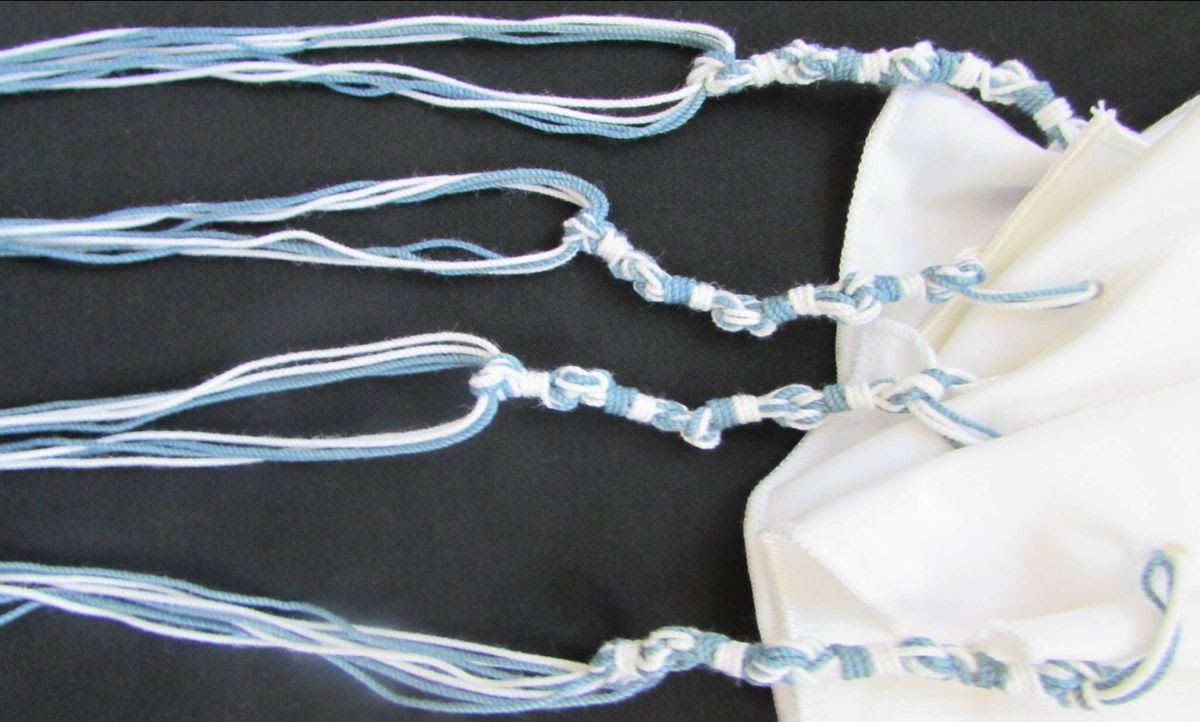

tzitzit
Jonathan Sacks: Beyond the Fringe – Shelach Lecha
Our Torah portion ends with one of the great commands of Judaism – tzitzit, the fringes worn on the corners of our garments as a perennial reminder of our identity as Jews and our obligation to keep the Torah’s commands:
The Lord said to Moses: “Speak to the Israelites; tell them to make fringes on the corners of their garments throughout all the generations. To the fringe, on each corner, they should attach a blue cord. And this shall be your fringe: seeing it, you shall remember all the Lord’s commands and keep them. You will not then go astray, following the lusts of your heart or of your eyes. This is to remind you to keep all My commands, to remain holy to your God.”
Num. 15:37-40
So central is this command, that it became the third paragraph of the Shema, the supreme declaration of Jewish faith. I once heard the following commentary from my teacher, Rabbi Dr Nachum Rabinovitch.
He began by pointing out some of the strange features of the command. On the one hand, the Sages said that the command of tzitzit is equal to all the other commands together, as it is said: “Look at it and recall all the commandments of the Lord and observe them.” It is thus of fundamental significance.
On the other hand, it is not absolutely obligatory. It is possible to avoid the command of fringes altogether by never wearing a garment of four or more corners. Maimonides rules: “Even though one is not obligated to acquire a [four-cornered] robe and wrap oneself in it in order to [fulfil the command of] tzitzit, it is not fitting for a pious individual to exempt himself from this command” (Laws of Tzitzit, 3:11). It is important and praiseworthy but not categorical. It is conditional: if you have such a garment, then you must put fringes on it. Why so? Surely it should be obligatory, in the way that tefillin (phylacteries) are.
There is another unusual phenomenon. In the course of time, the custom has evolved to fulfil the command in two quite different ways: the first, in the form of a tallit (robe, shawl) which is worn over our other clothes, specifically while we pray; the second in the form of an undergarment, worn beneath our outer clothing throughout the day.
Not only do we keep the one command in two different ways. We also make different blessings over the two forms. Over the tallit, we say, “who has sanctified us with His commandments, and commanded us to wrap ourselves in a fringed garment.” Over the undergarment, we say, “who has sanctified us with His commandments, and commanded us concerning the precept of the fringed garment.” Why is one command split into two in this way?
Rabbi Rabinovitch gave this answer: there are two kinds of clothing. There are the clothes we wear to project an image. A king, a judge, and a soldier all wear clothing that conceals the individual and instead proclaims a role, an office, a rank. As such, clothes, especially uniforms, can be misleading. A king dressed as a beggar will not (or would not, before television) be recognised as royalty. A beggar dressed as a king may find himself honoured. A policeman dressed as a policeman carries with him a certain authority, an aura of power, even though he may feel nervous and insecure. Clothes disguise. They are like a mask, hiding the person beneath. Such are the clothes we wear in public when we want to create a certain impression.
But there are other clothes we wear when we are alone, that may convey more powerfully than anything else the kind of person we really are: the artist in his studio, the writer at his desk, the gardener tending the roses. They do not dress to create an impression. To the contrary: they dress as they do because of what they are, not because of what they wish to seem.
The two kinds of tzitzit represent these different forms of dress. When we engage in prayer, we sense in our heart how unworthy we may be of the high demands God has made of us. We feel the need to come before God as something more than just ourselves. We cover ourselves in the robe, the tallit, the great symbol of the Jewish people at prayer. We conceal our individuality – in the language of the blessing over the tallit, we “wrap ourselves in a fringed garment.” It is as if we were saying to God: I may only be a beggar, but I am wearing a royal robe, the robe of your people Israel who prayed to You throughout the centuries, to whom You showed a special love and took as Your own. The tallit hides the person we are and represents the person we would like to be, because in prayer we ask God to judge us not for what we are, but for what we wish to be.
The deeper symbolism of tzitzit, however, is that it represents the commandments as a whole (“look at it and recall all the commandments of the Lord”) – and these become part of what and who we are only when we accept them without coercion, of our own free will. That is why the command of tzitzit is not categorical. We do not have to keep it. We are not obligated to buy a four-cornered garment. When we do so, it is because we choose to do so. We obligate ourselves. That is why opting to wear tzitzit symbolises the free acceptance of all the duties of Jewish life.
This is the most inward, intimate, intensely personal aspect of faith, whereby in our innermost soul we dedicate ourselves to God and His commands. There is nothing public about this. It is not for outer show. It is who we are when we are alone, not trying to impress anyone, not wishing to seem what we are not. This is the command of tzitzit as undergarments, beneath, not on top of, our clothing. Over this we make a different blessing. We do not talk about “wrapping ourselves in a fringed garment” – because this form of fringes is not for outward show. We are not trying to hide ourselves beneath a uniform. Instead, we are expressing our innermost commitment to God’s word and call to us. Over this we say the blessing, “who has commanded us concerning the precept of tzitzit” because what matters is not the mask but the reality, not how we wish to appear, but what we really are.
In this striking way tzitzit represent the dual nature of Judaism. On the one hand it is a way of life that is public, communal, shared with others across the world and through the ages. We keep Shabbat, celebrate the festivals, observe the dietary laws and the laws of family purity in a way that has hardly varied for many centuries. That is the public face of Judaism – the tallit we wear, the cloak woven out of the 613 threads, each one a command from God.
But there is also our inner life as people of faith. There are things we can say to God that we can say to no-one else. He knows our thoughts, hopes, fears, better than we know them ourselves. We speak to Him in the privacy of the soul, and He listens. That internal conversation – the opening of our heart to Him who brought us into existence in love – is not for public show. Like the fringed undergarment, it stays hidden. But it is no less real an aspect of Jewish spirituality. The two types of fringed garment represent the two dimensions of the life of faith – the outer persona and the inner person, the image we present to the world and the face we show only to God.

- Do you act differently when you know people are watching you?
- Do you feel different when wearing a uniform (or dressed for shul, school, or work) rather than wearing your favourite clothes at home?
- Why is it sometimes harder to do the right thing if no-one will ever know about it?
|
|