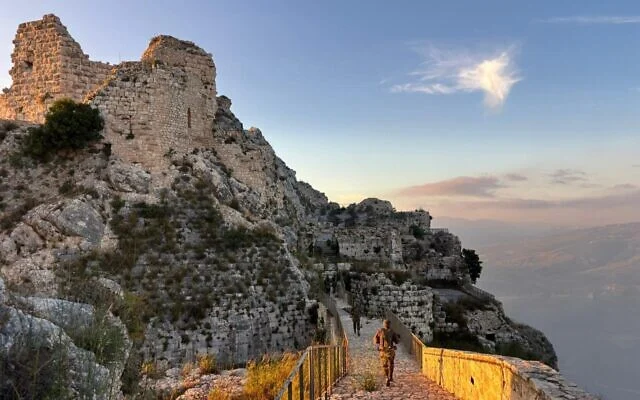

Troops of the Golaini Brigade’s Reconnaissance Unit operate at the Beaufort Castle in southern Lebanon, in a handout photo published on May 31, 2026. (Israel Defense Forces)
Jonathan Feldstein: Beaufort, the Tehran Grand Bazaar, and Boots on the Ground in Lebanon
A twelfth-century Crusader fortress in southern Lebanon teaches a lesson that Washington keeps refusing to learn: ceasefires are not a strategy, and walking away from the battlefield only guarantees the next generation will have to return to it.
Beaufort is a twelfth-century Crusader fortress perched on a commanding height in southern Lebanon. For nearly a thousand years, it has been used to control vast stretches of territory and to launch military operations with relative impunity. Its position is not just strategically significant. It is a symbol of who holds the ground and who does not.
On June 6, 1982, Beaufort became the site of an intense battle when Israeli troops invaded southern Lebanon to eliminate the PLO, which had been using the fortress and surrounding positions to attack northern Israel. Operation Peace for Galilee succeeded in pushing back the PLO and eventually forcing its leadership to flee to Tunisia. Six Israeli soldiers were killed in the initial assault on Beaufort. One of them was Raz Guterman. I was a teenager in Israel that summer, living at Kibbutz Haogen, where his family had just buried him.
I have never been to Beaufort, but Beaufort has never left me.
In May 2000, Israel unilaterally withdrew from southern Lebanon. The withdrawal looked like defeat, and it functioned like one. Celebrations were of leaving rather than winning. The Islamist terror organization Hezbollah filled the vacuum, built an underground military network across Lebanon, and became the country’s de facto armed force. That withdrawal led directly to the 2006 Second Lebanon War and to the sustained operations against Hezbollah that followed. Most recently, on the Hebrew calendar anniversary of the 1982 capture, the IDF raised the Israeli flag over Beaufort again.
The 2000 withdrawal inspired a film called “Beaufort,” in which the retreat itself was portrayed as a kind of victory. That framing captures the trap Israel has been in ever since: a permanent argument between controlling territory from which attacks on northern Israel originate, versus withdrawing under the daily pressure of soldier casualties and drone strikes, and watching the enemy reconstitute and grow stronger in the space left behind.
Giving up territory brings neither peace nor security. Israeli withdrawals from Gaza and Lebanon have been followed by a stronger, more dangerous enemy returning to the ground that was ceded.
The War of the Ceasefires
In Israel, what is unfolding could be called the Third Lebanon War, though it is being referred to as the War of the Ceasefires. The name captures something important: even between declared ceasefires, the enemy neither abandons its goals nor stops firing to achieve them. Terror organizations do not observe pauses in good faith. They use them to rearm, regroup, retrench, and return.
This matters beyond Lebanon. It speaks directly to the broader question of America’s posture toward the Islamic Republic of Iran and whether US boots on the ground should ever be part of the strategy.
I have had a running debate on this with the host of a daily radio program who draws a firm line: no boots on the ground, ever. He supports confronting the Islamic Republic but treats ground forces as a red line he will not cross. My argument is different. If war against the Islamic Republic is just and necessary for American strategic interests and security, as we both agree it is, then all options must remain on the table for the purpose of achieving a decisive victory. Taking boots on the ground off the table before the war is won is not a principled position. It is a negotiating concession made to the enemy before negotiations have even begun.
War cannot be the Hokey Pokey, with one foot in and one foot out. To win, both feet must be in. That is not a preference. It is a requirement.
The Tehran Grand Bazaar
I want to be clear about something else: even if American boots are on the ground, the primary fighters for Lebanon must be the Lebanese themselves, and the primary fighters for Iran must be the Iranian people. Foreign forces can create conditions for liberation. They cannot substitute for it. A ground presence is not a police action on behalf of another country’s citizens. It is a means of decisive military outcome, after which the people of that country must take ownership of their own future.
What the United States is doing now is something else entirely. It is more dangerous and more consequential to be sure, but if we draw an analogy to bargaining in the Tehran Grand Bazaar, it is bargaining badly.
Anyone who has negotiated in a Middle Eastern market understands the dynamic. A buyer who appears rushed, overeager, or unfamiliar with prices will pay far more than necessary. Merchants use urgency and high opening bids to make eventual “concessions” seem like generosity. The strongest position is patience, restraint, and a genuine willingness to walk away.
The Islamic Republic can see and smell the eagerness. Every week we are told a deal is close, the terms are nearly set, and agreement is imminent. And yet it does not arrive. That is not a negotiation. That is bargaining to lose.
When Iran walks away from negotiations because Israeli troops are operating against Hezbollah in Lebanon, and the United States responds by calling on Israel to halt a planned strike in Beirut, the message received in Tehran is not “America is serious.” The message is that the threat of escalation works, that pressure produces American concessions, and that the game is worth continuing. Terrorists whose negotiating culture spans centuries do not need a book on the art of the deal. They are already practicing it.
What the next generation will inherit
I look at my son and sons-in-law, each of whom has spent hundreds of days in reserve duty since the Hamas massacre of October 7, 2023. They are prepared to fight and to win. But a War of the Ceasefires does not produce victory. It produces the next war. If this generation does not finish the job, their sons, who are now seven to nine months old, will have to fight the Fourth Lebanon War, and perhaps the Fifth, with their own boots on the ground, on a battlefield that could have been settled decisively today.
Lebanon has become Tehran’s surrogate battlefield. The lesson of Beaufort, learned three times now and still not fully absorbed, is that holding the ground matters. Withdrawing creates vacuums. Vacuums are filled by enemies who return stronger, more entrenched, and more dangerous than before. Even unintended appeasement gives those enemies the oxygen to reconstitute.
In war and in the bazaar, there are winners and losers. The United States cannot afford to lose both the negotiation and the war by being too eager to end either one.
It is better to defeat the enemy resoundingly once and for all, even with boots on the ground, than to keep returning to Beaufort, physically or metaphorically, and watch the next generation fight the battle that should have been won today.