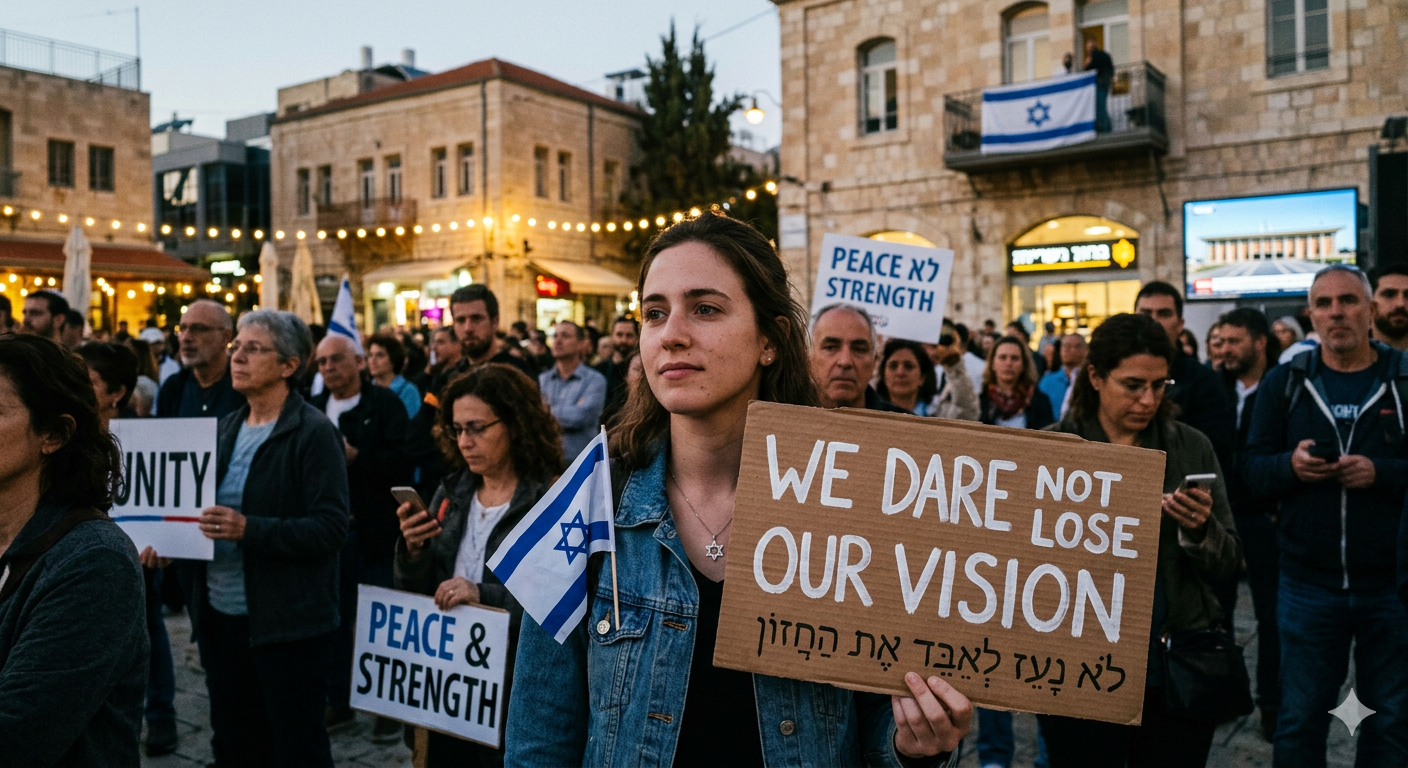

Gabe Ende: We Dare Not Lose Our Vision
The insufferable excesses of Israeli television have brought me closer to Netflix– more precisely, to the historical dramas offered by the network. They are a wonderful diversion from the commercial, “reality” and blah-blah-blah-heavy shows which have become our staple.
The two most recent films under my belt are “New York Gangs”, dealing with the mega-violence between the Irish newcomers and the more veteran “natives” in the Big Apple during Civil War times, and “Gandhi”, which illustrates the efforts of this great leader to solve oppression and hatred by means of non-violent confrontation. I could not avoid reflecting somberly upon our situation throughout these films and emerged with several modest conclusions:
- We must not permit the thirst for vengeance to take control of us—This phenomenon most certainly played a role in our military campaign against Hamas after the seventh of October. How do I know? I found myself personally craving it at the beginning of our counter-attack. Something very visceral within me elated when buildings were destroyed without apparently punctilious concern for the fate of their residents. And I wasn’t alone. Many of my friends and neighbors shared those feelings. The horrors of the large-scale slaughters in the “Gaza Envelope” and at the Nova Festival very naturally evoked this cold-blooded sensation even among the most morally sensitive among us and it took a while for it to dissipate. But as Gandhi remarked, the “eye for an eye” doctrine, if uncontrolled, will ultimately drive all of humanity blind.
There are those who contend that a very violent response is necessary “to teach the other side a lesson that he will never forget”. I wonder. Had we killed an additional 50,000 Gazans, would it have redounded to our benefit or to that of Hamas? After the Holocaust, a group of prominent ex-partisans secured the support of no less than Chaim Weizmann for a plan to poison the water supply in certain German cities ” to avenge our slaughtered millions”. Had the operation not been aborted, would our people be better off today? And if we “try and fry” the hundreds of “nukhbeh” murderers incarcerated in Israeli prisons, as Ben Gvir is demanding, will this make Israel a safer and more emotionally satisfying place for Jews?… In a scene from “The Godfather”, a young Mafioso is asked, “Why must you continue to fight?” and he replies, “Our fathers were enemies and we are the sons of our fathers”. Are we moving into this psychological cul-de-sac? A large majority of Palestinians are apparently already there.
Is there any way to apply the brake to this ever-spiraling violence? Though the concept appears to be light-years from current reality, any hope for such must ultimately include an excruciating process of reconciliation. The long-range alternative isn’t Bibi’s Power Diplomacy nor Jabotinsky’s “Iron Wall”, but Sampson’s “Let me die with the Philistines”.
- A “One-State Solution” , if at all feasible in our land of irrational impulses, must be based upon a political entity with which all parties can identify— The catastrophic failure of Gandhi’s efforts to maintain a united India is graphically depicted in the film. Every avenue was pursued—until fears and frustrations exploded in everyone’s face. Conversely, the warring New Yorkers sought obsessively to rid themselves of the “other”, but the Powers that Be decided otherwise– and the result is the powerful, prosperous, and stable though multi-ethnic United States of America.
Can American society serve us as a model? Under the best of conditions—with eyes and minds closed to security considerations– not unless Israel became significantly less “Jewish” and more universal. But we’re moving in a decidedly opposite direction. Article 13 of the Declaration of Independence— the clause expressing our commitment to complete equality—has been dangerously threatened, if not supplanted, by the Nation- State Law. Territorial annexation (as in East Jerusalem) has brought with it a denial of voting rights for the annexed Arabs– and such is certainly the intention of those who covet annexation of the West Bank and Gaza. Despite heated denials and “hasbara” geared to distorting reality, this will be a road to incontestable apartheid. We have enough difficulty providing the Arab citizens of Israel with de facto equality… Is there any way to digest a hostile Palestinian entity without completely destroying our digestive system? Sometimes, with all the attendant dangers, less remains invariably more.
There is, however, a formula for an optimally democratic Jewish State (within the ultimate framework of two states), one in which “Jewish preference” is confined to the areas of Aliyah and Klita (immigration and “absorption”) on the basis of our moral obligation to Jews everywhere seeking to live in a Jewish State and obvious demographic imperatives. Such a policy would hopefully enable the character of future Israeli Jewishness to rest less upon interests shamelessly characterized as “values” (e.g.” Jewish settlement “) and more upon the vision of a moral society, formulated most cogently by our “literary prophets”. And our secure majority will not be threatened.
- “Without a vision, a people will not survive.” As I observed the grip that Gandhi’s portrayal of simple universal values had upon so many people, I felt a twinge. Our leaders—among others—rarely refer to such values anymore. The public is urged to pursue essentially “national values”. There is often a correlation between the two, but frequently a stark contrast. For instance, citizens who express—in deeds as well as words—solidarity with small West Bank villagers suffering from repeated pogroms at the hands of fascist thugs thriving in the impunity granted by our extremist-bloated government are frequently depicted by “the national camp” as “radical anti-Israel leftists”. Are they not rather Defenders of the Jewish Moral Tradition?
We are suffering from a mindset of ethical near-sightedness, an ethos that deprecates moral values perceived as counterproductive to the national agenda. But our refusal to abandon a Moral National Vision will ultimately be the factor which will determine if we will stride on the “Right Side of History” or condemn ourselves to historical opprobrium. This is not a call to lay down our arms but simply not to allow current exigencies to determine the image of the people that we would like to be. If we view the march to Jewish self-realization as involving ethnic cleansing and territorial conquest, as advanced not only by Kahanist politicians but by significant rabbinic mentors in the “Religious Zionist” camp, Jewish identity will become a disgrace. But if we insist upon steadfastly maintaining a vision emphasizing the imperative of universal moral values as an essential component of our Jewish-Zionist vision, our future will rest upon much more solid ground.
A doctrine of Oppressive Realism has taken grip upon our society, oppressive in that any conception—not only immediate policy proposals but even long-term visions—including peace without military occupation or outright annexation—is considered to be an expression of delusive naivete. Peace will come only after we have fought and fought—like the Spartans, says Bibi—and allied ourselves with others committed to fighting Evil. Only “total victory” will bring us peace.
Is this an appropriate rationale for Jewish statehood? Is this to be the Jewish destiny? Is this what “realism” is all about? We’ve got to stand firm against this messianic madness and the “religious Zionist” authorities who lend it rabbinic legitimacy.
- 4. Iran-We are now at war with Iran, an important war in which we have invested great hopes and expectations and are experiencing significant achievements. I would like to temper these feelings with a quote from a recent article by Prof. Michael Milstein, director of the Forum for Palestinian Studies at Tel Aviv University:
“A week into ‘Operation Lion’s Roar’ brings Israel close to the juncture at which she stood several times in her history, such as after the Six-day War and the First Lebanese War : a short period of dizzying military victories was succeeded by a more complex stage,in which the challenge was to translate tactical victories into strategic achievements. The success of this stage was all-too-often undermined by unnecessarily prolonged fighting and disruptive fantasies.”
He suggests that we carefully study these failures and learn from them. I hope that we’re all on board with that.אקבימםךםעטcein military technology and intelligence in her history