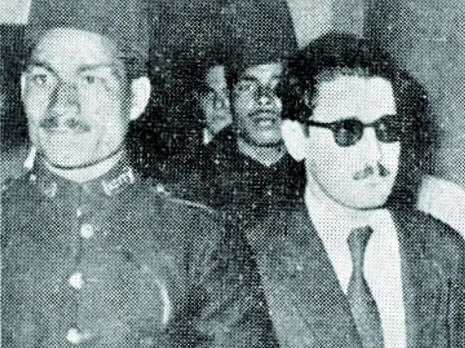

Dr. Moshe Marzouk during trial in Egypt in 1955 (GPO)
Michael Oren: A Truly Unfortunate Business The Lavon Affair

The Lavon Affair remains a stain on Israel’s intelligence record and a lesson for Israeli leaders today.
The end of this month, January 31, will mark seventy-one years since Egypt’s execution of Israeli agent Moshe Marzouk and six decades since his death resulted in an Israeli prime minister’s resignation. Why do both anniversaries remain acutely relevant?
One evening in the summer of 1954, Philip Natanson, a young Egyptian Jew, was walking to Alexandria’s Rio Theater when suddenly his suit burst into flames. Luckily, Egyptian agents were soon on hand to put out the fire, but possibly tipped off by a turncoat Israeli agent, they also arrested Natanson for arson. A search of his apartment produced the names of several additional Egyptian Jewish suspects along with their Israeli handlers. All were swiftly apprehended, jailed, and accused of spying for Israel.
So began the fiasco that cost the lives of four Jews, Egyptian as well as Israeli, destroyed careers, and toppled a government. Formally known as the Lavon Affair, and colloquially as HaEsek HaBish—the Unfortunate Business—the scandal upended Israeli politics for nearly a decade. Its details may seem arcane, even incomprehensible, to younger generations of Israelis, yet the conflagration ignited in Philip Natanson’s pocket in many ways continues to burn. A colossal intelligence failure and our leaders’ refusal to take responsibility for it remain major themes in Israeli politics today.
Natanson belonged to Unit 131, a secret cell of Egyptian Jewish Zionists who gathered information on Israel’s largest and most powerful Arab enemy. Established in 1948 not by the Mossad but, controversially, by IDF intelligence (Aman), 131 was considered a military unit that took its orders from the army. In 1954, these instructions included vandalizing public places—theaters, American and British cultural centers, libraries—in order to create panic and a sense of lawlessness. Communists and the Muslim Brotherhood would be blamed. The goal was to convince the British government that the domestic situation in Egypt was too unstable to proceed with the proposed evacuation of Britain’s massive military base along the Suez Canal.
That installation, the empire’s largest in the Middle East, was considered a strategic asset by the Israelis who viewed it as a buffer between their nascent state and Egypt. Israeli leaders also feared that the Canal Zone’s considerable military stores would fall into Egypt’s hands, augmenting its already formidably equipped forces. Israel was willing to do anything to prevent Britain’s withdrawal and Egypt’s further armament—even undertake a reckless scheme.
Reckless was, in fact, too kind an adjective for Operation Susannah, the plan to generate chaos in Egypt. Harebrained was more apt. With a negligible chance of success even if fully implemented—the few incendiary devices eventually planted caused little or no damage— the “false flag” operation was soon exposed and the members of 131 arrested. Two of those seized, Yosef Carmon and the Israeli agent Meir “Max” Bineth, committed suicide in prison. Nine others were tried for treason.
Israelis officially denied any knowledge of the operation and accused the Egyptians of staging a show trial. Behind the scenes, though, Israel’s foreign ministry mounted an international campaign to save the imprisoned Jews. Egyptian president Gamal Abdel Nasser quietly agreed not to seek the harshest sentences, but his crackdown on the Muslim Brotherhood prohibited him from showing more mercy toward Jewish traitors than toward fervid Muslims. Seven of the accused were given long-term prison sentences while two, Moshe Marzouk and Shmuel Azar, were condemned to hang. Despite desperate Israeli pleadings, on January 31, 1955, Marzouk and Azar climbed the gallows.
The international fallout of Susannah’s failure was immense, with both Britain and the United States furious at Israel’s imprudence. The Canal Zone was fully evacuated and transferred to the Egyptian army. Months later, Nasser signed the largest-ever arms deal in the Middle East, acquiring thousands of the most advanced planes, tanks, and guns from the Soviet bloc. The “second round” of war with Israel, as Nasser called it, was only a question of time.
In Israel, subsequently, the searing question was, “Who gave the order?” Defense Minister Pinchas Lavon, a favorite Labor Party son, pointed the finger at IDF Intelligence Chief Benjamin Gibli along with the Defense Ministry’s Secretary General, Shimon Peres. David Ben-Gurion, who had temporarily stepped down as prime minister and defense minister in 1953, denied any knowledge of the affair, as did his successor, Moshe Sharett. But Ben-Gurion never fully left his Mapai party’s politics and led his protegees, Peres and Chief-of-Staff Moshe Dayan, in blaming Lavon. Meanwhile a state commission formed by Sharett to assign culpability for the disaster failed to conclusively fault him. Nevertheless, Lavon was soon forced to resign as defense minister—Ben-Gurion replaced him and soon ousted Sharett as well—and spent the rest of his life denying any responsibility for the Unfortunate Business.
Yet, neither was Ben-Gurion to be spared. Subsequent doubts surrounding the truth of Gibli’s testimony to the state commission led to the appointment of a new inquiry under Supreme Court Justice Haim Cohen. This indeed found evidence of perjury and exonerated Lavon, but Ben-Gurion rejected a compromise formula proposed by Sharett and Finance Minister Levi Eshkol that would have cleared Lavon’s name without implicating any other Mapai members. Such a “middle way,” he argued, amounted to little more than a “paper fix” over a serious case of lying and forgery within the defense ministry. His refusal to accept this outcome led him to resign as prime minister on January 31, 1961, declaring that he could not remain in office following a decision that “would be incompatible with fundamental principles of justice and the basic laws of the state.” His relations with his fellow Mapainiks was further strained when, after a return to office, Ben-Gurion again resigned in 1963 and retired to his desert home on Kibbutz Sde Boker. He would never again return to office.
Throughout this period, the convicted members of Unit 131 languished in Egyptian prisons. During research for a sequel to my first book, The Origins of the Second Arab-Israeli War: Egypt, Israel, and the Great Powers, 1952 to 1956, I came across a declassified document from March, 1957. Shortly after the Sinai Campaign in which Israel launched a successful strike against the burgeoning Egyptian army and captured many of its soldiers, a U.S. State Department representative asked Israeli Foreign Minister Abba Eban if Israel wanted to exchange the POWs for the imprisoned Egyptian Jews. Abba, anxious to avoid the impression of accepting responsibility for their incarceration, answered, “no.”
Two of the prisoners were released in 1962, and the rest, including the only woman, Marcelle Ninio, in 1968. Yet not until 2005 did the State of Israel recognize their sacrifice and the IDF assign them retroactive officer ranks. Still, the Unfortunate Business remains a stain on Israel’s intelligence record and a lesson for Israeli leaders today.
While many security officials have accepted responsibility for October 7, the political echelon refuses to do so. It further rejects the formation of a state commission to investigate the catastrophe, preferring a politically appointed inquiry free of Supreme Court involvement. Much depends on the outcome of the next elections, but the naming of any investigative body is unlikely in the near or even foreseeable future. But, as the Lavon Affair teaches us, responsibility for failures cannot be indefinitely avoided. Blaming others never proves effective in the long run and eventually returns to harm us, boomerang-like. Accountability, not sixty years ago nor even today, cannot be escaped.