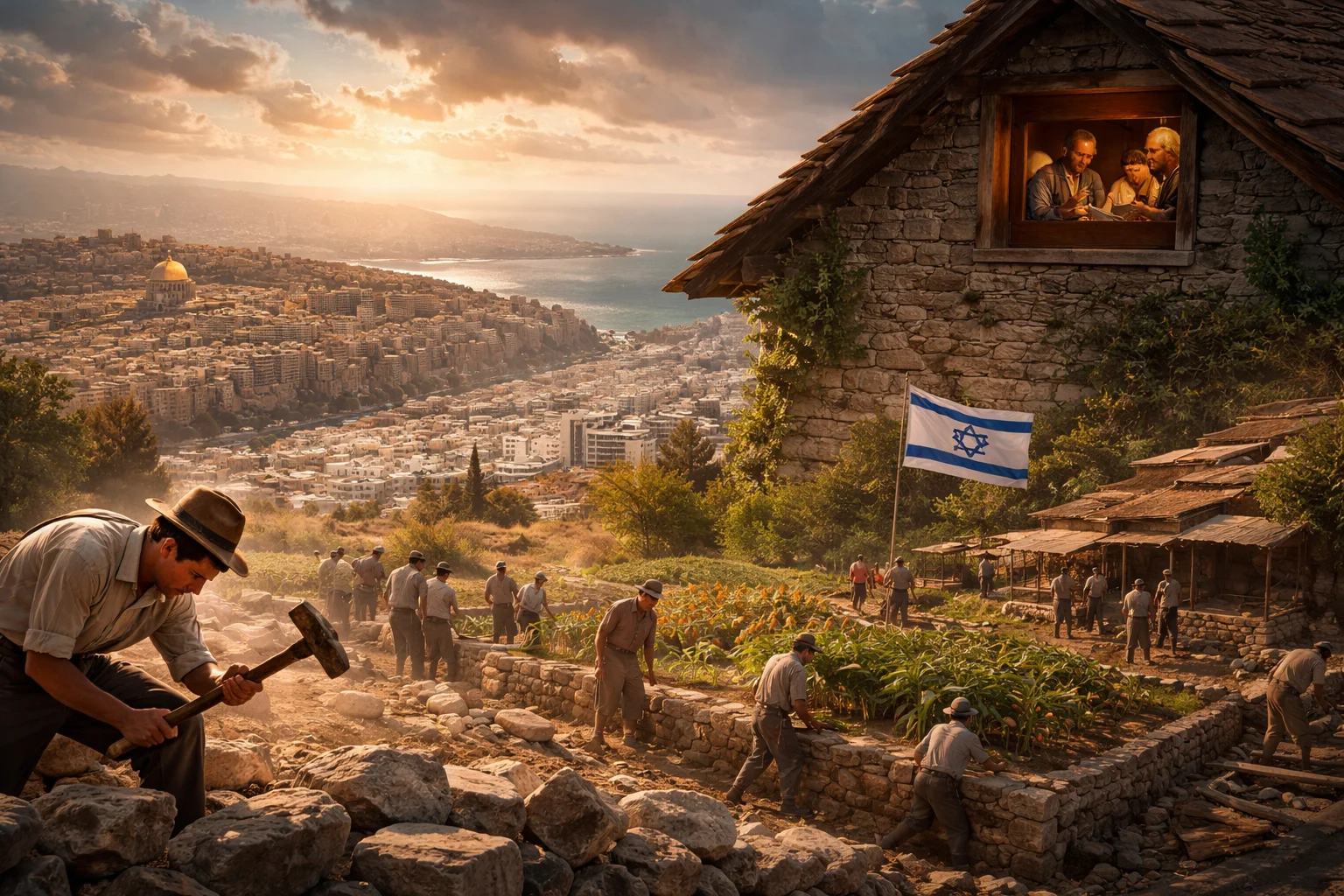

Photo Credits: Sabine Sterk (AI)
Sabine Sterk: Who Built the Land? The Truth About “Occupation”
Who Built the Land? The Truth About “Occupation”
Scroll through social media today, and you will inevitably encounter the same accusation, repeated like a mantra: Israel is occupying land that belonged to Arabs who were there first. The argument is usually presented as self-evident proof. “There were more Arabs than Jews in the land,” people say, pointing to population numbers from the British Mandate period as if demography alone determines indigeneity, ownership, or justice.
It sounds convincing until you actually look at history.
The territory the British called the “Mandate of Palestine” after the fall of the Ottoman Empire was not an Arab state, not a Palestinian state, and not a sovereign country at all. It was a neglected Ottoman province for centuries, followed by a temporary British administration. The name “Palestine” itself was not evidence of Arab nationhood; it was an administrative label imposed by imperial powers, first Roman and later British. To retroactively turn that label into proof of exclusive Arab ownership is to confuse bureaucracy with history.
What is consistently ignored in these online debates is why Jewish numbers were low at certain points in history, how they became higher again, and most importantly, who actually built the foundations of the modern country.
When an Israel hater once challenged me directly: “So how many Jews were there really under the Ottoman Empire?”, I didn’t respond with numbers alone. I responded with a metaphor, because sometimes facts need a human frame to be understood.
Imagine this.
Once, a very large Jewish family lived in a huge house. They built it. They owned the land. They had the documents, the history, the proof. Over time, thieves, robbers, and murderers broke in. Violence followed. Much of the family was killed. Others fled in all directions, forced into exile. A small group survived by hiding in the attic, clinging to life under unbearable conditions.
Downstairs, the house was never peaceful. Different gangs fought each other, replaced one another, ruled briefly, collapsed, and left destruction behind. Meanwhile, in the attic, the hidden family rebuilt. They studied. They innovated. They preserved their identity. They never forgot the house beneath their feet.
Centuries later, a group of international decision-makers arrived. They surveyed the situation and decided not to punish the criminals who had broken in. Instead, they proposed a compromise: split the house. The family in the attic would keep a portion, and the others would get the rest.
The family agreed. They invited their long-lost relatives home and began building again. The others, suddenly realizing that the original owners had never disappeared, rejected the compromise and chose war.
The rest, as they say, is history.
This metaphor mirrors the Jewish historical experience with remarkable accuracy. Jewish presence in the Land of Israel did not begin in 1920, nor did it disappear during exile. Jews were driven out by force, by Romans, Byzantines, and later Islamic empires, but a continuous Jewish presence remained, while millions lived in diaspora with an unbroken connection to the land.
Population figures from the British Mandate period are often weaponized without context. Yes, in the early 1920s, Jews were a minority. But minorities can be indigenous. Numbers alone do not erase origin, history, or legal rights. Indigenous status is not determined by who happens to be more numerous after centuries of conquest and displacement.
What changed during the Mandate years is not merely Jewish population size, but Jewish action.
Between 1920 and 1948, the Jewish community built a state before it officially existed. Jewish institutions functioned as a government in waiting. There was a national council, a labor federation that provided healthcare and pensions, a defense force, courts, tax systems, agricultural collectives, universities, hospitals, and an education system conducted in Hebrew, a revived ancient language turned into a living national tongue. Tel Aviv rose from sand dunes into the first modern Hebrew city.
This was not accidental. It was deliberate nation-building.
In contrast, Arab leadership during the same period did not build parallel institutions of governance. There was no unified parliament, no national healthcare system, no coordinated education network, and no economic development framework preparing for independence. The central organizing effort focused primarily on opposing Jewish immigration, not on building a state.
This contrast matters deeply because it exposes the core falsehood behind the “occupation” claim.
Israel was not imposed on a functioning Arab state. There was no Palestinian sovereignty dismantled in 1948. What existed was a Jewish society ready for independence and an Arab leadership that rejected partition and chose war instead of statehood, twice, in fact, once in 1947 and again in subsequent decades.
Another often-ignored truth is that Jewish development lifted the entire region. Jewish agriculture, industry, healthcare, and infrastructure improved life for everyone. Arab population growth during the Mandate was driven largely by natural increase and improved living conditions, conditions created in no small part by Jewish investment and modernization.
Being smaller in number does not make you less indigenous. History is filled with indigenous peoples who were reduced to minorities by conquest and exile. Jews are one of the clearest examples. What makes the Jewish story unique is not only survival, but return and rebuilding.
The accusation that Israel is a colonial occupier collapses under scrutiny. Colonizers do not revive ancient languages. Colonizers do not return after two thousand years with historical, religious, and legal ties intact. Colonizers do not build a state from the ground up while being attacked from all sides.
Israel exists because Jews chose construction over destruction, institutions over chaos, and compromise over annihilation, until compromise was met with war.
So the next time someone waves population statistics in your face and calls that proof of occupation, remember the house, the attic, and the family that never stopped belonging there. History is not a snapshot. It is a story and when told honestly, it reveals who truly built the land.
About Time To Stand Up for Israel
Time To Stand Up for Israel is an independent foundation dedicated to fighting misinformation, countering antisemitism, and providing clear, fact-based education about Israel. We do not engage in internal Israeli politics. We stand on two core principles: Israel has the right to exist. Israel has the duty to defend itself. Support our work: Donate and/or subscribe at: www.timetostandupforisrael.com