
Galia Miller Sprung: October 7th and My Personal Journey
It’s hard to know what to write while waiting –for the hostages, for the end of the war. For the end of Gaza – maybe. Everything can change before I hit “Save.” But one date remains frozen: October 7th, 2023. While we wait, I want to share a personal journey—a family trip to the Gaza Envelope, the Otef, two years and one day after the massacre, and as it turned out, just five days before the hostages were released.
I’ve written about two previous visits to the Otef, but this time, we drove through the yellow steel gates of Kibbutz Kfar Aza to family – extended family for me, but family.
We followed Guy to the house where he had been living with his pregnant wife and their toddler daughter on October 7th. I’d heard their story, read Guy’s initial WhatsApp family post with a short summary of how he kept the terrorists from entering the safe room, mamad. I’ve seen two videos of what their house looked like after the fierce battle to rescue them, but to focus on Guy, his hands, his body language, his calm, as he gives a minute-by-minute account firsthand is chilling.
When the alarms went off, Guy and Ofri automatically went to the mamad where their toddler was sleeping. But this time it was different. Gunfire somewhere outside. Explosions. No electricity. No communication. Then, a real miracle, the generator kicked in. It never worked when they needed it, but on October 7th, it did. WhatsApp but no phone calls.
When terrorists broke into the house, Guy grabbed the lever-style mamad door handle in a tug of war for survival. For over three hours, Guy pulled the handle towards his body, which was pressed firmly against the wall to the side of the door, using that miracle of unending strength that flows through your body when you are the only barrier between terrorists and your family. The terrorists sporadically fired into the mamad door and some of the bullets penetrated the steel, missing Guy only because he’s tall and slim. Ofri and the toddler huddled in a corner away from the door. Eventually, Guy was able to communicate with a friend via WhatsApp, who relayed information to security forces. Their situation was desperate.
“Use a drone to blow up the patio!” Guy begged. They did, almost. A drone fired an explosive next to house, not wanting a direct hit. This distracted the terrorists and elite forces stormed in, killing two of the terrorists and taking another two prisoner, but not before grenades exploded in the living room, piercing the walls, the ceiling, cabinets, destroying the house. The soldiers quickly led Guy and his family out of the carnage, out of the kibbutz and into a reality they are still trying to understand.
Months later, I translated the interrogation of one of these terrorists into English so Ofri could use it when she was invited by Jewish communities in the States to speak about their experience. I can now picture audiences listening to firsthand testimony from a woman who was eight months pregnant at the time, with their toddler huddled next to her. No food, no bathrooms, no movement. Imagine comforting an 18-month child during when bullets smash into the wall near you, and explosions and gun battles are raging.
The inside of the house needed to be completely redone. We stood in the empty house whose walls are now smooth and white. No holes, no blood stains. No dead terrorists. But then Guy points out dents in the door frame of the safe room. Permanent reminders.
But a house is a structure. It is not a home. Home is your safe place. Your personal protected haven. Your intimate moments. Your children’s beds and toys. When Guy, Ofri and their daughter left their house, everything else stayed inside. Inside with the smell of explosives permeating clothes, bedding, towels. Inside where framed pictures of Guy and Ofri and the baby were displayed, couches where they sat together playing with their baby, dishes, plants, mementoes in pieces or riddled with shrapnel. Your most cherished personal space— invaded.
Before we could catch our breath, could internalize Guy’s story, he was leading us to another area of the kibbutz. Now we stood near the homes of members who had been murdered, kidnapped or had miraculously survived.
“You all know the story of the X family,” Guy would start. And of course, we did. Then came the story of the Idan family – of the little Israeli-American girl, Avigail, who was in her father’s arms when he was fatally wounded.
“She ran to that house over there,” Guy points out. “They didn’t open the door, so she ran to the next house.” She was taken to Gaza. Three years old. She was released 51 days later and joined her two siblings who hid by their mother’s body in the shelter and were rescued.
“Where was Nira killed,” I ask referring to a friend’s mother-in-law. And more questions. Two of my grandchildren ask about relatives of people they knew. Later, Guy points out the area where the niece of close friends was killed. A bit of closure. No matter where you go, someone knows someone.
We reach another section, the small, attached homes of the “young generation” neighborhood. The area is roped off but our view is not blocked. A large banner with the picture of twins Ziv and Gili Berman serves as a barrier. The sign reads, “Our Gili and Zivi are still hostages in Gaza.” Each home has a large picture of the person who lived there – name in red, murdered; name is yellow; hostage in Gaza. When I saw Gali and Zivi on TV after their release from Gaza, hugging after being separated for the two years they were held by Hamas, I felt a personal relief. Tragically, the other signs will remain. Or will they?
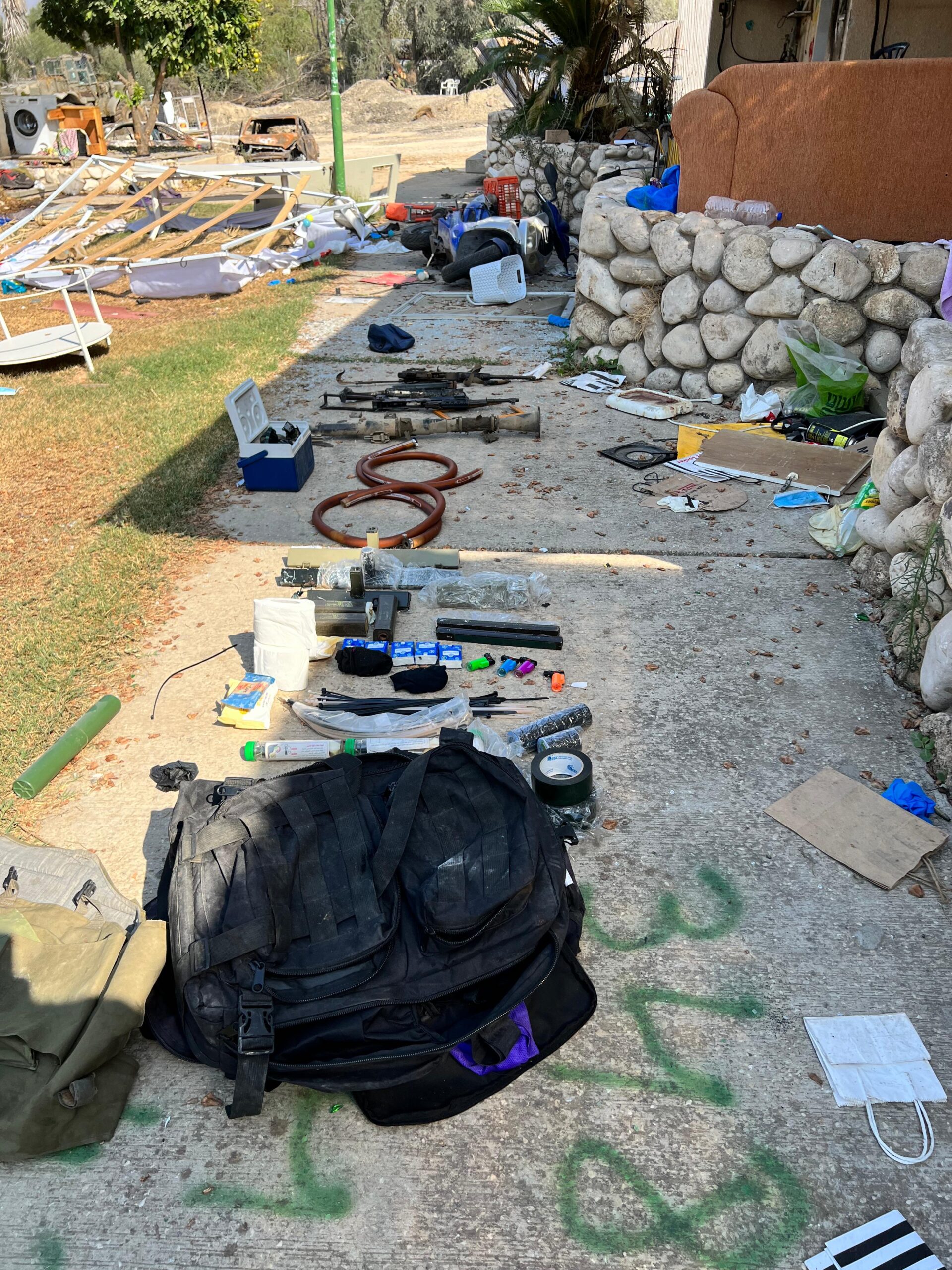
It’s a hot topic under discussion among kibbutz members. What to do with the bullet-holed, burned, grenade-damaged attached homes. Leave them as a memorial? Raze them and build a different memorial? New homes? Too soon to decide.
We continued to the grassy central area near the education center where the little children used to run around freely. Now it’s the battleground where some of their fathers, relatives or family friends were murdered trying to reach the weapons room, trying to repulse the attack. Are these children going to be able to play there again? Too soon to know.
As we were standing there, Guy pointed out a man walking towards us. He’s the grandfather of two orphans from the kibbutz. Another heart-wrenching situation that most people don’t think about. Who is raising the orphans from the Otef? Who gets custody? Older children can choose, but not all are old enough. Tough questions in an already painful reality.
After nearly three hours of immersion in the Kfar Aza on October 7th and beyond, we hugged Guy and continued our tour of the Otef. We drove the fifteen minutes to the “Car Cemetery” in Moshav Tekuma and then to the Nova memorial site. At the Car Cemetery, we lit a candle near the ambulance – the one our friend Alina and 17 others had been hiding in and under – until it was hit with Hamas grenades and RPGs. At the Nova, we found the individual memorials for our friends and lit candles there, too.
Lighting candles, visiting the sites—this is how I heal. Each of us must find what helps. It might be easier for an individual than for a community.
“We cannot even begin the healing process until everyone is home,” Guy said that day. Kfar Aza is struggling. They lost 64 kibbutz members; 19 were kidnapped to Gaza. Tragically, two were accidentally killed by fire from the IDF and the rest were released. The numbers still do not compute.
Thank God, the hostages are home now. And the war is over. Hopefully.
But what happened on October 7th will never end. We cannot ever completely move on. We will continue to visit the Nova, the Car Cemetery, and memorials around the country. We cannot let October 7th slide into the past and be forgotten. The survivors, like Guy and his family, the Berman brothers, and the families of the victims, need to know we remember. That we know what they’ve suffered.
Right now, Guy is keeping an eye on the reconstruction, but it’s no longer their home. It’s the remains of their house. They will return to Kfar Aza but not to that house where terrorists rummaged through their refrigerator helping themselves to their food, putting their feet up on their coffee table perhaps. Lounging on their couch with their weapons that just murdered their friends, relaxing on their bed. Their presence is suffocating.
Who could return to such a house?
Now a family of five, they will create a new home somewhere else on the kibbutz. They will continue to tell their story and heal in the process. And for Americans far from the Otef, listening to them is an act of solidarity, a way to honor the lives lost and the families shattered. And it builds a mutual resilience that endures.
In Guy’s words, “Am Yisrael Chai!”