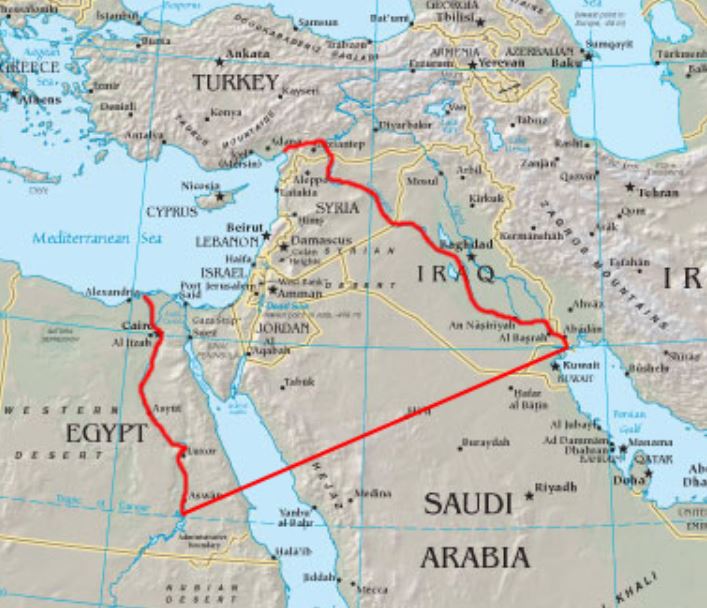

A supposed map of “Greater Israel” that you might find on Wikipedia
Prof. Sam Lehman-Wilzig: Mapping Israel’s Biblical Borders
With the recently signed agreement ending the Gaza War, the far Right’s dream of resettling Gaza has evaporated. But was it really based on anything historical? More broadly, what were the borders of the Land of Israel according to the Bible – and throughout biblical times? (I’ll now show that these two aspects are not the same thing.)
As they say, “it’s complicated.” From the time of the Bible, Israel(ite)’s borders have morphed repeatedly – not only in the text but in political actuality as well. From sweeping promises in the Book of Genesis (Breishit) – that were contradicted by accounts in the very same Book! – to specific topographic descriptions in the Book of Numbers (Ba’midbar), then later in the period of the Judges and Kings, and finally rabbinic discussions over a millennium afterwards, the boundaries of the Promised Land expanded and contracted like an accordion.
The first grand description of Israel’s borders appears in Genesis 15:18: “On that day the LORD made a covenant with Abram, saying, ‘To your descendants I give this land, from the river of Egypt to the great river, the river Euphrates’.” That would encompass a huge territory including modern-day Israel, the above “territories,” Lebanon, significant parts of Syria, all of Jordan, and even much of Iraq! This sweeping map is repeated in several later texts (Exodus 23:31; Deuteronomy 1:7; Joshua 1:4).
However, it has two problems. First, historically the Israelites never controlled anything close to such an extensive area. Second, prosaic descriptions in Genesis undermine such a “promise.” For example, in Genesis 21: 33-34 we read: “And Abraham planted a tamarisk-tree in Beer-sheva, and called there on the name of the LORD, the Everlasting God. And Abraham sojourned in the land of the Philistines many days.” The Philistines were not a target of Joshua’s conquest – so that “in principle” Beer-sheva shouldn’t be part of the Land of Israel.
Later biblical books offer somewhat more precise (and modest) boundaries, in preparation for the Israelites’ entry into Canaan. Here’s Exodus 23: 31: “I will set your borders from the Red Sea to the Sea of the Philistines [meaning the Mediterranean], and from the desert to the river.” But what does the Bible mean by “the river”? Many commentators suggest the Euphrates (in today’s Iraq), but this suffers from a major problem: the Israelites were on the east side of the Jordan River which they crossed westward to conquer Canaan. If the Euphrates was part of their promised land, then they should have first moved eastward to conquer territories bordering the Euphrates before turning to Canaan. Not only didn’t they do it then, but they never even tried to do that afterwards. Thus, the verse above must have referred to the Jordan River, although two tribes did settle immediately east of it (still hundreds of kilometers away from the Euphrates).
Indeed, the Book of Numbers (34: 2, 11-12) makes this explicit: “…When you come into the land of Canaan, this shall be the land that shall fall unto you for an inheritance…. And the border shall go down… and shall strike upon the slope of the sea of Kinnereth eastward. And the border shall go down to the Jordan, and the goings out thereof shall be at the Salt Sea [the “Dead Sea”]; this shall be your land according to the borders thereof.”
To make matters even more confusing, the Bible leaves open the possibility of expanding the border (Deuteronomy 19: 8): “And if the LORD your God enlarges your border, as He has sworn to your fathers, and gives you all the land which He promised….” But then in the very next verse, that too is proscribed: “…then shall you add three cities [of refuge] more for yourselves, beside these three.” That’s very far from the Euphrates, or the Nile.
What happens when the Israelites actually conquer Canaan? Basically, the boundaries follow the verses as described in the Book of Numbers, leaving out many regions included in the earlier and much broader promise from the Book of Genesis.
The Prophets don’t stray too far from this either. For example, Ezekiel (chapters 47–48) propounds a future-oriented map in an ideal messianic age (post-exile), in which the borders start near Damascus in the north, the Jordan River and Dead Sea on the east, and the Mediterranean to the west (the southern edge is unclear).
And then there’s Samson and David, both of whom sojourn in what the Bible (at this relatively later stage) clearly defines as Philistine country (today’s “Gaza plus”) – once again, no “up to the Nile” border here for the Children of Israel.
Half a millennium later, when Ezra returned with other leaders from Babylon exile (5th century BCE), only certain parts of Israel were resettled and sanctified. This had a major impact on which areas later generations included within the “holy” land regarding legal matters.
Several centuries after that, the Mishnah and Talmud grappled with the various (legal and theological) aspects of the biblical borders, offering several different definitions, each for distinct purposes (agricultural, economic, ritual purity, etc.). For instance, when discussing the “Sanctity of the Land” (Kedushat Ha’aretz), tithes and sabbatical years were to apply only to areas conquered by Joshua, but not necessarily to all biblically promised territory.
How does all this relate to the contemporary situation? First, clearly the historical Land of Israel never had one definitive “border.” Second, the Bible and later commentators were quite OK with such a situation. For instance, Ezra did not lament the circumscribed borders of the Land of Israel and didn’t even try to define them. Rather, he focused on rebuilding Jewish society after the return to Zion, with the aim of preserving the Jews’ religion and national identity. That sounds quite similar to modern Zionism. Third and finally is the central lesson derived from the above two aspects: despite an original, eschatological description of Israel’s widespread “future” borders, all of Jewish history and actual descriptions were based on the practical realpolitik situation at each specific time.
Thus, anyone can choose to point at some “true” border based on some traditional source. Yet the thrust of Jewish history and its official narratives on this core issue have always been one of political flexibility and realism. A lesson that Israel’s leadership – today and in the future – would do well to take to heart.