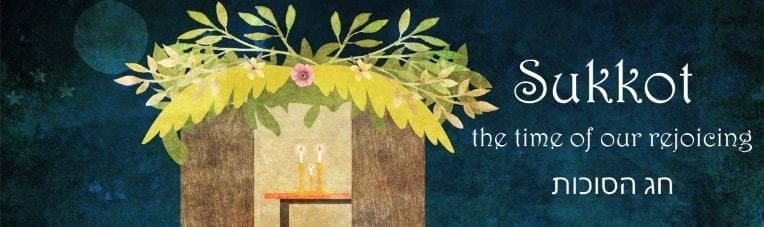

Prof. Sam Lehman-Wilzig: The Contemporary Meaning of Sukkoth
Sukkoth, also known as the Feast of Tabernacles, is an ancient agricultural holiday. Does it still have relevance – even significance – in the modern post-industrial (and certainly post-agricultural) world? Absolutely.
A sukkah is built to be a temporary hut. Therein, paradoxically, lies its contemporary message. Yes, Sukkoth is about remembering elements of very early Jewish history. First, the Israelites’ forty-year desert sojourn after escaping Egypt – living in temporary abodes on the way to the Promised Land.
Second, whereas today most of us live in a world of personal plenty, certainly regarding food and shelter, that wasn’t the case in the ancient world. To celebrate a good harvest, Sukkoth became the grand finale of the agricultural year in the Land of Israel. Farmers would gather their crops, sighing with relief and thanking the Lord for any bounty – the reason Sukkoth always falls at the end of the summer, during the big harvest.
Third, Sukkoth was a time to share. After the harvest, farmers were encouraged to open their hearts (and storerooms) to those in need – orphans, widows, the poor, and strangers. It was a built-in system for providing assistance, ensuring that no one was left out of the celebration. Thus, unlike our locked home’s front door, the sukkah (without any “door”) is open to all.
Notwithstanding all this historical memory and practice, the holiday today contains fundamental, social, and economic meaning that still resonates for us moderns. First, as just noted, Sukkoth constituted an early form of social safety net whereby generosity and caring for one’s neighbors ensured subsistence for even the weakest among society. The Hebrew Bible incorporates a form of early capitalism (private property) with social welfare (ensuring the survival of all) – a Jewish ethic that continues in the modern world through private philanthropy and large-scale voluntarism (especially in Israel).
One might think, therefore, that Sukkoth holds meaning only for the poor and downtrodden. Not so, for by forcing us to move into a not-altogether-cozy sukkah, even the well-to-do are separated from their regular comfort zone. Jews, no matter how wealthy, important, or comfortable, are required to step out of their home and spend time (for the truly religious, even sleeping there!) in a temporary, bare bones “shack.”
Why? Sukkahs are supposed to be fragile and relatively open to the sky – a not-so-subtle reminder that whatever our place within the social hierarchy, everyone is vulnerable and dependent on forces larger than us. The vicissitudes of life don’t necessarily skip over the rich and powerful. For seven days (eight outside Israel), socio-economic barriers drop; everyone shares the same experience, humbly and simply. Indeed, emphasizing such vagaries of life – like a sudden, heavy downpour – the sukkah’s “ceiling” is required to be porous (layered only with fronds and other leaves), forcing its inhabitants back into their non-drenched, cozy home where they can contemplate and compare the two disparate modes of living space.
Moreover, there’s also a profound social message as well, related to the distinctive Sukkoth ritual regarding the “Four Species”: etrog (citron), lulav (palm), hadas (myrtle), and aravah (willow). Each represents a different type of person, with their own strength and character. By bringing them all together in prayer (the last three form one triple object), Sukkoth sends the message that every community member counts; all have something to offer. Only by including the full array of society’s individuals can it flourish – celebrating unity through diversity.
Leading us to the macro-level as well. Back then, Jews from all over Israel would traditionally travel to Jerusalem for a huge festival, bringing offerings and sharing in public celebrations. In the modern Jewish State, this tradition has been renewed with massive prayer services at the Western Wall, in a waving lulav/etrog sea.
Clearly, Sukkoth is a holiday of contrasts. It reflects the stability and consistency of the seasons and their bounty, emulated in traditional holiday practices going back thousands of years. However, the sukkah itself also reminds us how fragile is our seeming permanency. Not only does it force us to think about other people who don’t have safe homes (e.g., refugees, homeless, poor families facing eviction), but it also holds up a mirror to us: “there but for the grace of God go I…”.
One could add that all this presents a refreshing challenge to modern consumer culture. Spending a week in a simple shelter, away from everyday comforts, forces us to rethink what really matters. Gratitude, humility, and community are more than simply words – they’re lived experiences.
The bottom line: the holiday of Sukkoth is much more than simply a religious tradition. Its roots in agriculture, its lessons about generosity and equality, plus its ability to bring different people together, have all shaped Jewish communities for millennia. It continues to offer a roadmap today for living ethically, connectedly, with a sense of responsibility to others. In a divided and overly hurried world, Sukkoth invites us to slow down, look around and within, and remember that real wealth is derived from community, kindness, and the bonds we create and cultivate together.